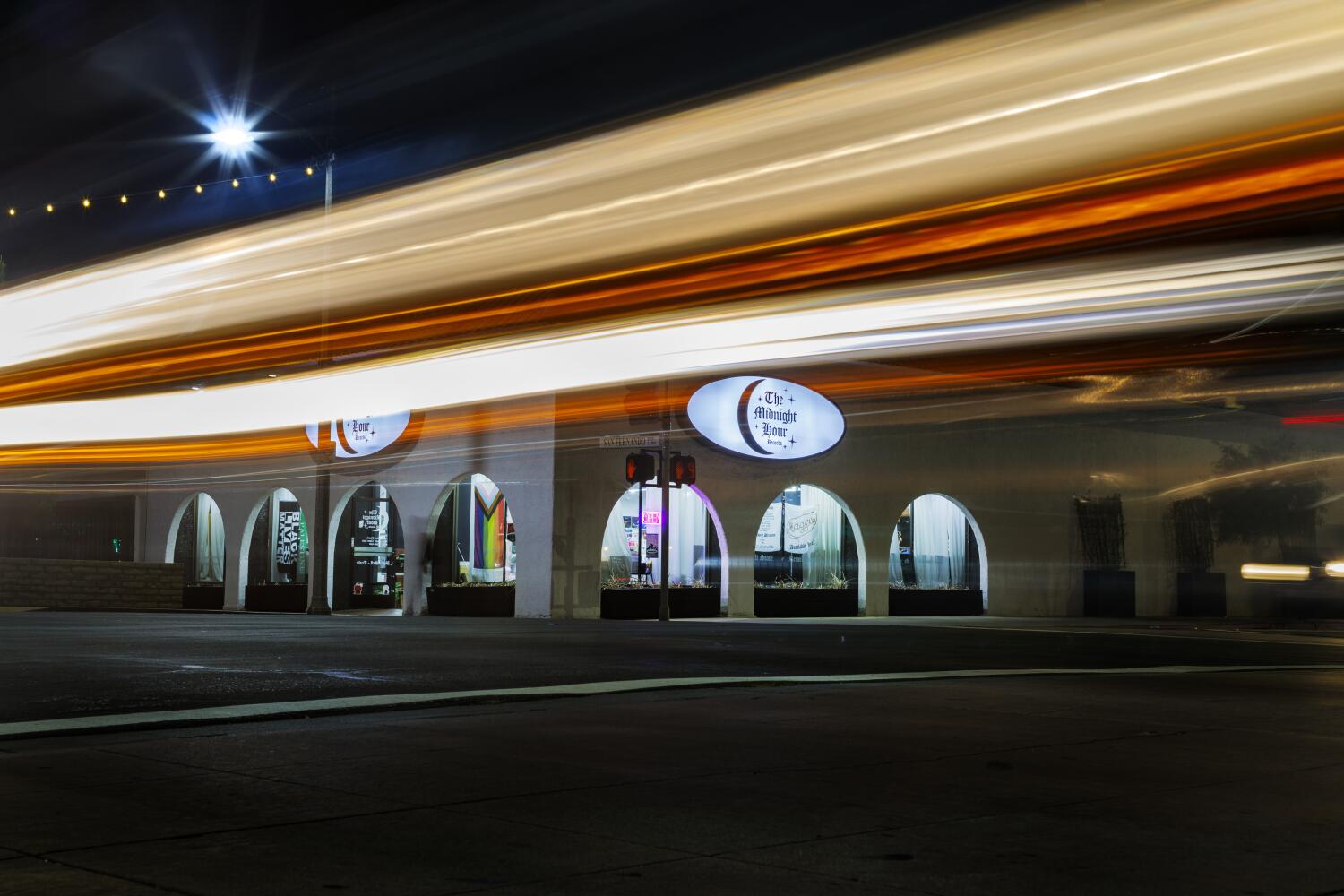
The air inside Midnight Hour Records doesn’t smell like social justice. It smells like aging cardboard, Nag Champa, and the faint, metallic tang of a spinning turntable. It’s a cramped sanctuary in the San Fernando Valley where the floorboards creak under the weight of punk 7-inches and classic soul LPs. On any given Tuesday, you might find a teenager flipping through Morrissey records or an old-timer hunting for a clean copy of Abraxas. But when the sun dips below the Santa Susana Mountains and the neon signs on San Fernando Road flicker to life, this shop transforms into something else entirely. It becomes a fortress.
Most record stores are monuments to nostalgia. This one is a logistics hub for survival.
Sergio and his crew didn’t set out to be the face of a resistance movement. They wanted to sell music. They wanted to build a community around the crackle of a needle hitting a groove. But in a neighborhood where the rumble of a white van can send a shockwave of silence through a backyard carne asada, neutrality was never an option. In the San Fernando Valley, the threat of ICE—Immigration and Customs Enforcement—isn't a headline or a political talking point. It is a weather pattern. It is the sudden storm that breaks apart families before the morning coffee gets cold.
The Geography of Fear
To understand why a record shop matters, you have to understand the geography of the Valley. It’s a sprawl of strip malls and sun-bleached asphalt where the line between "documented" and "undocumented" is often a jagged crack running right through the middle of a single living room.
When raids happen, they don't just take people. They take the ghosts of people. They leave behind half-eaten breakfasts, unpaid utility bills, and children standing on sidewalks wondering why the car is still in the driveway but their father is gone.
Midnight Hour stepped into this vacuum. They realized that a record store is one of the few remaining "third places"—spaces that aren't home and aren't work—where people feel safe enough to linger. While big-box retailers or sterile government offices feel like surveillance traps, a shop filled with Bad Brains posters feels like home. Sergio leveraged that trust. He didn't just host local bands; he started hosting Know Your Rights workshops.
Imagine a young woman, let’s call her Elena. She’s twenty-two, a DACA recipient, and she spends her nights worrying that a broken taillight could end her life in California. She walks into Midnight Hour. She isn't there for a protest. She’s there to buy a gift. But while she’s browsing, she sees a stack of bright yellow cards near the register. They aren't concert flyers. They are instructions.
Do not open the door. Do not sign anything. Ask for a warrant signed by a judge.
This is the "invisible stake" of the shop. It isn't just about the music. It’s about the information that moves through the room as freely as the basslines.
Why Vinyl and Vigilance Mix
There is a specific rhythm to the resistance here. It’s a DIY ethos borrowed straight from the punk rock records lining the walls. Punk has always been about more than just three chords and a bad attitude; it’s about mutual aid. It’s about the idea that if the system won’t protect you, you protect each other.
Midnight Hour became the unofficial headquarters for "The Valley Watchers." This is a loose network of neighbors, activists, and shopkeepers who keep an eye on the streets. They use encrypted messaging apps to alert the community when ICE vehicles are spotted near the local courthouse or the supermarkets.
Think about the irony. In an age of high-tech surveillance and biometric tracking, the most effective defense is a guy in a Black Flag shirt standing on a corner with a smartphone.
The shop provides the physical space for these organizers to breathe. When you are constantly looking over your shoulder, the simple act of sitting in a chair and listening to a record is a radical act of reclamation. It’s an assertion that you belong here. You are not a "case file." You are a neighbor.
The Sound of Staying Put
The critics of places like Midnight Hour often retreat into the safety of cold statistics. They talk about "rule of law" as if the law were a static, perfect thing rather than a living instrument that has, historically, been used to tear at the fabric of immigrant communities. They don't see the human cost. They don't see the kid who stops going to school because he’s afraid his mother won't be there when he gets home.
The shopkeepers at Midnight Hour see it every day. They see the trembling hands of people picking up those yellow cards.
It is easy to be brave in a tweet. It is much harder to be brave when your business is a literal target. By positioning themselves as a hub for ICE resistance, the owners of Midnight Hour invited the kind of scrutiny that kills small businesses. They chose a side. In a world that prizes "brand neutrality" and "broad market appeal," choosing a side is a dangerous luxury.
But then, consider the alternative.
What is a record store if not a repository of human stories? Every album on those shelves is a chronicle of someone’s struggle, someone’s love, or someone’s heartbreak. To sell the records while ignoring the struggles of the people buying them would be a betrayal of the medium itself. You can’t listen to Marvin Gaye’s What’s Going On and then look the other way when your neighbor is being loaded into a van.
Beyond the Four Walls
The influence of this small San Fernando storefront has bled outward. It has created a template for other small businesses in the Valley. A barbershop down the street now keeps the same "Know Your Rights" cards. A coffee pop-up uses its tips to fund legal defense for local families.
The "tapestry"—if we must call it that—of the resistance is woven from these small, seemingly insignificant threads. It’s a decentralized defense system.
It works because it is rooted in the local. A massive non-profit in DC can’t tell you which alleyway the white vans are idling in on a Thursday morning. Sergio can. The skaters who hang out out front can. The grandmothers who walk past the shop on their way to the panaderia can.
The stake isn't just political. It’s existential.
If the Valley loses its immigrant heart, it loses its soul. The San Fernando Valley is a place built by the hands of those who arrived with nothing but a dream and a willingness to sweat under the unforgiving California sun. To purge them is to hollow out the city.
The Needle Stays in the Groove
Late at night, when the shop is finally empty and the "Closed" sign is flipped, the work doesn't stop. There are phone calls to lawyers. there are updates to the alert networks. There are plans for the next fundraiser.
The music keeps playing, but the volume has changed.
We often look for heroes in capes or in high office. We forget that sometimes, a hero is just a person who refuses to move. A hero is a shopkeeper who decides that his counter is a border, and he gets to decide who is protected behind it.
Midnight Hour Records isn't just a business. It’s a heartbeat. It’s a reminder that even when the "midnight hour" feels literal—when the darkness of uncertainty feels like it’s swallowing the neighborhood whole—there is still a light on. There is still a turntable spinning. There is still a community that refuses to be quiet.
The needle stays in the groove, even when the floor is shaking.
Walking out of the shop and back into the San Fernando heat, the city looks different. The strip malls look less like sprawl and more like a series of interconnected bunkers. You realize that the power doesn't come from the people in the vans. It comes from the people holding the records, watching the street, and waiting for the next song to start.