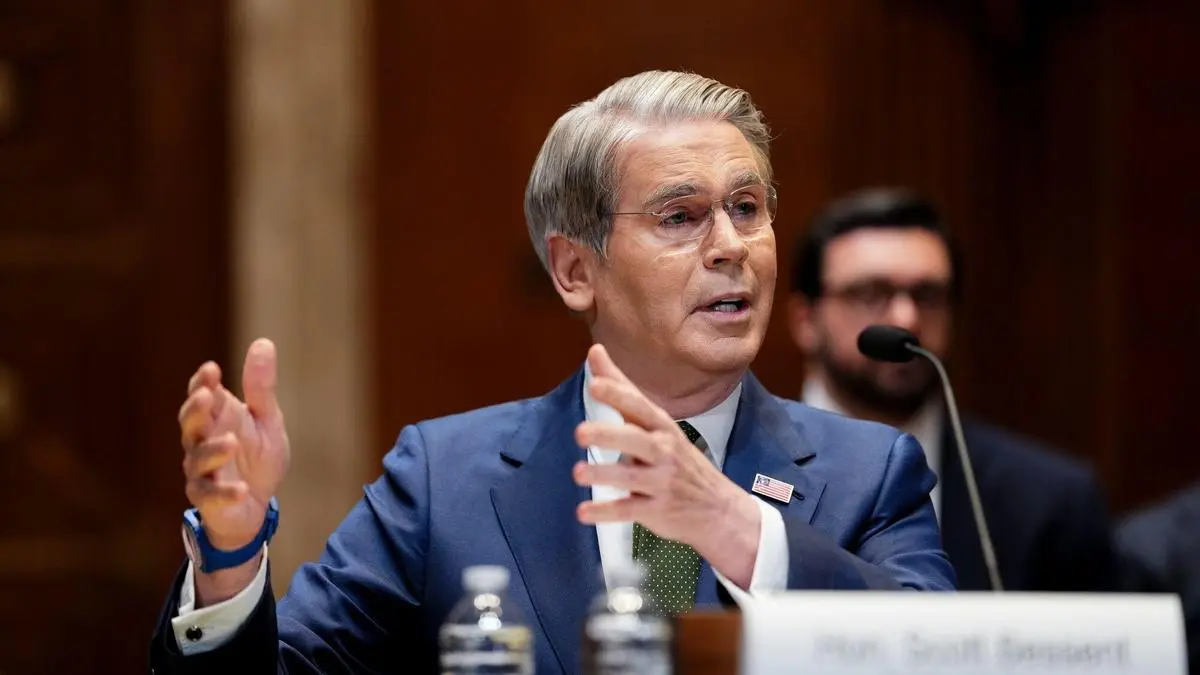
The global energy market currently rests on a razor’s edge. While political rhetoric often focuses on green transitions and long-term climate goals, the immediate reality for millions of households in India depends on a narrow, volatile stretch of water: the Strait of Hormuz. Treasury Secretary Scott Bessent recently brought this reality into sharp focus, framing U.S. naval operations not merely as military posturing, but as a direct subsidy to global energy stability. This is about the flow of Liquified Petroleum Gas (LPG), the blue flame under the cooking pots of rural and urban India alike.
For India, the stakes are existential. As the world’s third-largest energy consumer, the nation has tied its developmental goals to the consistent arrival of tankers from the Middle East. When the Strait of Hormuz sees a flare-up in tensions, the price of tea in Delhi doesn't just go up—the entire economic machinery of the subcontinent begins to shudder. Washington is now making it clear that while its Seventh Fleet keeps the lanes open, the burden of this security needs to be shared, specifically pointing the finger at Beijing to use its significant leverage in Tehran to prevent a total maritime lockdown.
The Hormuz Chokepoint and the Indian Kitchen
The mathematics of Indian energy security are brutal. More than half of India’s LPG requirements are met through imports, and a staggering 90% of those imports originate from the Persian Gulf. When Bessent highlights the role of the U.S. Navy, he is addressing a supply chain that is physically vulnerable at several "gate" points. The Strait of Hormuz is the most critical of these. It is a narrow neck of water where the deep-water channels are barely two miles wide in each direction.
If Hormuz closes, the global LPG market doesn't just tighten; it breaks. Unlike crude oil, which can be stored in massive strategic reserves or diverted through pipelines with some effort, LPG infrastructure is specialized and less flexible. For India, a disruption here means immediate domestic inflation. The government’s massive push to move households away from traditional biomass toward clean cooking fuel—the Ujjwala Yojana scheme—relies entirely on the premise of cheap, accessible LPG. A naval skirmish thousands of miles away can effectively derail a decade of Indian social policy overnight.
Why Washington is Calling Out Beijing
The shift in U.S. diplomatic tone is significant. By urging China to help reopen or maintain the opening of the Strait, the U.S. Treasury is acknowledging a new multipolar reality. China is the largest buyer of Iranian oil and a massive consumer of Gulf energy. Yet, for decades, the United States has shouldered the "policing" costs of the Persian Gulf. The U.S. Fifth Fleet, headquartered in Bahrain, provides the security umbrella that allows Chinese and Indian tankers to move unmolested.
Bessent’s remarks suggest that the era of the "free rider" is coming to an end. The U.S. is increasingly unwilling to be the sole guarantor of sea lanes that primarily benefit its primary economic rivals and strategic partners who remain neutral in broader geopolitical conflicts. By specifically mentioning India’s LPG supply, the Treasury Secretary is weaving a web of mutual interest. He is reminding New Delhi that its energy security is tied to American naval power, while simultaneously pressured China to act as a responsible stakeholder rather than a passive beneficiary of regional stability.
The Mechanics of Maritime Deterrence
Maintaining an open Strait of Hormuz is not just about having ships in the water. It is about electronic warfare, mine countermeasures, and constant surveillance. The U.S. Navy spends billions annually to map the seabed and monitor small-boat activity that could threaten commercial shipping. For an LPG carrier—essentially a floating bomb under high pressure—even the threat of a kinetic strike is enough to send insurance premiums through the roof.
When insurance rates for tankers "spike," the cost is passed directly to the consumer. In a price-sensitive market like India, a 20% increase in freight insurance can make LPG unaffordable for the very populations the government is trying to protect. This is the "hidden tax" of maritime instability. U.S. naval operations act as a massive insurance policy that keeps these premiums manageable.
India’s Strategic Silence and the Path Forward
New Delhi finds itself in a delicate position. India has historically maintained strong ties with Iran and has avoided joining U.S.-led maritime coalitions like Operation Prosperity Guardian in the Red Sea, preferring to deploy its own naval assets independently. However, the scale of the threat in the Persian Gulf is beyond the capacity of any single regional navy to manage alone.
The Indian Navy has increased its presence in the Arabian Sea, but its role is largely protective and reactive. It lacks the carrier strike groups and the vast logistical network required to keep the Strait of Hormuz open if a state actor decides to shut it down. This creates a dependency on U.S. hegemony that sits uncomfortably with India’s "strategic autonomy" doctrine.
The Limits of Diplomacy
Can China actually influence the situation? Beijing’s relationship with Tehran is transactional and deep. China provides the financial lifeline that allows the Iranian economy to survive under Western sanctions. If Beijing were to signal that a closure of the Strait is a red line, Tehran would have to listen. However, China has shown little appetite for using its political capital to solve security problems that the U.S. is currently solving for free.
Bessent is essentially trying to change the cost-benefit analysis for Beijing. By making the security of the Strait a matter of public diplomatic record, the U.S. is signaling that it may not always be willing to play the role of the global maritime police force without greater cooperation from other major beneficiaries.
The Economic Ripple Effect of a 21-Mile Gap
The Strait of Hormuz is 21 miles wide at its narrowest point. This tiny geographic feature dictates the inflation targets of the Reserve Bank of India. If the U.S. pulls back, or if the "safeguard" operations Bessent mentions are scaled down, the volatility would be catastrophic. We are talking about a potential doubling of LPG prices in a matter of weeks.
This isn't just about energy; it’s about social stability. High fuel prices lead to transport strikes, increased food costs, and public unrest. For the Indian government, the U.S. naval presence in the Gulf is a silent pillar of their domestic mandate.
The reality of 2026 is that energy security is no longer just about who has the most gas in the ground. It is about who has the most guns on the water to ensure that gas reaches the port. As the U.S. Treasury signals a move toward a "burden-sharing" model, countries like India must decide how much they are willing to contribute to their own defense, and how much they are willing to pressure their other partners—like China—to stop playing both sides of the fence.
The blue flame in an Indian kitchen is a testament to a complex, fragile international order. If that order fails, the lights don't just go out in the Gulf; the heat goes out in millions of homes across the subcontinent. The U.S. has laid its cards on the table. The next move belongs to the powers that have for too long assumed the ocean's highways would stay open forever.
Demand for energy is physical, but its delivery is political.