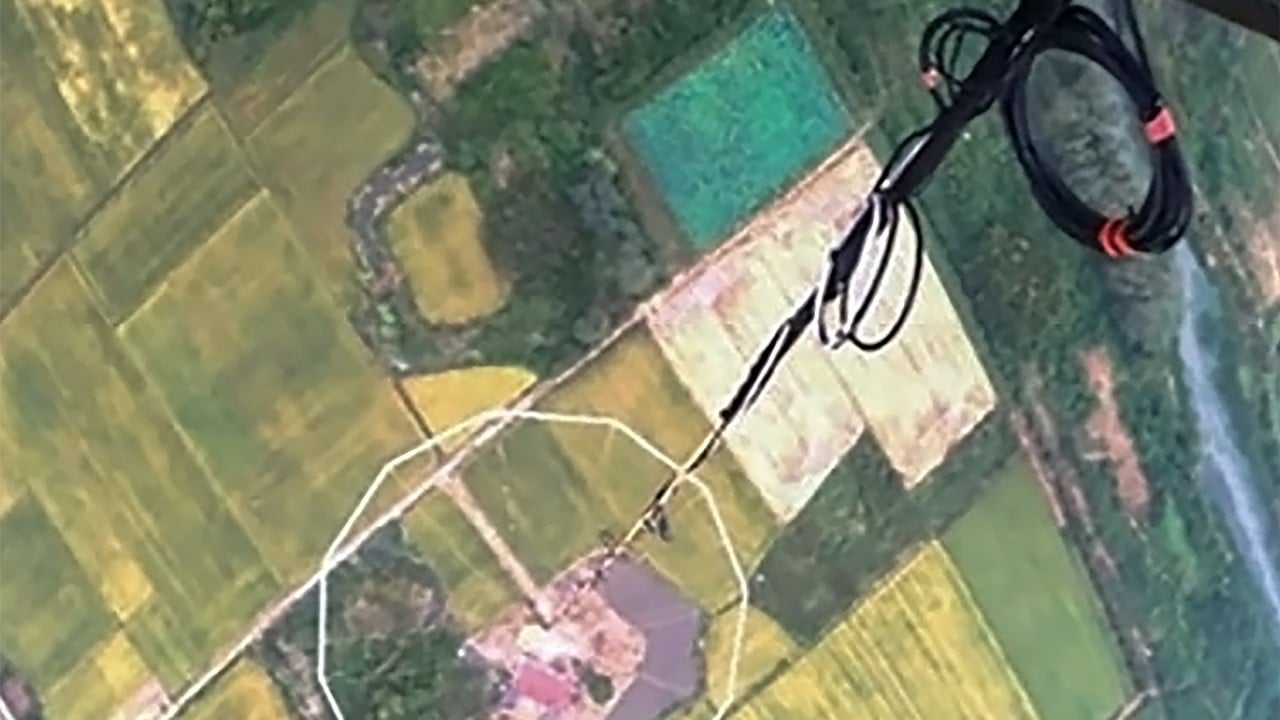
Defense analysts are panicking over a giant coil array flown on a Chinese test aircraft. The lazy consensus across mainstream defense media is predictable: Beijing has built a game-ending submarine detector that reads the magnetic wake of submerged nuclear hulls, effectively rendering the South China Sea transparent. They warn that the US Navy’s underwater hegemony is finished.
It is a terrifying narrative. It is also completely wrong.
The media is falling for computer models and highly staged tech demonstrations while ignoring the brutal, unyielding physics of magnetics and operational warfare. I have seen procurement offices and intelligence branches burn billions chasing non-acoustic submarine detection breakthroughs for decades. Every single time, the reality on the water brutally humbles the laboratory simulations. China’s giant coil array is not an existential threat to hidden Western submarines. It is an expensive, hyper-sensitive antenna flying directly into a wall of basic physics.
The Tyranny of the Inverse Square Law
The current panic stems from academic papers published by researchers at institutions like Northwestern Polytechnical University. These studies claim that when a massive object like a Seawolf-class submarine cuts through the water, the resulting fluid disturbance—specifically the Kelvin wake—moves charged seawater ions through the Earth’s geomagnetic field. This movement generates a secondary, ultra-faint magnetic signature.
The math works perfectly on a supercomputer. In the real world, the signal strength drops off at an devastatingly punishing rate.
Magnetic fields don't radiate like radio waves; they decay according to an inverse cube or inverse square law depending on the geometry of the source. By the time a magnetic wake signal travels from a submarine cruising at 200 meters depth up to the surface, and then through the air to an airborne receiver, the signal is practically non-existent. We are talking about disturbances measured in femtoteslas—one quadrillionth of a tesla.
To put that in perspective, the Earth's natural background magnetic field fluctuates constantly by tens of nanoteslas due to solar winds, ionospheric shifts, and geological formations. A flying coil array trying to isolate a submarine's magnetic wake is the equivalent of trying to hear a whisper inside a crowded stadium during a touchdown roar, while riding a roller coaster.
The Fatal Flaw of Airborne Magnetics
Even if you build a sensor sensitive enough to register a femtoteslar shift, you run into the operational nightmare of platform noise.
An aircraft is a giant, moving chunk of vibrating metal stuffed with electrical systems, generators, and engines. The moment you strap a massive coil array to an airplane or a large drone, the platform itself creates an overwhelming magnetic storm that drowns out the sensor.
Historically, Magnetic Anomaly Detection (MAD) systems solved this by placing a small sensor at the end of a long, aerodynamic boom sticking out of the tail of a maritime patrol aircraft, keeping it as far away from the engines as possible. China’s approach flies a giant array closer to the fuselage or via towed bodies, requiring monumental, real-time software filtering to cancel out the aircraft's own signature.
Imagine a scenario where the filtering software must distinguish between:
- The magnetic signature of the aircraft turning 2 degrees to the left.
- The shifting currents of the ocean surface below.
- The tiny, transient magnetic ripple of a submarine that passed by twenty minutes ago.
The computing power required to achieve this in a laboratory is massive. Doing it in real-time inside a turbulent turboprop or a vibrating drone hull is an entirely different beast. The moment the aircraft maneuvers, your baseline data ruins the calculation.
Submarines Don't Cooperate with Lab Models
The media's favorite talking point is that "wakes cannot be silenced." This is true in a vacuum, but false in the messy reality of undersea warfare.
The Chinese computer models that sparked this frenzy rely on a highly specific set of parameters: a large submarine traveling at high speed (often cited around 24 knots) at a relatively shallow depth of 30 meters.
No submarine skipper operating in a highly contested environment like the Taiwan Strait or the South China Sea is going to cruise at 24 knots at periscope depth. That is tactical suicide.
Modern nuclear attack submarines (SSNs) operate under strict acoustic and hydrodynamic hygiene. When they are hiding, they creep along at speeds below 5 knots. At ultra-low speeds, the fluid disturbance is minimal, the Kelvin wake disappears, and the resulting magnetic interaction with the Earth's field drops far below the detection threshold of even the most advanced theoretical sensors.
Furthermore, Western navies are not sitting still. Advanced deperming facilities—massive cradles wrapped in high-current cables—regularly neutralize the magnetic signatures of submarine hulls before deployment. If the hull's residual magnetic signature is suppressed, and the ship is moving slow enough to avoid generating a turbulent wake, the flying coil array is effectively blind.
The Real Value of the Coil Array
If the system is so heavily limited by physics, why is China building and flight-testing it?
The answer is not a revolution in anti-submarine warfare (ASW), but a necessary evolution in regional defensive geography. The South China Sea is a shallow, chaotic, and highly cluttered maritime environment. Traditional passive sonar is constantly degraded by commercial shipping noise, shifting thermal layers, and complex underwater topography.
China isn't looking for a magic bullet to sweep the entire Pacific clear of Western submarines. They are building a localized, multi-layered surveillance grid—what some defense circles call the "Great Undersea Wall."
The giant coil array is intended to act as a hyper-localized tripwire for narrow chokepoints, not a wide-area search tool. It is designed to work in tandem with:
- Seafloor fiber-optic acoustic arrays.
- Active sonar buoys deployed by surface ships.
- Low-frequency active sonar networks.
If a submarine is forced to speed up to evade an active sonar ping or a torpedo, then it creates the high-speed wake that a flying magnetic array might pick up. The coil array is a finisher, not an opener. It relies entirely on other systems doing the heavy lifting of finding the submarine first.
The Hidden Cost of Non-Acoustic Hype
The danger of buying into the hype of "transparent oceans" is that it distorts military procurement and strategy. Western analysts who scream that acoustic stealth is dead are inadvertently telling their navies to abandon the very real, highly effective art of passive silencing in favor of chasing exotic, unproven countermeasures.
Chasing non-acoustic detection methods is a black hole for defense budgets. It yields spectacular headlines, impressive academic funding, and flawless laboratory presentations. But when the weather turns foul, the sea state rises, and the target drops its speed to 3 knots, you are always left relying on the same fundamental tool that has governed undersea warfare for a century: acoustic sonar.
The ocean remains a dark, opaque, and incredibly hostile place for sensors. China's giant coil array is a remarkable engineering effort, but it hasn't broken the laws of physics. Until it does, the silent service remains exactly that: silent.


