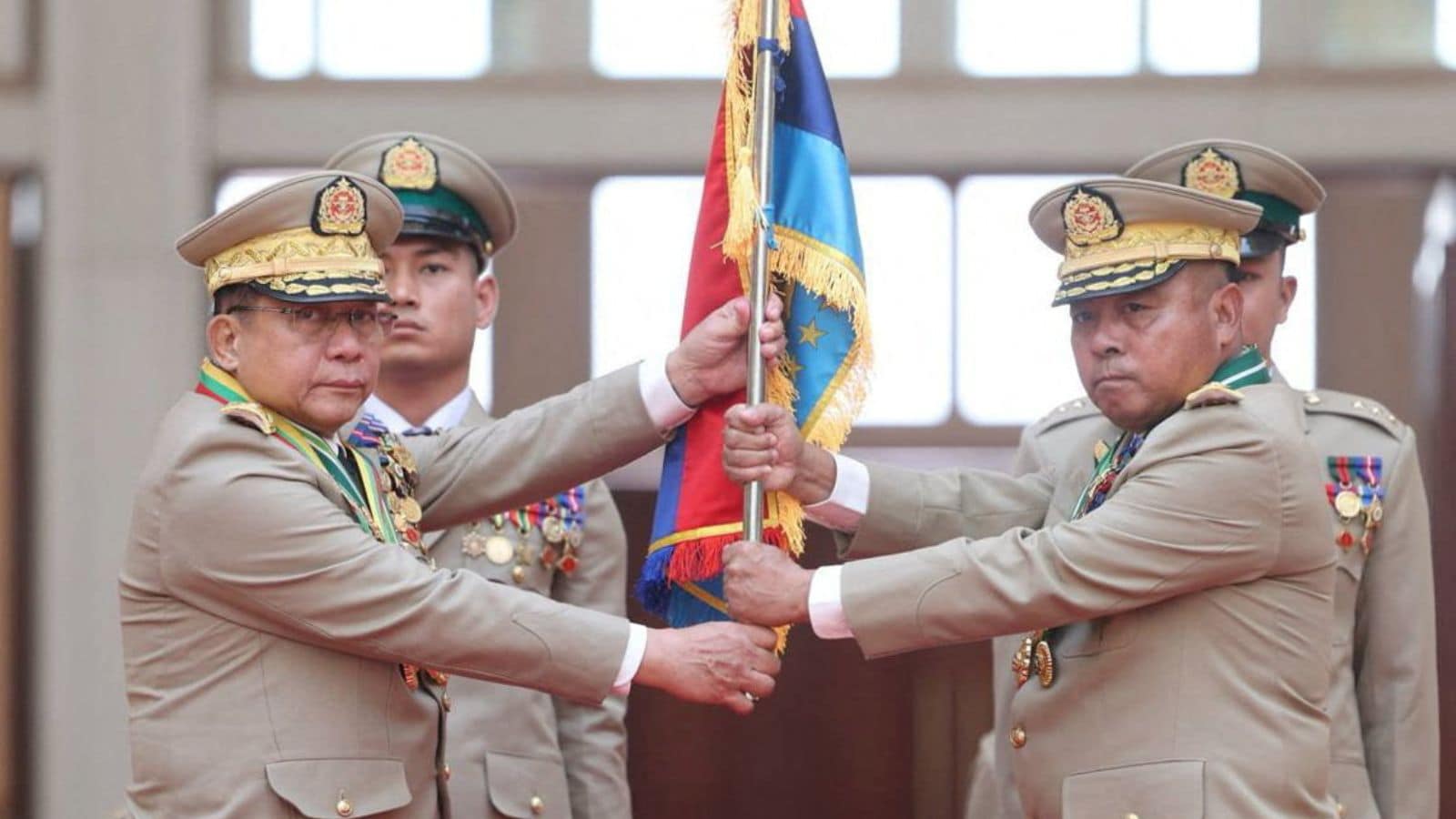
The international press is currently obsessed with a script that doesn’t exist. They see Senior General Min Aung Hlaing shedding his olive drabs for a silk longyi and think they’re witnessing a transition. They call it a "move toward civilian rule" or a "bid for legitimacy."
They are wrong.
Min Aung Hlaing isn't stepping down to run for President; he is rebranding a failing firm because the creditors are at the door. To understand what is actually happening in Naypyidaw, you have to stop looking at Myanmar as a budding democracy or a simple military junta. Start looking at it as a distressed asset managed by a CEO who has run out of liquid capital.
The mainstream narrative suggests that the General is following the "Thein Sein playbook"—the 2011 maneuver where the military traded direct control for international investment. But that comparison is lazy. Thein Sein had a unified military and a global community eager to believe a lie. Min Aung Hlaing has neither.
The Myth of the Powerful President
The Western obsession with the title of "President" in Myanmar is a category error. Under the 2008 Constitution—a document the military wrote themselves—the President is a glorified administrator.
In the Myanmar power hierarchy, the Commander-in-Chief of the Defense Services (Tatmadaw) holds the actual keys. He controls the three most important ministries: Defense, Home Affairs, and Border Affairs. He has a guaranteed 25% of seats in parliament, meaning no constitutional change can happen without his permission.
So why would a man holding absolute military power "step down" to take a job that, on paper, has less autonomy?
He wouldn't. Unless the military itself is fractured.
The move to the presidency is not a promotion. It is a tactical retreat. By moving into a "civilian" role, Min Aung Hlaing attempts to solve two problems that have paralyzed his regime since the 2021 coup: diplomatic isolation and the internal blame game.
Bankruptcy Protection for a Failed State
Since 2021, Myanmar has become a pariah. Even ASEAN, usually a toothless tiger that refuses to comment on "internal affairs," has barred the junta from its summits. This isn't just an ego blow; it’s a financial catastrophe.
The regime needs foreign currency. It needs the Myanmar Economic Holdings Limited (MEHL) and the Myanmar Economic Corporation (MEC) to function without the constant friction of sanctions. By donning a suit, Min Aung Hlaing is betting that regional neighbors like Thailand, India, and China will have the "diplomatic cover" they need to resume business as usual.
It is a "rebranding" in the most cynical sense.
If he is the "President" of a "Transitional Government" that holds "Elections," he provides a hook for realpolitik-minded diplomats to argue for the lifting of sanctions. They will say, "Look, he's a civilian now. The process is working."
It’s a lie, but it’s a lie that pays.
The Internal Purge You Aren't Seeing
The most overlooked aspect of this "stepping down" is the internal pressure within the Tatmadaw.
Military organizations are built on the perception of competence. For three years, the Tatmadaw has been humiliated on the battlefield. The Three Brotherhood Alliance and various People’s Defense Forces (PDFs) have seized border towns, overran outposts, and forced mass surrenders.
In any corporate structure, when the quarterly reports are this blood-red, the Board of Directors starts looking for a fall guy.
By moving to the presidency, Min Aung Hlaing is trying to hand the "Commander-in-Chief" headache to someone else while maintaining "Commander-in-Chief-Plus" status. He wants to distance himself from the day-to-day tactical failures of the army while remaining the ultimate arbiter of the state.
However, this creates a dangerous power vacuum. The Tatmadaw operates on a strict seniority system. If he installs a puppet as the new army chief, he risks a counter-coup from disgruntled generals who are tired of dying for a man who is now sitting in a plush office in Naypyidaw. If he installs a strongman, he creates a rival.
Why the "Election" is a Mathematical Farce
The media will spend the next year analyzing polling data and "opposition" parties. This is a waste of ink.
The planned elections are not a democratic exercise; they are a census conducted at gunpoint. The Union Election Commission (UEC) has already dismantled the National League for Democracy (NLD). The new proportional representation (PR) system is specifically designed to ensure that no single party can ever challenge the military-backed Union Solidarity and Development Party (USDP).
Imagine a scenario where a company changes its voting bylaws so that the CEO’s family always holds 25% of the shares, and then asks the employees to vote on who should be the "Employee of the Month." That is the Myanmar election.
The real question isn't who wins. The question is whether the regime can even hold a vote in 40% of the country. They have lost control of the periphery. To hold an election, they need to regain territory they haven't held in years.
The China Factor: The Only Vote That Matters
Forget the UN. Forget the US State Department. The only entity that determines if Min Aung Hlaing’s "Presidential" gambit works is Beijing.
China wants stability for its China-Myanmar Economic Corridor (CMEC). They don't care if the leader wears a uniform or a suit, as long as the pipelines keep flowing and the borders are quiet.
Min Aung Hlaing’s shift to the presidency is a direct signal to China. He is saying, "I am stabilizing the situation. I am creating a formal, recognizable government you can sign contracts with."
If China bites, the regime survives. If China continues to hedge its bets by supporting ethnic armed groups on the border, the "President" title is just a fancy shroud for a dying regime.
Stop Asking if He'll Win
People keep asking: "Can Min Aung Hlaing win the presidency?"
That is the wrong question. In a rigged system, winning the title is easy. The right question is: "Can he govern?"
The answer is a resounding no.
The "civilianization" of the junta does nothing to address the fundamental collapse of the Myanmar kyat. It does nothing to fix the brain drain that has seen the country’s brightest minds flee or join the resistance. It does nothing to stop the localized inflation that has made basic goods unaffordable for the average family.
A general in a suit is still a general who oversaw the destruction of his own economy.
The Trap for the West
There is a segment of the "international community"—the pragmatic consultants and the "stability at all costs" crowd—who will argue that we should engage with President Min Aung Hlaing. They will claim that it's better to have a flawed civilian government than a chaotic military one.
This is the trap.
Accepting this transition is an admission that mass murder and a coup can be laundered through a fake election and a wardrobe change. It tells every other aspiring autocrat in Southeast Asia that if you hold out long enough and kill enough of your own people, the world will eventually get bored and accept your new business card.
The End of the Charade
Min Aung Hlaing is not a visionary leader transitioning his country to democracy. He is a man who burned down his house and is now trying to sell the charred remains as "industrial chic."
He is stepping down because the uniform has become too heavy, stained with the blood of a civil war he cannot win and the stench of an economy he cannot manage. But the suit won't fit him any better.
The presidency isn't his path to power. It's his exit strategy. And the tragic reality for Myanmar is that while the CEO is busy rebranding, the company is still on fire.
The General thinks he’s playing chess. He’s actually just moving the deck chairs on the Titanic and calling it a "strategic realignment."
Don't buy the brochure.