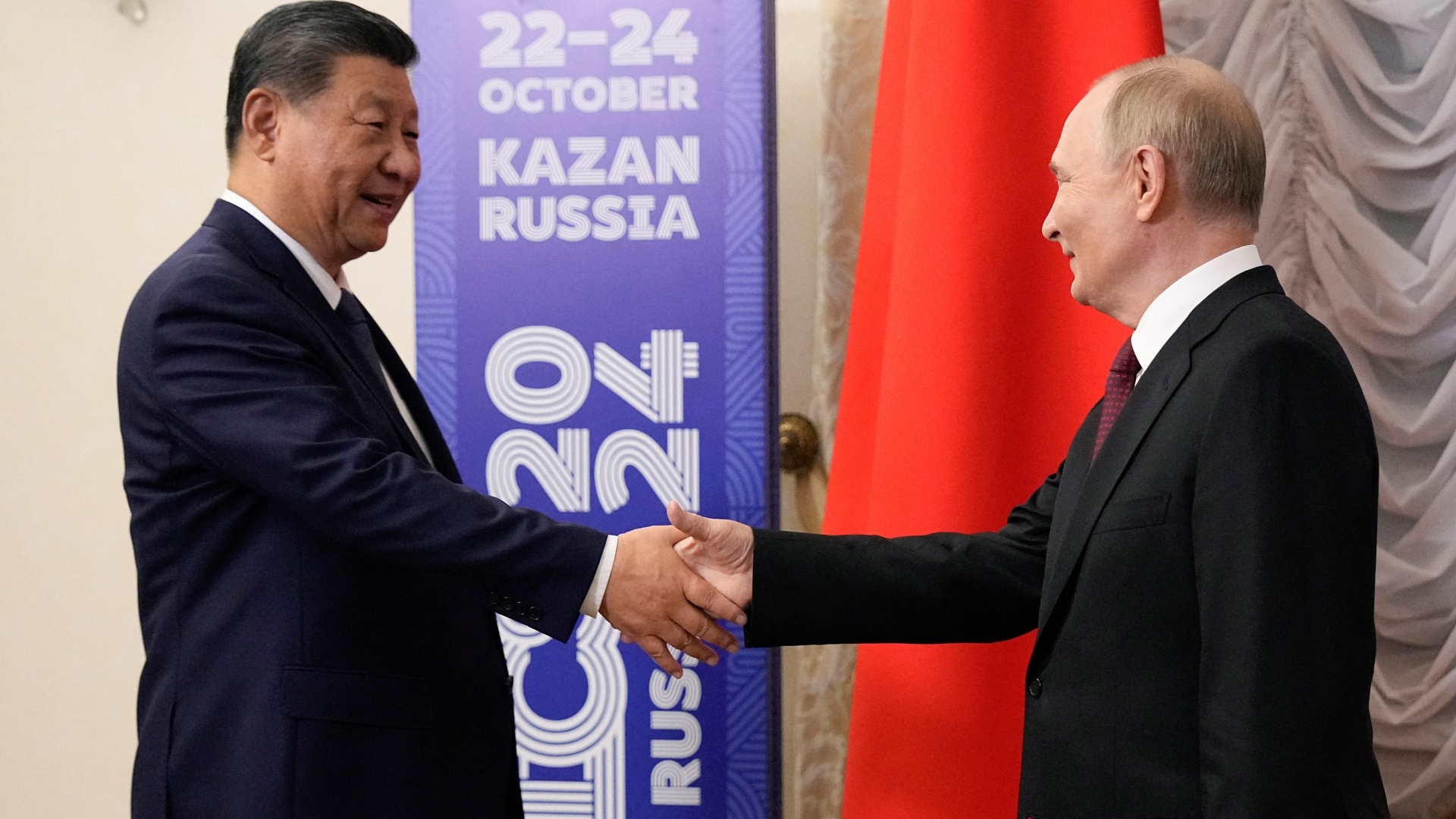
The mainstream media is salivating over Sergey Lavrov’s confirmation that Vladimir Putin will trek to China in the first half of 2026. They call it a "strengthening of the no-limits partnership." They frame it as a unified front against a fracturing West. They are wrong.
This isn’t a victory lap. It is a desperate sales pitch from a vassal state to its landlord.
If you’re watching the tickers and reading the wire services, you’re seeing a narrative built on 1970s-era geopolitical tropes. The reality is far more clinical, cold, and transactional. Putin isn’t going to Beijing to lead; he’s going there to beg for a lifeline that Xi Jinping is increasingly hesitant to extend.
The Asymmetry of Power No One Admits
The "partnership" is a PR fantasy designed to spook Washington. In reality, the economic leverage is so lopsided it’s comical.
Let’s look at the raw math. Russia’s GDP is roughly $2 trillion. China’s is over $18 trillion. To China, Russia is a gas station with a nuclear arsenal—a convenient source of cheap, discounted BTU’s and a buffer against NATO, but hardly a "peer." When Putin lands in 2026, he won't be negotiating from a position of strength. He will be checking the status of his credit line.
China’s trade with the US and the EU combined still dwarfs its trade with Russia by a factor of nearly ten. Xi Jinping is a pragmatist, not a martyr. He will not tank the Chinese banking system or invite secondary sanctions to save a kinetic conflict in Eastern Europe that has lasted far longer than Beijing anticipated.
I’ve watched analysts miss this for years. They see a handshake and assume a treaty. They see a joint statement and assume a blood oath. In the boardrooms of Shanghai and the halls of the Zhongnanhai, Russia is viewed as a distressed asset. You don’t partner with a distressed asset; you strip it for parts.
The Power of Siberia 2 Pipe Dream
Expect the 2026 visit to center heavily on the Power of Siberia 2 pipeline. This is the ultimate litmus test for who actually holds the cards.
Russia needs this pipeline to pivot its energy exports away from the European graveyard. China, however, is in no rush. Beijing knows that every month they delay, the price of Russian gas drops. They are playing the long game, waiting for Russia to become so desperate that they agree to "domestic Chinese pricing"—essentially forcing Gazprom to sell at a loss.
The "lazy consensus" says this pipeline is a guaranteed win for both. It isn't. It’s a chokehold. Once that infrastructure is laid, Russia has exactly one customer for that specific gas field. China can turn the tap off at any moment to extract political concessions. Putin is effectively building his own cage and asking China to hold the keys.
The Yuanization Trap
Mainstream outlets love to talk about "de-dollarization" as if it’s a noble crusade. It’s actually a trap for the Russian Central Bank.
By shifting trade to the Yuan, Russia hasn't achieved sovereignty; it has swapped one master for another. The Yuan is not a fully convertible currency. It is a controlled instrument of the Chinese Communist Party. When Russia holds Yuan, it holds "company store" money. It can only spend those reserves on Chinese goods, on Chinese terms, at Chinese prices.
- Risk 1: Russia cannot use Yuan to stabilize the Ruble on global markets.
- Risk 2: China can devalue the Yuan at will to boost its own exports, wiping out the value of Russian reserves overnight.
- Risk 3: The Chinese "Cross-Border Interbank Payment System" (CIPS) gives Beijing total visibility into every single Russian transaction.
This isn't financial independence. It’s an accounting takeover.
The Technology Deficit
The 2026 summit will undoubtedly feature "high-tech cooperation" rhetoric. Ignore it.
Russia’s defense industry is gasping for high-end semiconductors. China is wary of providing them directly due to the threat of Western sanctions on firms like SMIC. What we will see instead is China selling Russia mid-tier, consumer-grade tech that is "good enough" for the battlefield but keeps Russia decades behind the global curve.
China has no interest in seeing a technologically dominant Russia. They want a Russia that is just strong enough to distract the United States, but weak enough to remain subservient to Beijing’s regional ambitions in Central Asia.
The Arctic Pivot
While the world watches the border of Ukraine, the real friction of 2026 will be the Arctic.
Russia views the Northern Sea Route as its private sovereign highway. China, labeling itself a "near-Arctic state," wants international access. During this visit, watch for subtle language regarding "joint development." In diplomatic speak, this means China is buying its way into the Russian North.
I’ve seen this play out in private equity a thousand times: the majority partner provides the "opportunity," and the minority partner provides the cash. Slowly, the guy with the cash owns the whole operation. Putin is selling off the last of Russia’s strategic crown jewels—Arctic sovereignty—to keep the lights on in Moscow for another fiscal year.
Stop Asking if They Are Allies
The question "Are Russia and China allies?" is fundamentally flawed. It’s a binary question for a complex, predatory relationship.
The correct question is: "When does the cost of maintaining Russia exceed the benefit for China?"
By mid-2026, the global economy will likely be in a different cycle. If China’s domestic property crisis continues to fester, Xi will need Western markets more than ever. Putin’s visit will be a delicate dance where he tries to prove he is still a "useful" disruptor, while Xi evaluates if it’s time to distance himself from a liability.
The Actionable Reality for Investors and Analysts
If you are betting on a "Eurasian Hegemon" that will topple the West, you are misreading the room.
- Short Russian Sovereignty: The long-term trajectory is a slow-motion liquidation.
- Watch the Banks: The real news won't be the Putin-Xi handshake; it will be whether Chinese "Big Four" banks increase their exposure to Russian entities. (Spoiler: They won't).
- Monitor Central Asia: This is where the mask slips. China is aggressively displacing Russian influence in Kazakhstan and Uzbekistan. If you want to know how the "alliance" is really doing, look at who is building the railways in Tashkent.
Putin’s 2026 visit to China isn't the start of a new world order. It’s the finalization of a corporate takeover. The CEO of the smaller firm is flying to the headquarters of the conglomerate to sign the merger papers, hoping he gets to keep his office and a decent title.
Stop looking for a partnership. Start looking for the receipt.