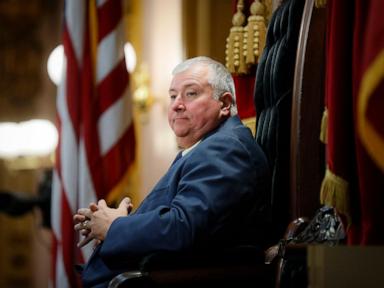
The United States Supreme Court’s refusal to hear the appeals of former Ohio House Speaker Larry Householder and lobbyist Matt Borges marks the terminal point of a $60 million racketeering enterprise. This decision solidifies a legal precedent regarding the intersection of political "dark money" and criminal bribery under the Racketeer Influenced and Corrupt Organizations (RICO) Act. The case does not merely represent a lapse in ethics; it provides a blueprint of the functional components required to execute a large-scale legislative capture and the subsequent failure of the "First Amendment defense" in federal corruption trials.
The Architecture of a $60 Million Racketeering Enterprise
To understand the scope of the conviction, one must analyze the specific utility of the funds involved. The scheme was not a simple exchange of cash for votes. It was a multi-stage operational funnel designed to acquire, consolidate, and protect political power. The enterprise operated through three distinct phases:
Phase I: Acquisition of the Speakership
The primary objective of the initial capital infusion was the installation of Larry Householder as Speaker of the Ohio House. By funneling millions from FirstEnergy Corp. through a 501(c)(4) entity—Generation Now—Householder funded the campaigns of a slate of candidates loyal to his leadership. This created a debt of patronage that bypassed traditional party structures. In this stage, the money functioned as venture capital for political control.
Phase II: The Legislative Quid Pro Quo
Once the speakership was secured, the enterprise shifted to the delivery of the legislative product: House Bill 6 (HB 6). This legislation provided a $1.3 billion bailout for two aging nuclear power plants owned by a subsidiary of FirstEnergy. The "bribe" in this context was not a personal payment to a bank account in the traditional sense, but the sustained funding of the political apparatus that allowed Householder to maintain his position of authority.
Phase III: The Defense of the Asset
When a grassroots movement attempted to trigger a statewide referendum to repeal HB 6, the enterprise moved into its most aggressive phase. Millions were deployed to hire "blockers" who physically intimidated signature gatherers and funded a xenophobic disinformation campaign claiming the referendum was a Chinese government plot to undermine Ohio’s energy grid. Matt Borges’ involvement centered on this phase, specifically the bribing of a campaign staffer for inside information to sabotage the repeal effort.
The Failure of the First Amendment Defense
The central pillar of the defendants' appeal rested on the argument that their actions were protected under the First Amendment as "vigorous political advocacy." This defense sought to exploit the gray area between protected political speech and criminal activity. However, the Sixth Circuit Court of Appeals and the Supreme Court’s subsequent denial of certiorari emphasize a critical distinction in federal law.
The First Amendment protects the right to spend money to influence elections, but it does not provide a shield for an underlying "agreement" to trade official acts for those funds. The prosecution successfully proved the existence of a quid pro quo—a specific exchange of value for a specific legislative outcome. The court found that the use of a 501(c)(4) "social welfare" organization did not grant the enterprise immunity. Instead, the lack of transparency inherent in these organizations was used as a mechanism for concealment, which is a hallmark of racketeering.
Measuring the Cost of the Regulatory Capture
The economic impact of the HB 6 scheme extends beyond the $60 million in bribes. It represents a significant distortion of the energy market in Ohio.
- Ratepayer Liability: The $1.3 billion bailout was designed to be funded by surcharges on the monthly bills of Ohio residents and businesses.
- Market Distortion: By subsidizing inefficient nuclear plants, the legislation artificially suppressed the growth of renewable energy sectors that were excluded from the subsidy framework.
- Political Risk Premium: Corruption at this level increases the "cost of doing business" in a state, as firms must factor in the necessity of political influence-buying rather than competing on technical or economic merit.
The RICO Factor and Judicial Finality
The use of the RICO Act was the decisive factor in securing the 20-year sentence for Householder. Traditionally used against organized crime syndicates, RICO allows for the prosecution of individuals for the actions of a broader enterprise if they participated in a pattern of racketeering activity.
By applying RICO to a statehouse, federal prosecutors signaled that the "political organization" was, in fact, a "criminal enterprise." The Supreme Court’s refusal to intervene confirms that the 20-year sentence—the longest ever handed down in an Ohio public corruption case—is legally sound. This removes the possibility of a "good faith" defense regarding political fundraising; if the fundraising is inextricably linked to a specific legislative act, the intent shifts from political to criminal.
Structural Vulnerabilities and Future Risk
Despite the convictions, the structural vulnerabilities that allowed the HB 6 scheme to flourish remain largely unaddressed. The reliance on 501(c)(4) entities allows for "dark money" to flow into political systems without the immediate disclosure of the source. This creates a feedback loop where:
- A corporate entity identifies a multi-billion dollar regulatory hurdle.
- The entity funds a non-profit "social welfare" group with no disclosure requirements.
- The non-profit funds the rise of a specific political figure.
- The political figure removes the regulatory hurdle.
The Householder case demonstrates that the only current check on this loop is federal intervention after the crime has been committed. There is no automated systemic barrier to prevent the initiation of such a cycle.
The strategic takeaway for observers of corporate governance and political risk is that the "legal" use of dark money does not offer protection if the underlying intent is the subversion of official duties. The Supreme Court has effectively closed the door on the argument that large-scale political bribery can be rebranded as "standard lobbying." The 20-year sentence remains the benchmark for the cost of legislative capture. Organizations must now audit their political spending not just for compliance with FEC or state election laws, but for exposure to RICO-level scrutiny if their lobbying efforts result in high-value, specific legislative "wins" that coincide with significant financial transfers.