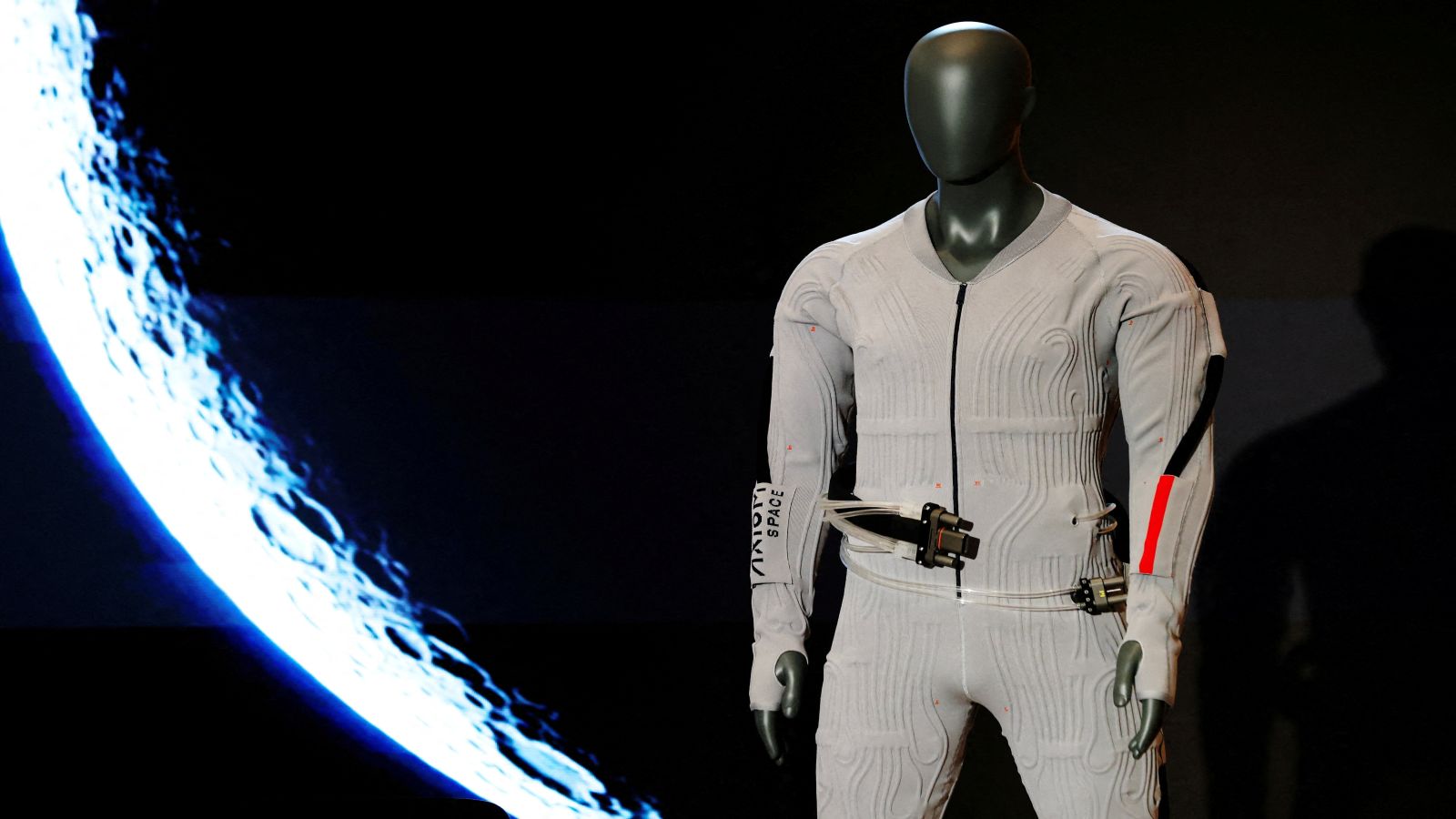
The engineering requirements for extravehicular activity (EVA) at the lunar South Pole present a stark, non-linear optimization problem. Human survival in an environment featuring extreme thermal variations ranging from -250°F to +250°F (-157°C to +121°C), absolute vacuum, high-velocity micrometeoroids, and abrasive regolith requires an intricate, multi-tiered pressure and environmental containment vehicle. While public attention scales with high-profile brand associations, a rigorous system-level decomposition of the Axiom Extravehicular Mobility Unit (AxEMU) reveals that the partnership between Axiom Space and Prada is driven by fundamental thermodynamics, textile material physics, and human factors engineering rather than aesthetic design.
The core challenge of spacesuit architecture lies in balancing pressure containment with joint mobility and heat dissipation. The human body under physical exertion acts as a thermal engine, producing significant metabolic heat that cannot dissipate via convection or conduction in a vacuum. Consequently, an astronaut's primary threat during a sustained eight-hour EVA is not freezing, but lethal metabolic overheating and carbon dioxide toxicity. Evaluating the AxEMU requires analyzing its structural hierarchy from the skin outward, specifically examining the newly engineered Liquid Cooling and Ventilation Garment (LCVG) and its integration with the Portable Life Support System (PLSS). For a closer look into similar topics, we recommend: this related article.
The Dual-Loop Thermodynamic Control Framework
The human body at peak physical exertion generates up to 3,000 BTUs (approximately 880 Watts) of metabolic heat per hour. In the vacuum of space, radiation is the only natural mechanism for heat transfer, which is entirely insufficient to match human metabolic output. To prevent heat stroke, the AxEMU shifts the thermal load from the human body to an engineered mechanical system through conduction and forced convection.
The LCVG serves as the direct thermal interface, operating via two discrete mechanical loops that manage the astronaut's microclimate: To get more details on this topic, in-depth reporting can be read on TechCrunch.
1. The Conductive Heat Transport Loop
The inner layer uses an intricate network of flexible, high-density tubing routed along major muscle groups. Cold water circulates through this closed loop, absorbing metabolic heat through conductive contact with the skin. The warmed water travels back to the PLSS, where the heat is expelled into space via a sublimator or an evaporative cooling system, dropping the fluid temperature before recirculating it back to the body.
The architectural vulnerability of legacy space suits resided in single-point failures within this cooling line; a single crimp or pump failure would immediately compromise the loop, triggering an abort scenario. The AxEMU addresses this structural risk by incorporating a fully redundant cooling circuit. The primary and secondary loops operate in parallel or standby configurations, establishing a backup path that ensures continuous thermal regulation if the primary loop loses pressure or experiences mechanical stagnation.
2. The Convective Gas Ventilation Loop
Metabolic function simultaneously introduces a chemical threat: the accumulation of exhaled carbon dioxide ($CO_2$). The LCVG integrates a dedicated gas ventilation loop completely separate from the liquid cooling lines. This subsystem introduces fresh oxygen directly across the astronaut’s faceplate.
This continuous gas stream performs a dual function. First, it washes away exhaled $CO_2$, preventing the formation of localized pockets of toxic gas within the helmet. Second, it drives moisture evaporation from the head and neck, assisting in latent heat removal. The moisture-laden, $CO_2$-rich gas is pulled from the boots and lower extremities back into the PLSS. There, it passes through a regenerable metal-oxide or amine-based scrubbing system to strip out $CO_2$, removes excess humidity via a condensing heat exchanger, and returns purified oxygen back into the suit pressure garment.
Structural Textile Mechanics and Material Optimization
The integration of Prada into the aerospace engineering workflow solves a specific manufacturing bottleneck: translating three-dimensional human kinesiologic movement into multi-layered, non-stretch technical textiles without generating pressure hot spots or friction injuries. The mechanical performance of the LCVG relies on three core competencies derived from competitive offshore racing textiles, such as those developed for the Luna Rossa sailing team.
Engineered Knit Architecture
Traditional spacesuit liners suffer from structural bunching around major articulation points, such as the axilla, elbow, and popliteal fossa. Under a pressurized load, any excess fabric fold creates localized pressure concentrations that can cause skin abrasions or compromise micro-vascular circulation during long-duration operations.
Using advanced 3D digital knitting modeling, the internal layer is manufactured as a continuous, variable-density textile. The fabric properties change dynamically across the geometry of the garment. Areas requiring high elasticity and breathability utilize a loose, porous knit pattern, while high-friction zones feature a dense, wear-resistant weave to ensure the liquid-carrying tubes remain locked against the skin without shifting under physical stress.
Specialized Fiber Selection and Durability
Lunar missions dictate strict weight constraints and require repeated deployment cycles without access to laundry infrastructure. The choice of fibers for the LCVG must satisfy mutually exclusive criteria:
- High Thermal Conductivity: The yarn matrix must not insulate the body from the internal cooling tubes.
- Hydrophobic and Antimicrobial Properties: The material must manage sweat wick efficiency while preventing microbial proliferation over multi-week mission profiles.
- Tensile Longevity: The material must resist stretching out over repeated eight-hour wear cycles to preserve the precise alignment of the cooling lines against the skin.
The material intelligence provided by the commercial textile sector allows the AxEMU to move away from heavy, uniform synthetic fibers toward multi-filament, engineered polymers that optimize the strength-to-weight ratio of the inner pressure garment assembly.
External Environmental Shielding: The AxEMU Outer Layer
The LCVG cannot function without the structural isolation provided by the outer garment layers unveiled in the initial phases of the project. The external shell acts as a micrometeoroid and thermal barrier, shielding the inner systems from the unattenuated solar radiation and thermal dips found within the permanently shadowed regions (PSRs) of the lunar South Pole.
The outer protective layer relies on heavy cross-industry materials science to address three primary environmental vectors:
[Outer Layer: Albedo Reflector & Micrometeoroid Shield]
                     │
                     ▼
[Insulation Layer: Multi-Layer Insulation (MLI) Vacuum Barrier]
                     │
                     ▼
[Pressure Bladder: Bladder & Restraint Layer (10,000–12,000 ft Eq.)]
                     │
                     ▼
[Inner Layer: Prada x Axiom LCVG (Dual-Loop Liquid & Gas Lines)]
Thermal Radiation Mitigation
Without an atmosphere to diffuse incoming solar energy, surfaces on the Moon absorb direct radiation, heating the exterior of the suit to +250°F. Conversely, entering a shadow drops the temperature instantly to -250°F. The outer layer addresses this via high-albedo coatings and specialized Multi-Layer Insulation (MLI) blankets. The MLI operates like a thermos flask, using multiple layers of highly reflective aluminized Mylar separated by non-conductive scrim net layers, functioning optimally only within the vacuum environment to stop radiative heat transfer.
Micrometeoroid and Regolith Defense
Tiny particulate matter travels at hyper-velocities in space, creating an impact risk. The outermost skin utilizes high-strength synthetic polymers like Kevlar or Nomex blends to arrest the kinetic energy of these particles before they pierce the inner pressure bladder. Furthermore, lunar regolith consists of highly abrasive, jagged volcanic shards with no atmospheric weathering. The weave of the outer layer must be dense enough to prevent these microscopic needles from migrating through the fabric layers, where they could puncture mechanical seals or degrade the internal plumbing of the LCVG.
Anthropomorphic Sizing and Commercial Infrastructure
The deployment of the AxEMU signals a structural shift in NASA’s procurement strategy, moving from customized, government-owned hardware to an as-a-service commercial acquisition model. The legacy Apollo and Space Shuttle Extravehicular Mobility Units were constrained by rigid sizing architectures, often excluding segments of the astronaut corps due to the extreme costs associated with custom-tailoring hard pressure components.
Axiom Space designed the AxEMU with a highly modular, adjustable sizing infrastructure. The soft and hard joints can be lengthened, shortened, or re-indexed using internal sizing rings and adjustable restraint lines. This allows a single suit architecture to accommodate a broad spectrum of anthropomorphic dimensions, ensuring proper fit and center-of-gravity alignment for a diverse astronaut population.
This modularity provides direct economic benefits to both government and commercial space flight operators. By standardizing the primary structural interfaces and utilizing highly flexible, adaptive inner garments like the LCVG, the cost per mission hour drops. The suits are built to be maintained on-orbit or aboard commercial space stations, minimizing the logistics tail of returning hardware to Earth for deep overhaul cycles.
Tactical Integration and Operational Limits
The AxEMU system introduces distinct technological advantages, but its operational envelope contains strict physical boundaries that mission profiles must account for:
- The Consumables Bottleneck: The duration of an EVA is limited to eight hours. This constraint is not dictated by the endurance of the textile layers, but by the physical capacity of the PLSS to store oxygen, scrub $CO_2$, and power the water circulation pumps. Once the $CO_2$ scrubbing matrix reaches chemical saturation, or the primary battery capacity drops below safety margins, the suit's life support system degrades non-linearly.
- The Kinetic Mobility Trade-off: Despite advanced pattern-making and low-torque joints, any suit pressurized to internal atmospheric levels (typically equivalent to an altitude of 10,000 to 12,000 feet on Earth) naturally resists deformation. Every joint flex requires the astronaut to work against the internal volume displacement of the gas. Over an eight-hour window, this continuous resistance causes significant muscular fatigue, placing a premium on the biomechanical efficiency and fit provided by the inner LCVG layer.
- Regolith Contamination Thresholds: While the outer layer shields the internal mechanisms from dust during execution, the accumulation of electrostatic lunar dust on the suit exterior presents a severe hazard during ingress and egress. If fine regolith bypasses the airlock cleaning protocols, it can enter the internal habitat, potentially damaging the seals of the LCVG connection manifolds during post-EVA maintenance and suit donning.
The design of the AxEMU demonstrates that cross-industry collaboration yields optimal results when focused on deep technical crossover rather than surface-level branding. Prada's value to the aerospace sector lies in its historical data regarding textile performance under physical strain, which compliments Axiom’s lifecycle expertise in life support systems and pressure containment.
For future deep space missions, including long-duration lunar surface habitation and eventual human Mars exploration, developers should treat the textile layer not as passive clothing, but as an active, mechanical component of the life support system. Mission success relies on refining these flexible, high-density interfaces to further reduce the metabolic overhead of human movement within a pressurized environment.