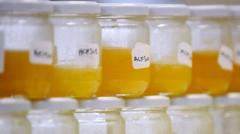
A wooden crate sits on a wet dock in Rotterdam. Inside, thousands of glass jars sparkle under the industrial floodlights, their labels boasting of organic, cold-pressed Greek olive oil. To the average consumer, this is a heart-healthy elixir, the cornerstone of a Mediterranean diet. To the man standing over the crate with a clipboard, it is a mathematical triumph of deception.
He knows something the buyer doesn't. He knows that the "liquid gold" inside these jars started its life as low-grade sunflower oil in a warehouse three borders away. He knows exactly how many milligrams of chlorophyll were added to achieve that grassy, virgin hue. He knows that the beta-carotene provides the counterfeit "peppery" finish on the back of the throat.
This isn't just a scam. It is a multi-billion-dollar shadow industry that thrives because it understands human psychology better than any laboratory can. We want to believe in the purity of our food. We want to believe that a premium price tag guarantees a premium soul. But in the global supply chain, the soul is the first thing to be auctioned off.
The Ghost in the Machine
The tech industry promised us an end to this. We were told that blockchain would create an unshakeable digital ledger, tracing every olive from the branch to the bottle. We were told that DNA sequencing and isotope ratio mass spectrometry would make it impossible to hide a lie in a vat of oil or a bag of "wild-caught" fish.
Yet, food fraud isn't shrinking. It’s evolving.
Consider the "paper trail" problem. A blockchain is only as honest as the person entering the data. If a corrupt supplier digitizes a lie at the point of origin, the blockchain simply becomes a high-tech megaphone for that lie. It creates a false sense of security—a digital "Seal of Approval" that actually makes it easier for fraudsters to operate because the end buyer stops asking questions once they see the QR code.
The reality is that technology is a tool, but greed is a fuel.
A Taste of Copper and Greed
Let’s look at a hypothetical scenario—though it plays out in reality every single day. Meet Elena. She is a mother of two in a suburban neighborhood, buying honey for her daughter’s cough. She reaches for the jar labeled "Manuka," paying four times the price of the plastic bear sitting next to it.
Elena thinks she is buying medicine. In reality, she might be buying a blend of corn syrup and caramel coloring, spiked with just enough real honey to pass a basic pollen count test.
The sting isn't just financial. When we talk about food fraud, we often focus on the "fraud" and forget the "food." In 2008, the melamine scandal in Chinese infant formula wasn't just a business story. it was a tragedy that sickened 300,000 children. The perpetrators weren't trying to kill anyone; they were trying to fool a protein test. Melamine, high in nitrogen, makes watered-down milk look protein-rich to a sensor.
The sensor was "robust." The technology worked perfectly. It detected nitrogen. But the humans behind the machine forgot that nitrogen doesn't always mean nourishment.
This is the central tension of the modern pantry. As our detection methods get more sensitive, the "recipes" for faking food get more sophisticated. It is a chemical arms race where the prize is your dinner plate.
Why the Systems Fail Us
If you walk into a high-end grocery store today, you are surrounded by ghosts. That "Kobe" beef? There is a high statistical probability it never saw Japan. That "truffle oil"? It’s likely perfume-grade 2,4-dithiapentane derived from petroleum.
We rely on a patchwork of regulations that were designed for a world that no longer exists. Our food system is now so fragmented that a single frozen lasagna might contain ingredients from sixteen different countries, processed in three others, and packaged in a fourth.
Each handoff is a shadow. Each shadow is an opportunity.
- The Volume Problem: Regulators can only test about 1% to 2% of imported food. If you are a smuggler, those are better odds than you’ll ever find in a casino.
- The Profit Margin: The "premium" on luxury foods is so high that the cost of getting caught is simply viewed as a business expense. A fine is just a tax on a successful year.
- The Chemical Mimicry: Fraudsters now use "masking agents" specifically designed to bypass the very tests the FDA and EFSA use to verify purity.
But there is a deeper, more human reason why this persists: we hate being the "difficult" customer. We want the bargain. We want the $10 bottle of "extra virgin" oil that should cost $30. We participate in the fraud through our own willful ignorance. We see the price, we see the shiny label, and we choose not to look at the shadows.
The Invisible Stakes
When we lose the ability to trust what we eat, we lose a fundamental piece of our humanity. Eating is the most intimate act of consumerism. We take the outside world and put it inside our bodies. We build our cells out of what we buy at the market.
When that process is corrupted, the damage ripples outward. It isn't just about the person who gets a rash from an undeclared allergen in "pure" spice mix. It’s about the honest farmer in Italy who is driven out of business because he cannot compete with the price of "liquid gold" made in a chemical plant. It’s about the collapse of local economies that depend on the integrity of their regional brands.
Technology will continue to improve. We will see portable scanners that can tell you the sugar content of an apple through its skin. We will see AI-driven logistics that flag suspicious price drops in the global supply chain.
But a scanner cannot measure integrity.
The fix isn't just more data. It’s a return to shorter lines. It’s the uncomfortable realization that if a food product seems too cheap to be true, someone, somewhere, is paying the difference. Usually, it’s the person holding the fork.
The man on the Rotterdam dock finishes his notes. He signs the paperwork. The crate of "organic" oil is loaded onto a truck, destined for a supermarket near you. He isn't a monster. He’s a businessman who found a gap in the world and filled it with sunflower oil and green dye.
He knows that by the time you realize the flavor is a bit... off... he will have already moved on to the next shipment. He knows that in a world of infinite complexity, the simplest lie is the hardest to catch.
The next time you stand in the aisle, looking at a label that promises the world, remember: the most sophisticated technology in that store is the one trying to convince you that a miracle only costs five dollars.
Trust is the only ingredient they can't synthesize in a lab. Once it’s gone, no amount of blockchain can bring it back. If we want to solve food fraud, we have to stop buying the lie before we ever buy the product.