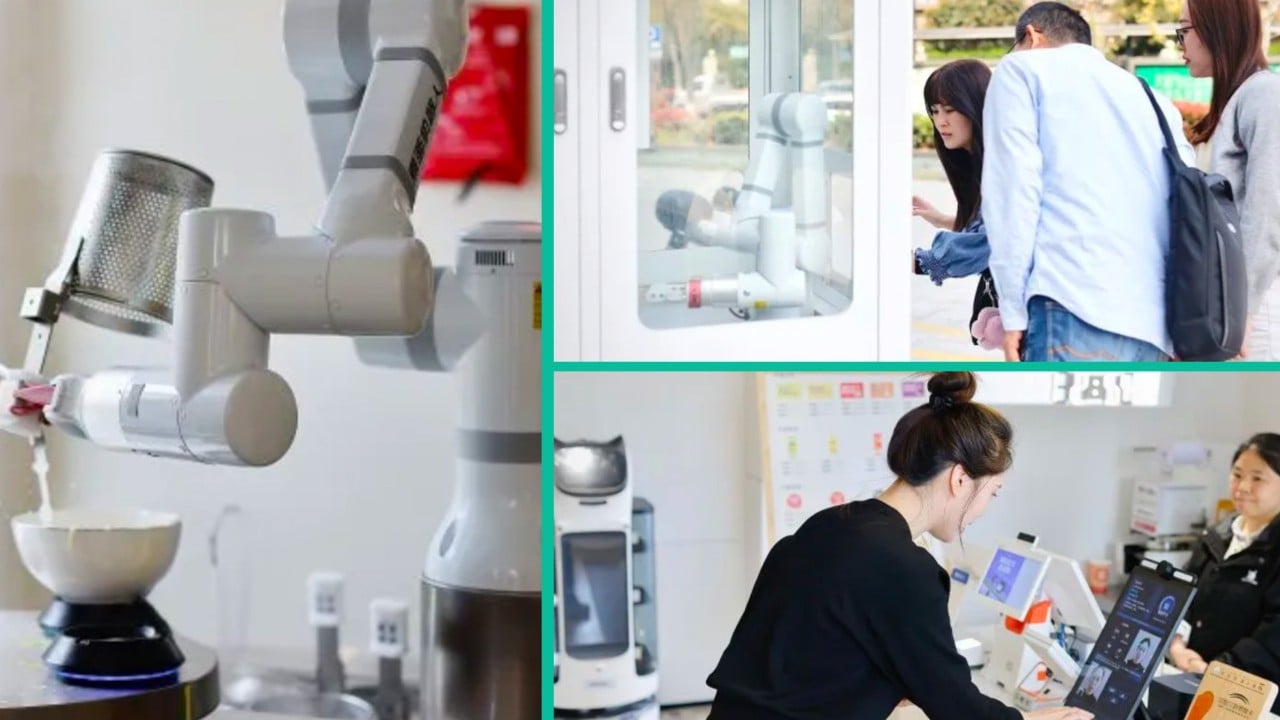
The woman standing in front of the kiosk at the Shanghai restaurant doesn’t look like a patient. She looks hungry. She is tired, perhaps, from a ten-hour shift in a glass-and-steel tower, her neck stiff from the silent tyranny of the ergonomic chair. She steps up to a screen, not to scroll through a colorful gallery of fried rice or oily noodles, but to surrender her secrets to an algorithm.
"Open wide," the interface suggests, though not in those exact words. If you found value in this article, you might want to check out: this related article.
She sticks out her tongue. A high-definition camera captures the texture, the hue, the slight coating on the surface. Next, it scans the skin of her face, mapping the puffiness under her eyes and the subtle flush of her cheeks. Within seconds, the machine has synthesized her exhaustion into data. It doesn't just see a customer; it sees a biological system in search of equilibrium.
This isn't a scene from a dystopian novel. It is lunch. For another perspective on this development, see the recent update from Mashable.
The Pulse in the Code
At the heart of this technological shift in Chinese dining is a convergence of ancient wisdom and aggressive innovation. For millennia, Traditional Chinese Medicine (TCM) has relied on the four pillars of diagnosis: looking, listening, smelling, and touching. A practitioner would look at the tongue—the "mirror of the heart"—to understand the internal climate of the body. They would see dampness, heat, or deficiency where a Western doctor might only see a lack of vitamins.
The robot at the front of the house is simply the latest vessel for this old soul. By analyzing the "coating" and color of the tongue, the AI determines whether the diner is suffering from internal "heat"—often manifesting as inflammation or irritability—or perhaps "dampness," which correlates to lethargy and digestive heaviness.
It is a strange, intimate transaction. You give the machine your image; it gives you a prescription disguised as a bowl of soup.
Consider a hypothetical diner named Li. Li has been sleeping poorly. His tongue is slightly redder than usual at the tip, and his face shows the subtle dehydration of a man who lives on black coffee. In a standard restaurant, Li might order the spiciest dish on the menu for a quick endorphin hit, inadvertently fueling the "fire" already simmering in his system. But the AI intervenes. It suggests a cooling winter melon soup and steamed fish with ginger. It makes the choice he didn't know he needed to make.
The stakes here are invisible but profound. We are witnessing the end of the "blind meal." For most of modern history, eating out has been an act of indulgence or convenience, often at the expense of our long-term vitality. We eat what tastes good in the moment, oblivious to the chemical cascade we are triggering. This technology attempts to bridge the gap between flavor and function, turning the act of dining into a deliberate medical intervention.
The Digital Pulse Taker
The complexity of these systems goes beyond a simple photo. The AI is trained on hundreds of thousands of clinical images, cross-referencing the topography of a human tongue against a massive database of diagnostic outcomes. It is looking for patterns that the human eye might miss: the specific shade of purple that suggests poor blood circulation, or the tiny cracks that point to a depletion of fluids.
But why now?
China is currently grappling with a massive shift in public health. As the middle class has grown, so have the "rich man’s diseases"—diabetes, hypertension, and obesity. The healthcare system is strained. In this environment, the restaurant ceases to be just a place of commerce. It becomes a frontline clinic.
The integration of AI into this process removes the friction of a doctor’s visit. You don't have to book an appointment to know your liver Qi is stagnant. You just have to be hungry.
There is, of course, a tension here that we must acknowledge. There is something inherently cold about a lens replacing the warm, calloused hand of a TCM master. When a doctor takes your pulse, there is a transfer of empathy. When a machine scans your face, there is only a transfer of packets. We are trading the human touch for a hyper-efficient accuracy that never sleeps and never gets tired of looking at tongues.
The Architecture of the Recommendation
Once the scan is complete, the data flows into the kitchen. This is where the narrative of the meal shifts from diagnosis to alchemy. The AI doesn't just pick a dish from a static menu; it often directs the precise balance of ingredients.
- For the "Cold" Constitution: The system prioritizes warming elements like cinnamon, ginger, and lamb to kickstart a sluggish metabolism.
- For the "Damp" Constitution: It leans toward Job’s tears (barley), lotus leaf, and hawthorn to help the body shed excess fluid and improve clarity.
- For the "Stressed" Diner: It looks for ingredients that "soothe the liver," such as chrysanthemum or goji berries.
The food arrives, and here is the irony: it is delicious. The technology hasn't replaced the chef; it has given the chef a blueprint. The "Invisible stakes" are the years of life potentially clawed back from the brink of chronic illness, one balanced meal at a time.
But let’s be honest about the discomfort. Many of us feel a reflexive twitch at the idea of a camera "analyzing" our faces just to serve us a salad. We worry about where that data goes. Does the restaurant know I haven't slept? Does it know I'm aging? In an era where our digital footprints are already sold to the highest bidder, our biological footprint feels like the final frontier of privacy.
Yet, for the diners in these high-tech hubs, the trade-off seems acceptable. The convenience of health is a powerful sedative for the anxiety of surveillance. If the machine can tell me why I’m tired and then fix it with a bowl of noodles, I might just stick my tongue out.
Beyond the Plate
The implications of this reach far beyond the borders of a single province or a single culture. We are entering the age of personalized nutrition. For decades, we have been told what to eat based on broad, sweeping generalizations—the food pyramid, the keto craze, the Mediterranean diet. These are "one size fits all" solutions for a species that comes in seven billion different sizes.
The robot restaurant is a prototype for a future where your kitchen, your grocery store, and your favorite bistro all speak the language of your specific biology.
Imagine a refrigerator that knows your blood sugar is spiking and refuses to unlock the drawer with the chocolate. Or a smartwatch that communicates with a vending machine to ensure you get the specific electrolyte balance your heart needs after a run. It sounds like science fiction, but the "Tongue-Scanning Robot" is the proof of concept.
It forces us to ask a difficult question: Do we actually want to be "optimized"?
There is a certain joy in the "bad" meal. The greasy burger at midnight, the sugary cake at a wedding, the salt-laden fries shared with a friend. These are emotional calories. They feed the soul even as they tax the body. If we hand over our menus to the machines, we risk losing the spontaneity of desire. We risk turning the dinner table into a laboratory bench.
The Silent Waiter
Back in the restaurant, the woman finishes her meal. The "cooling" ingredients have done their work, or perhaps the placebo effect of being "cared for" by a sophisticated system has lowered her cortisol. She feels better.
She pays with a facial scan—the same face that diagnosed her—and walks back out into the neon hum of the city. She didn't have to explain her symptoms to anyone. She didn't have to confess her habits. The machine already knew.
We are often told that technology alienates us, pushing us further into our glowing screens and away from the physical reality of our bodies. But here, the opposite is happening. The technology is forcing the user back into their own skin. It is making them hyper-aware of the bitterness on their tongue, the circles under their eyes, and the direct connection between what they swallow and how they feel.
The robot isn't just a gimmick. It is a bridge. It stands at the intersection of five thousand years of herbal history and a future defined by silicon. It reminds us that despite our skyscrapers and our satellites, we are still just biological engines that require the right fuel to keep from breaking down.
The machine watches. It learns. It waits for the next tongue to be offered up like a prayer.
In the end, the most human thing about us is our fragility. And in a crowded, humming corner of China, a robot is finally starting to understand exactly how fragile we are.