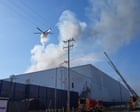
A massive roof fire at a 500,000-square-foot warehouse in Los Angeles just turned a quiet afternoon into an environmental and logistical nightmare. Thick clouds of black smoke blanketed the historic Boyle Heights neighborhood, forcing city officials to issue an emergency shelter-in-place order. While the flames are mostly down, the real story isn't just the smoke. It's the alarming combination of commercial solar panels and industrial refrigeration that made this blaze incredibly dangerous to fight.
The incident unfolded at a sprawling cold storage and freezing facility owned by Lineage logistics on South Los Palos Street. Around 2:35 p.m., more than 110 firefighters rushed to the scene to discover a fire tearing through the facility's extensive roof-mounted solar panel array. What looked like a standard commercial roof fire quickly escalated when a high-pressure line carrying industrial ammonia burst, creating a chemical hazard that forced first responders into a hasty retreat.
The dangerous chemistry of industrial cold storage
When you think of a warehouse fire, you probably picture burning cardboard or plastic pallets. Cold storage facilities are a different beast entirely. Large-scale commercial freezers rely heavily on anhydrous ammonia as a highly efficient, cost-effective refrigerant. While it keeps your frozen foods cold, it poses a severe threat when a building catches fire.
Ammonia is highly toxic to breathe and becomes flammable when mixed with specific concentrations of air. According to Los Angeles Fire Department Chief Jaime Moore, the fire managed to compromise a pressurized ammonia line, causing a massive, high-pressure stream of chemical gas to off-gas into the sky.
The chemical release immediately changed the firefighting strategy. Ground crews trying to scale the building faced dual threats: intense flames from the solar panels and a plume of irritating, toxic gas. Because the sheer volume of fire and gas was overrunning the water supply from standard hand lines, incident commanders ordered everyone off the roof.
To protect the surrounding community, city leaders, including Los Angeles Mayor Karen Bass, issued an immediate shelter-in-place order. The zone stretched south of the 101 Freeway to Washington Boulevard, and east of Soto Street to Indiana Street. Residents were told to stay inside, lock doors and windows, and shut off air conditioning units to keep the ambient toxic air from pulling into their living rooms.
When solar panels fight back against first responders
Solar infrastructure is a great way for massive logistics hubs to cut carbon footprints, but it presents a unique hazard for emergency crews. You can't just flip a switch and turn off a solar panel. As long as the sun is shining, those cells generate high-voltage electricity.
This constant electrical generation creates a massive electrocution hazard for firefighters using metal tools or spraying high-pressure water streams. The physical panels also create an impermeable barrier on the roof. Firefighters couldn't slice holes in the roof structure to ventilate the building or get water directly to the underlying deck, which allowed the fire to spread horizontally across the 500,000-square-foot surface like an uncontained brush fire.
Faced with a roof they couldn't stand on and an active ammonia leak, the LAFD took the rare step of requesting water-dropping helicopters. At least three fire choppers swooped low over the urban neighborhood, making more than half a dozen precise aerial drops. This heavy-duty aerial assault finally subdued the flames on the solar array, preventing the fire from burning down into the main interior storage bays.
A disturbing pattern in California logistics hubs
This isn't an isolated incident. The Boyle Heights fire caps off a rough couple of months for California warehouse infrastructure. Just last week, a massive Medline Industries facility in Tracy was completely destroyed by fire. Back in April, a massive six-alarm blaze wiped out a 1.2-million-square-foot Kimberly-Clark distribution center in Ontario, causing $156 million in property damage.
While the Ontario fire was blamed on an intentional act of employee arson, the rapid succession of these massive warehouse fires highlights the vulnerability of our modern supply chain hubs. When a 500,000-square-foot building goes dark, it creates a ripple effect throughout regional food distribution, customs brokerage, and freight networks.
Local agencies are keeping a close watch on the aftermath. The South Coast Air Quality Management District deployed inspectors to monitor downwind particulate matter, heavy metals, and volatile organic compounds released by the burning solar electronics and plastic housing. Chief Moore also noted a looming concern regarding potential lithium-ion battery banks inside the facility used to store the solar energy, which can trigger an unquenchable chemical fire process known as thermal runaway. Fortunately, no injuries have been reported, and the roof fire was largely contained by Wednesday evening, allowing authorities to lift the shelter-in-place order.
What building owners must do next
If you manage or own a commercial logistics facility with rooftop solar arrays, you need to reassess your emergency readiness before a crisis occurs. Modern green tech requires modern safety planning.
- Review the physical placement of your high-pressure refrigerant lines relative to your solar footings. Ensure there are clear pathways and physical barriers separating chemical infrastructure from electrical components.
- Install visible, clearly mapped rapid-shutdown switches for all rooftop solar strings at ground level to minimize electrocution risks for emergency personnel, even if it can't totally deactivate individual panels.
- Update your facility's emergency response plan with local fire departments so they know exactly where ammonia lines, battery storage rooms, and high-voltage conduits sit before they pull up to the scene.


