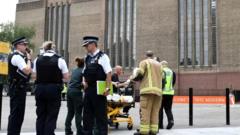
The recovery of a child thrown from the tenth floor of the Tate Modern gallery in 2019 has hit a staggering wall. What began as a miraculous story of survival against impossible odds has shifted into a grueling, stagnant reality. For the young victim, now nearly five years removed from the incident, the "sad step backwards" reported by his family isn’t just a medical fluke. It is a stark reminder of the limitations of modern neuro-rehabilitation when faced with the sheer physics of a 100-foot fall and the complex, compounding trauma of a developing brain.
While early reports focused on the "miracle" of his initial survival and the regaining of basic motor functions, the current situation reveals a much harsher truth. The boy is struggling with increased muscle stiffness, a common but devastating secondary complication known as spasticity, and a plateau in cognitive development that has forced his caregivers to temper their expectations. This is the reality of traumatic brain injury (TBI) that the public rarely sees once the headlines fade. It is not a linear climb toward wholeness, but a jagged, exhausting cycle of progress followed by regression.
The Physiology of a Plateau
Medical miracles are often temporary. In the immediate aftermath of the attack, the focus was entirely on survival—managing brain swelling, fixing broken bones, and stabilizing internal organs. But the human body has a way of settling into its injuries.
When the brain sustains the kind of catastrophic impact seen in this case, the neural pathways are not just bruised; they are often permanently rerouted or destroyed. Spasticity occurs because the damaged brain can no longer send the correct inhibitory signals to the muscles. The result is a constant state of contraction. It is painful. It is restrictive. It turns the simple act of moving a limb into a battle against one’s own nervous system.
The family's recent updates indicate that the boy's progress has stalled specifically because his body is growing. This is a cruel irony of pediatric TBI. As a child’s skeleton grows, their damaged muscles and tendons often cannot keep pace. The physical therapy that worked at age seven may become ineffective or even agonizing at age eleven. This creates a widening gap between the child’s physical potential and their physical reality.
The Hidden Cost of the Long Game
We have a tendency to treat recovery as a finished product rather than a perpetual process. The funding and attention for high-profile victims usually peak in the first twenty-four months. However, for a survivor of a 200-foot drop, the twenty-four-month mark is barely the end of the beginning.
The costs associated with this level of care are astronomical. We are talking about 24-hour supervision, specialized equipment that must be replaced every time the child hits a growth spurt, and a revolving door of specialists ranging from neurologists to occupational therapists. Even with the significant sums raised through public donations, the financial runway is never as long as it needs to be.
There is also the psychological toll on the family unit. To watch a child regain the ability to speak, only to see that speech become slurred or infrequent again, is a specific type of grief. It is a secondary trauma that the healthcare system is poorly equipped to handle. Most rehabilitation programs are designed for "improvement." They are significantly less effective at managing "maintenance" or "mitigation of decline."
The Failure of Public Space Security
The 2019 incident was not just a medical emergency; it was a catastrophic failure of institutional security. The perpetrator, Jonty Bravery, was a young man with a history of violent intent who was effectively allowed to wander a high-traffic tourist destination unsupervised.
The Tate Modern’s subsequent decision to close the viewing platform was a reactive measure, but it highlights a broader issue in how we manage public safety for high-rise architecture. If a space is accessible to the public, the assumption of safety must be absolute. The fact that someone with known, documented psychiatric issues could scout a location and execute a plan to throw a child over a railing suggests a systemic gap in how mental health data intersects with public security.
Why Progress Reverses in Pediatric TBI
In adult patients, the brain is a finished structure. When it is damaged, we know exactly what has been lost. In children, the brain is a work in progress. When a child suffers a TBI, they don't just lose the skills they already had; they lose the "template" for the skills they were supposed to develop in the future.
This is often referred to as "growing into the injury." A child might appear to be doing well in the years immediately following an accident, but as they reach the age where more complex executive functions, social nuances, and physical coordination are supposed to kick in, the damage becomes more apparent. The "step backwards" described by the family is likely the manifestation of this developmental ceiling. The brain has reached the limit of its current compensatory strategies.
To push past this, the medical intervention required isn't just more of the same. It requires aggressive, often invasive procedures. These might include:
- Botox injections to temporarily paralyze spastic muscles.
- Intrathecal Baclofen Pumps, which are surgically implanted to deliver muscle relaxants directly to the spinal cord.
- Selective Dorsal Rhizotomy, a permanent surgery to cut specific nerve fibers.
Each of these options carries significant risk and requires a level of physical resilience that the boy may not currently possess.
The Myth of Full Recovery
The narrative of the "miracle boy" is a comforting one for the public. It suggests that if we care enough and work hard enough, we can undo the effects of gravity and malice. But for those on the front lines of neurology, "full recovery" is a term used with extreme caution, if it is used at all.
Success in these cases is measured in millimeters. Success is the ability to sit up without assistance for ten minutes. Success is a day without a painful muscle spasm. When the family reports a regression, they aren't just being pessimistic; they are providing a realistic assessment of a life defined by a split-second act of violence.
The tragedy at the Tate Modern didn't end when the ambulance arrived, or when the trial concluded, or even when the boy first returned home. It is a permanent, evolving state of being. The "step backwards" is a signal that the current roadmap for his care has hit a dead end, and a new, likely more difficult path must be carved out.
The focus must now shift from the hope of a return to "normal" toward the radical acceptance of a new, highly supported life. The support systems—both medical and financial—need to be as permanent as the injury itself. Anything less is a betrayal of the survival we so loudly celebrated five years ago.
We must stop looking for the end of the story. There is no end. There is only the next day of therapy, the next adjustment of a brace, and the next attempt to find a way through the quiet, relentless struggle of a life interrupted.