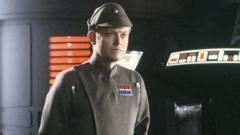
Michael Pennington has died at 82. For a lot of people, he was Moff Jerjerrod, the man sweating under the gaze of Darth Vader in Return of the Jedi. For others, he was the definitive Hamlet of his generation. Losing him feels like losing a bridge between the gritty, high-stakes world of 1980s blockbuster cinema and the prestige of the Royal Shakespeare Company. He wasn't just a face on a trading card. He was a powerhouse of the British stage who understood how to bring gravitas to every single frame he occupied.
Whether you knew him from the bridge of the Death Star or from a rain-soaked stage in Stratford-upon-Avon, his impact was undeniable. He belonged to a rare breed of actors who could make a sci-fi villain feel human and a 400-year-old play feel like it was written yesterday.
Beyond the Imperial Uniform
Most casual fans remember him for the frantic energy he brought to the second Death Star. It’s a thankless job, playing an Imperial officer. You’re usually there to get choked or look terrified. But Pennington brought something else to Jerjerrod. He played him with a sense of genuine, mounting anxiety that made the stakes of the film feel real. He wasn't just a cardboard cutout villain. He was a middle manager in a galaxy-spanning dictatorship, realizing he was never going to meet his construction deadlines.
That role stuck with him. He often spoke about the strange, enduring fame that came with Star Wars. It’s a weird life when a few weeks of filming in 1982 results in decades of fan mail. He handled it with grace. He understood the joy that world brought to people, even if his heart truly lived in the theatre.
A Shakespearean Titan
You can't talk about Pennington without talking about the RSC. He co-founded the English Shakespeare Company in 1986. That wasn't just a career move. It was a statement. He wanted to strip away the stuffiness of the classics and make them move. He wanted them to breathe.
His 1980 performance as Hamlet is still talked about in hushed tones by theatre historians. He didn't play the Prince of Denmark as a moping teenager. He played him with a sharp, dangerous intellect. You felt like this was a man who could actually take down a kingdom if he just got out of his own head for five minutes.
His work with Michael Bogdanov changed how Britain viewed its national playwright. They took Shakespeare on massive tours, hitting places that hadn't seen a professional production in years. They made it accessible. They made it loud. They made it matter.
The Art of the One-Man Show
Pennington was a master of the solo performance. His show Anton Chekhov was a masterclass in minimalism. He toured it for years, literally all over the world. He didn't need a massive set or a cast of thirty. He just needed a chair and his own deep understanding of the human condition.
That's the mark of a true craftsman. He didn't rely on CGI or elaborate costumes to tell a story. He relied on his voice and his presence. If you ever saw him live, you know what I'm talking about. He had a way of making a massive theater feel like a private living room.
Why His Passing Matters Now
We're in an era of "content." Everything feels disposable. We get a new Marvel movie every six months and a dozen streaming shows every week. Actors like Pennington remind us of what's missing. They remind us of the discipline of the craft.
He didn't do it for the "brand." He did it because he had something to say. He was a writer, too. His books about his roles—like User’s Guide to Hamlet—are essential reading for anyone who actually wants to understand acting. He didn't keep his secrets to himself. He shared them.
The Career Lessons from a Master
If you're an artist or even just someone who appreciates good work, look at how he handled his career. He balanced the commercial with the personal. He took the big paycheck roles but used that stability to fund the art he actually cared about.
- He never looked down on the material. Whether it was a soap opera or a Greek tragedy, he gave it 100%.
- He understood the power of collaboration. Founding a company is hard. It takes ego-management and grit.
- He kept learning. He was still taking on massive roles well into his 70s and 80s.
We don't see many careers like this anymore. It’s too easy to get pigeonholed. But Pennington refused to stay in one lane. He was a writer, a director, an actor, and a mentor.
Go watch Return of the Jedi tonight. Look at his face when Vader tells him the Emperor is coming. That’s not just acting; that’s a man who spent decades learning how to communicate pure, unadulterated dread. Then, if you can find it, look up clips of his Lear or his Oedipus. See the range. See the life. That's the legacy. That’s the standard. We won't see his like again soon. If you want to honor him, go buy a book of Chekhov's stories or finally read that Shakespeare play you've been avoiding. He would have liked that.