A sound is a vibration in the air. A word is a sound with a shadow. When we speak, we aren't just moving our lips; we are reaching into a collective attic, pulling out old, heavy tools, and swinging them around. Sometimes, we don't realize how much weight those tools carry until someone starts bleeding.
Consider a university student in London. We will call her Maya. She is twenty-one, idealistic, and her heart is currently a bruised fruit because of the images she sees on her phone every night. She stands in a crowded square, her breath misting in the cold air, and she shouts a phrase that feels like a heartbeat to her. Across the street, an older man named Isaac stands frozen. To him, that same phrase is not a heartbeat. It is the sound of a closing door. It is the sound of a grandfather's suitcase hitting the floor in 1944. It is an ending.
They are looking at the same syllables, but they are living in different centuries.
The phrases "From the river to the sea" and "Globalise the intifada" have become the acoustic borders of a war that is being fought as much in our vocal cords as it is on the ground. To understand why they have become so radioactive, we have to look past the dictionary definitions and into the ghosts that haunt the words.
The Geography of a Dream
"From the river to the sea, Palestine will be free."
On paper, it sounds like a geographical description. The Jordan River to the East, the Mediterranean Sea to the West. It describes a sliver of land roughly the size of New Jersey. For Maya, the phrase is an anthem of liberation. It represents a singular, secular state where everyone—Muslim, Jew, Christian—lives under one flag with equal rights. To her, it is the rejection of walls, checkpoints, and the tiered citizenship that defines the current reality. It is a vision of a "decolonized" future.
But for Isaac, the geography is a map of erasure.
The state of Israel sits exactly between that river and that sea. If Palestine is "free" across that entire expanse, Isaac asks, where does Israel go? In his mind, the phrase is a coded command for the dismantling of the world’s only Jewish state. He hears the echoes of 1948 and 1967, when Arab leaders spoke openly of "driving the Jews into the sea." To him, the rhyme doesn’t hide the threat; it sharpens it.
This is the central friction of the modern discourse. One side sees a vision of inclusion; the other sees a blueprint for expulsion. The history of the phrase is just as tangled. It was adopted by the Palestine Liberation Organization (PLO) in the 1960s, a time when their charter explicitly called for the end of the Zionist entity. Later, in the 1980s, Hamas—a group whose founding document was thick with anti-Semitic tropes—adopted the slogan as well.
Yet, as decades passed, the phrase migrated. It moved into the mouths of Western activists who had never read a PLO charter. For them, it became a generic shorthand for "end the occupation."
Does the intention of the speaker matter more than the history of the word? If I use a tool to build a house, but you recognize that tool as the one used to burn your father’s house down, who is right? The answer is usually both, and that is why the air in our cities feels so heavy.
The Shiver of the Shaking
If "From the river to the sea" is a debate about maps, "Globalise the intifada" is a debate about blood.
The word intifada literally translates from Arabic as "shaking off." It evokes the image of a dog shaking water from its coat—a natural, desperate reaction to a weight that shouldn't be there. In the late 1980s, the First Intifada was characterized largely by civil disobedience, strikes, and youths throwing stones at tanks. It was a David-and-Goliath narrative that captured the world's sympathy.
Then came the Second Intifada in the early 2000s.
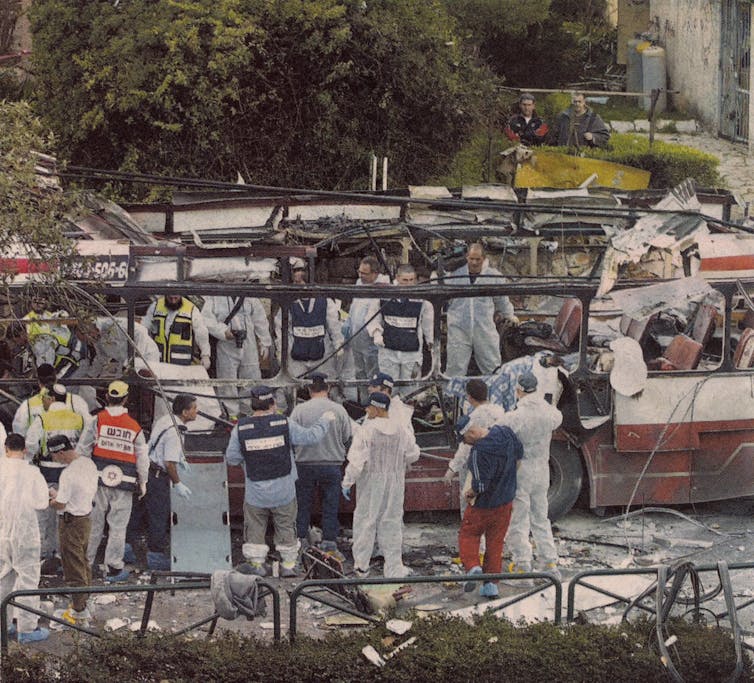
For anyone who lived through those years in Jerusalem or Tel Aviv, the word intifada isn't a political concept. It is a sensory memory. It is the smell of burnt upholstery on a Number 18 bus. It is the sound of a café window shattering. It is the panicked phone calls to family members that go unanswered for thirty seconds that feel like thirty years. Over 1,000 Israelis and 3,000 Palestinians died in that spasm of violence, many of them in suicide bombings targeting civilians.
When a protester shouts for a "global" intifada, they might think they are calling for a global movement of resistance, a worldwide "shaking off" of systemic oppression. They see it as a call to protest, to boycott, to rise up against the status quo.
But to the person walking past them, the word is a trigger for a specific kind of trauma. To "globalize" that experience is to suggest that the tactics of the Second Intifada—the targeting of ordinary people in the places they live and eat—should be exported to the streets of New York, Paris, and London. It sounds like an invitation to a hunt.
The Architecture of Fear
Language is not a vacuum. It is an ecosystem. When these phrases enter the public square, they don't just sit there; they interact with the people who hear them.
Psychologists talk about "schema"—the mental frameworks we use to organize information. If your schema for the Middle East is built on the history of 19th-century colonialism, you will hear "liberation" in these slogans. If your schema is built on the history of the 20th-century Holocaust and the subsequent displacement of Jews from Arab lands, you will hear "annihilation."
We are asking words to do too much work. We are asking eight-word slogans to carry the weight of seventy-five years of displacement, three millennia of religious longing, and the immediate, screaming grief of mothers on both sides of a border.
The problem is that slogans are designed to be sharp. They are designed to cut through the noise. But in cutting through the noise, they often cut through the possibility of empathy. They turn the "other" into a silhouette.
Maya thinks Isaac is a paranoid oppressor who refuses to see her humanity. Isaac thinks Maya is a radicalized zealot who wants him dead. Neither of them is listening to the words; they are listening to their own fears projected back at them through a megaphone.
The Invisible Stakes
Why does this matter so much? Why are we arguing over syllables when people are dying?
Because the words we use determine the solutions we are willing to accept. If you believe the goal is a single state "from the river to the sea," then the two-state solution is not a compromise; it is a betrayal. If you believe the phrase is a call for genocide, then any protest using it is not an exercise in free speech; it is a hate crime.
The stakes are the very fabric of our shared reality. When we lose a common language, we lose the ability to negotiate. We are left with a zero-sum game where one person’s freedom is another person’s funeral.
Consider the power of a single word change. In some circles, activists have begun saying "From the river to the sea, all people shall be free." Those three extra words—all people shall—change the vibration of the sentence. They attempt to bridge the gap between Maya’s dream and Isaac’s fear. They acknowledge that there are two peoples living between that water and that land, and neither is going anywhere.
But those versions rarely make it onto the posters. They don't scan as well. They don't have the rhythmic punch of the original. We sacrifice nuance for cadence, and in doing so, we sharpen the sword.
The Ghost in the Room
There is a silence that follows these chants. It is the silence of the people who are too exhausted to shout.
In a small apartment in Gaza, a father tries to find clean water for his daughter. He doesn't care about the slogans being shouted in London. He wants the sky to stop screaming. In a small house in an Israeli border town, a mother looks at the empty chair where her son used to sit. She doesn't care about the academic definition of "decolonization." She wants the hole in her heart to stop growing.
The phrases we argue about are often luxuries of the distant. We use them to signal our virtue or our victimhood from the safety of a sidewalk thousands of miles away. We treat the conflict like a sports match where we must choose a jersey and a chant, forgetting that the "players" are human beings whose lives are being dismantled in real time.
When we shout "Globalise the intifada," we are rarely the ones who will have to live through the "shaking." When we demand a specific map from the comfort of a different continent, we are rarely the ones who will have to figure out how to share a kitchen with our enemy.
The words are ghosts. They represent the spirits of the past—the Nakba, the Holocaust, the 1967 war, the suicide bombings—refusing to stay buried. They haunt our present because we haven't yet found a way to honor the pain of the past without letting it dictate the geometry of the future.
We are trapped in a linguistic loop. We use words to demand justice, but those same words inflict fresh trauma. We use words to demand safety, but those same words sound like a threat to the person next to us.
The air vibrates. The shadows grow.
Until we find a way to speak that doesn't require the erasure of the person listening, the river and the sea will remain not a sanctuary, but a divide. The intifada will not be a shaking off of oppression, but a shaking of the foundations of our common humanity. We are standing in the attic, swinging the old, heavy tools, wondering why the house is falling down around us.
The student lowers her megaphone. The man turns his head. For a brief, flickering second, their eyes meet across the pavement. In that moment, there are no slogans. There is only the terrifying, inconvenient realization that they are both afraid, and they are both breathing the same cold air.
The silence that follows is the only thing that actually belongs to both of them.