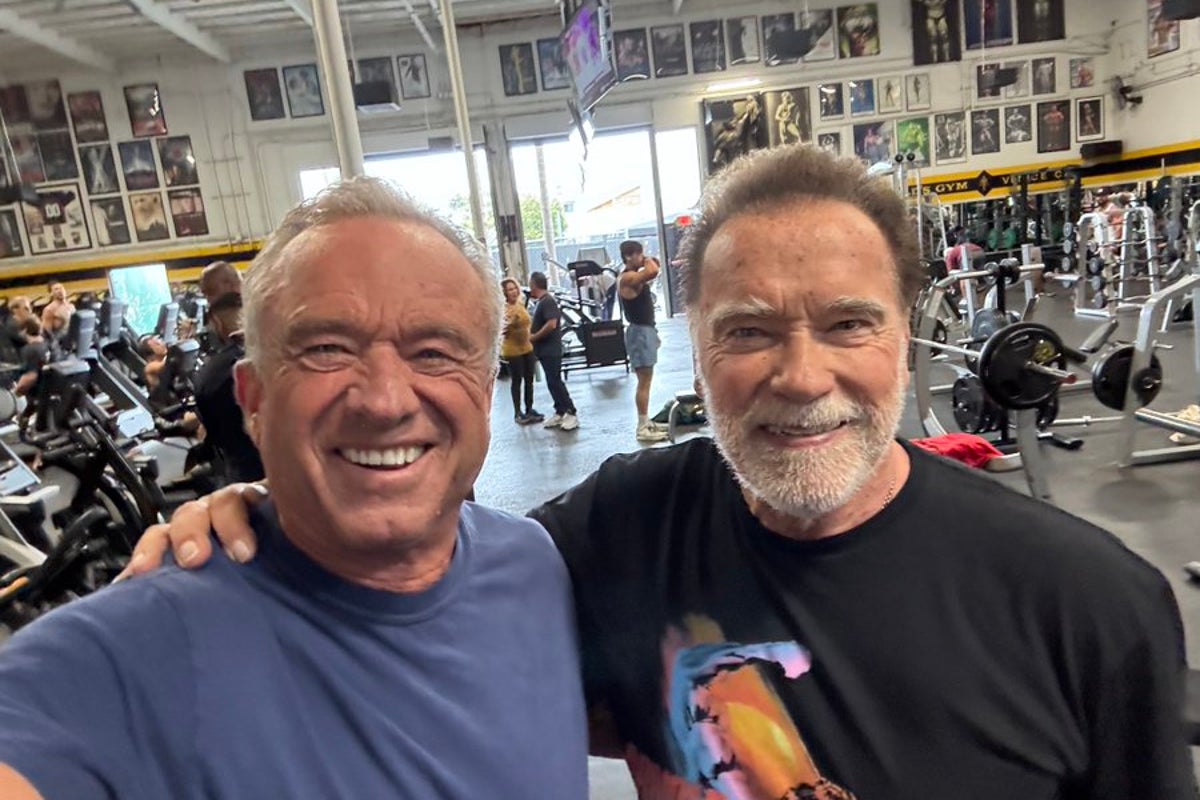
When Robert F. Kennedy Jr. posted a photo of himself training alongside Arnold Schwarzenegger at Gold’s Gym in Venice Beach, the internet treated it as a viral curiosity. Two aging icons, shirts off, hitting the weights in the "Mecca" of bodybuilding. But looking past the bicep curls and the "Senior’s Day" caption reveals a calculated fusion of two distinct American legacies. This was not just a workout. It was a high-stakes branding exercise designed to signal vitality, defiance, and a specific brand of hyper-masculine political independence.
Kennedy, currently the most disruptive force in the 2024 presidential cycle, is using physical fitness as a blunt instrument. By aligning himself with Schwarzenegger—the man who literally defined the modern aesthetic of the American male—Kennedy is attempting to bridge the gap between his Camelot roots and a modern, populist electorate that equates physical strength with the capacity to lead.
The Cultural Capital of Gold’s Gym
Gold’s Gym in Venice is not just a place to sweat. It is a cathedral of the physical. For Schwarzenegger, it is the site of his origin story, the place where he transformed from an Austrian immigrant into a global powerhouse. For Kennedy, appearing there is an endorsement of the rugged individualism that Schwarzenegger has championed for decades.
In the world of political optics, every background detail matters. The gritty, utilitarian aesthetic of Gold’s Gym serves as a stark contrast to the polished, sterile environments usually inhabited by Washington elites. By choosing this setting, Kennedy signals that he is comfortable in the trenches of Middle America’s aspirations, even if those trenches are located in prime California real estate. He is positioning himself as the "outsider" candidate who hasn't forgotten how to do the heavy lifting.
Schwarzenegger’s presence provides a layer of bipartisan armor. Though a Republican, the former "Governator" has often clashed with the modern direction of his party, much like Kennedy has broken ranks with the Democratic establishment. Their alliance in the weight room suggests a coalition of the fit and the frustrated—a demographic that cares less about party lines and more about perceived competence and vigor.
The Weaponization of Vitality
We are currently witnessing the most elderly presidential field in United States history. Age is no longer just a number; it is a primary campaign vulnerability. Kennedy is twenty years younger than the frontrunners, and he spends every available moment reminding the public of that fact.
His strategy is visceral. While other candidates release doctor's notes or carefully staged videos of themselves walking briskly to a podium, Kennedy is doing pull-ups on camera. The workout with Schwarzenegger is the ultimate escalation of this tactic. It exploits a primal human instinct: the tendency to associate physical health with mental acuity and decisiveness.
Critics argue that this is a distraction from policy, a "bodybuilding populism" that favors aesthetics over substance. However, in an era of TikTok clips and three-second attention spans, the image of a 70-year-old Kennedy keeping pace with a 76-year-old Schwarzenegger is more persuasive than a hundred white papers. It speaks to a desire for a "protector" figure—someone who looks like they could withstand the rigors of the Oval Office without breaking.
The Schwarzenegger Factor and the Independent Path
Arnold Schwarzenegger’s career has been a masterclass in shifting lanes. He moved from sports to cinema to the governorship of the world’s fifth-largest economy. He understands, perhaps better than anyone, how to leverage a personal brand into political power.
By hosting Kennedy, Schwarzenegger is not necessarily endorsing his specific policies on vaccines or the environment. Instead, he is endorsing the type of man Kennedy represents: the self-made, physically disciplined disruptor. This is a subtle but powerful distinction. Schwarzenegger has long advocated for "post-partisan" politics, and Kennedy’s campaign is the current vessel for that sentiment.
There is also the historical weight of the Kennedy family connection. Schwarzenegger was married to Maria Shriver, Robert F. Kennedy’s niece, for 25 years. Despite the divorce, the ties to the Kennedy clan remain a fundamental part of Arnold’s American identity. This workout was a family reunion of sorts, but one staged for a national audience to remind them of a time when the Kennedys were the undisputed titans of American life.
The Risks of the Muscle Aesthetic
While the "Senior’s Day" photo was a hit with Kennedy’s base, it carries inherent risks. There is a fine line between "fit" and "obsessive." Some voters view the focus on shirtless workouts as a sign of vanity or a lack of seriousness. It risks alienating the very "average" voters Kennedy needs to win over—those who don't have three hours a day to spend at Gold’s Gym.
Furthermore, the association with Schwarzenegger brings its own baggage. Arnold’s legacy is complicated by his own political controversies and personal scandals. For Kennedy, who is already fighting an uphill battle against mainstream media narratives, aligning with a "celebrity" politician can reinforce the idea that his campaign is more performance art than a serious bid for the presidency.
Fitness as Policy
Kennedy has attempted to frame these workouts as part of a broader platform on "making America healthy again." He frequently cites the rising rates of chronic disease, obesity, and the perceived "softness" of the American public. In this context, the gym session with Arnold is a live-action demonstration of his proposed solutions.
He isn't just talking about health; he is living it. This approach resonates with a growing "wellness" subculture that is increasingly skeptical of corporate medicine and government health mandates. By standing next to Schwarzenegger, Kennedy isn't just a politician; he is a peer to the bio-hackers, the CrossFitters, and the health-conscious skeptics who feel ignored by the current political establishment.
The Mechanics of the Viral Moment
The "Senior's Day" post didn't happen by accident. It was timed to capitalize on a lull in the traditional news cycle, ensuring maximum pickup by lifestyle and entertainment outlets that usually ignore political coverage. This is how Kennedy bypasses the traditional gatekeepers. He creates content that is too visually compelling for editors to ignore, even if they disagree with his politics.
The photo itself is a study in lighting and angles. The harsh overhead lights of Gold’s Gym accentuate muscle definition, making both men look remarkably durable for their age. It is an image designed to be shared, memed, and discussed. It forces the viewer to acknowledge Kennedy's physicality before they even think about his platform.
Breaking the Traditional Campaign Mold
Modern campaigns are usually managed to the point of exhaustion. Every word is polled, and every appearance is sanitized. Kennedy’s willingness to sweat, grimace, and joke around in a public gym breaks that mold. It feels authentic, even if it is just as choreographed as a stump speech.
This authenticity is his greatest weapon. In a political "landscape" (to use a term I’ll avoid, let’s say environment) where everything feels fake, the sight of two old lions grinding out reps feels real. It taps into a nostalgia for a more rugged, less complicated era of American masculinity.
The workout at Gold’s Gym wasn't about fitness advice. It was about power. Specifically, it was about the transition of power from the institutional elite to the individual. Kennedy is betting that the American people are tired of "frail" leadership and are looking for someone who can physically stand his ground.
The End of the Gym Session
As the cameras stopped clicking and the two men finished their sets, the message had already been delivered. Kennedy didn't need to give a speech. The image of him standing shoulder-to-shoulder with the Terminator said everything his campaign team wanted the public to hear.
The strategy is clear: out-hustle, out-lift, and out-last the competition. Whether this translates into votes remains to be seen, but for one afternoon in Venice Beach, Robert F. Kennedy Jr. successfully hitched his wagon to the most powerful fitness brand in history. He didn't just share a workout; he laid claim to a legacy of strength that many Americans feel has been lost.
Pick up the heaviest weight in the room and see who is still standing when the set is over.