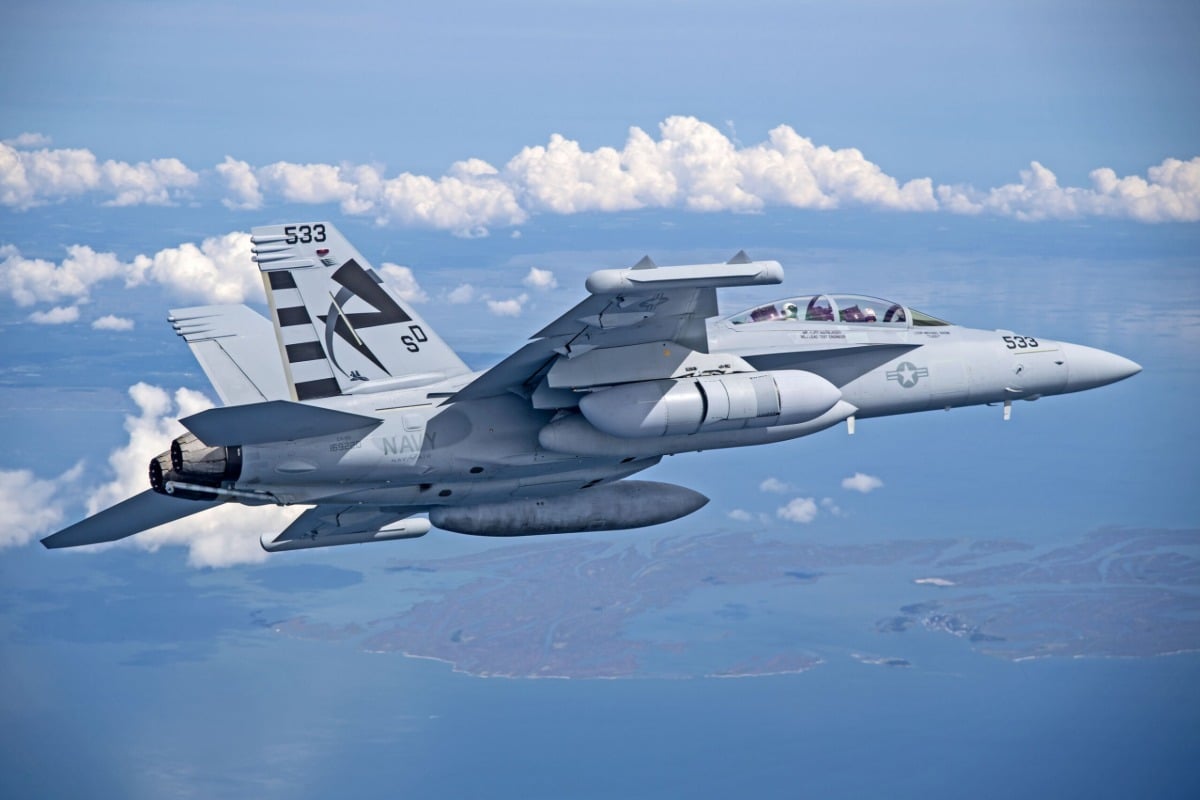
The modern cockpit is a deceptively quiet place. If you sit in the flight deck of an EA-18G Growler, thousands of feet above an ocean, the overwhelming sensation is one of isolated stillness. You hear the steady, rhythmic hum of the twin engines. You feel the faint vibration through your flight suit. Beyond the canopy, there is only an endless expanse of gray clouds and blue horizon.
But step inside the mind of the electronic warfare officer sitting in the back seat, and that peaceful sky transforms into a crowded, blindingly chaotic battlefield.
To the human eye, the airspace is empty. To the jet’s sensors, it is choked with a dense, suffocating web of invisible energy. Enemy radar waves are constantly painting the aircraft, searching for a reflection. Surface-to-air missile batteries on the ground are whispering to one another in digital code, calculating vectors, preparing to fire. Cell towers, military communications, and localized GPS signals crisscross the atmosphere in a tangled mess of frequencies.
In this unseen arena, the weapon that matters most is not a missile or a bomb. It is a signal. And right now, the United States Navy is quietly doubling down on the technology meant to control those signals before they turn deadly.
The Pentagon recently made a massive logistical pivot, moving to extend Raytheon’s contract for the Next Generation Jammer. On paper, it looks like standard defense bureaucracy—a routine extension of timelines and funding for a major military contractor. In reality, it is a high-stakes admission that the nature of warfare has shifted entirely. The military that wins the next major conflict will not be the one with the loudest explosions. It will be the one that commands the electromagnetic spectrum.
The Death of the Stealth Illusion
For decades, American military supremacy relied on a single, intoxicating promise: invisibility. The advent of stealth technology allowed aircraft like the B-2 bomber and the F-117 Nighthawk to slip through enemy airspace undetected, ghosting past radar grids like vapor. We built an entire generational strategy around the idea that if the enemy cannot see you, they cannot kill you.
That era is over.
Radar technology did not stand still. Today, potential adversaries possess advanced, multi-static radar networks that operate across various frequency bands. They can spot the faint disturbances left by stealth aircraft. They can track the thermal signatures. They can piece together fragmented data to paint a target profile. The blanket of invisibility has worn thin.
Consider a hypothetical scenario, but one that keeps naval planners awake at night. A strike group is operating in contested waters. A squadron of fighter jets is dispatched to neutralize an anti-ship missile site hidden deep inland. Twenty years ago, stealth alone might have gotten them to the target. Today, the moment they cross the coastline, a network of highly adaptive digital radars begins tracking their approach.
If those radars remain online, the mission fails. The pilots die.
The only way to survive is to blind the enemy. This is not done by destroying the radar dish with a missile—at least, not initially. It is done by flooding the enemy’s receivers with so much precisely targeted digital noise that their screens look like static on an old analog television.
This is the job of the Next Generation Jammer, or NGJ. When the Navy extends a contract like this, they are not just buying more hardware. They are buying time to perfect an incredibly complex form of digital alchemy.
The legacy jamming pods carried by the Navy's fleet have been working overtime for decades. They are analog systems designed in an era when enemy threats were static. If an adversary changed the frequency of their radar, a technician on the ground had to manually reprogram the jamming pod before the next flight.
That delay is a luxury the modern world no longer allows. Today’s threat systems are software-defined. They can alter their frequencies, waveforms, and pulse rates in milliseconds, dancing across the spectrum to evade jamming efforts. To fight a software-defined threat, you need a software-defined weapon.
Anatomy of an Invisible Shield
The technology Raytheon is building for the Navy is split into different increments, each targeting a specific slice of the electromagnetic spectrum. The mid-band system focuses on the frequencies most commonly used by surface-to-air tracking radars and fighter aircraft. The low-band system deals with early-warning radars that scan vast distances.
To understand how complex this is, imagine standing in a crowded, cavernous stadium where ten thousand people are all shouting different phrases at the top of their lungs. Your task is to listen to the chaos, identify one specific person whispering a secret password across the arena, and then scream a perfectly pitched counter-phrase that drowns out only that person's voice, without interrupting anyone else.
Now imagine doing that while traveling at the speed of sound.
The NGJ relies on Active Electronically Scanned Array technology. Instead of pointing a single, heavy dish at a target, the pod uses an array of hundreds of tiny solid-state transceivers. These transceivers can steer multiple beams of radio energy simultaneously, focusing intense, concentrated power directly at enemy radar receivers.
It is a masterpiece of engineering, but it is also a nightmare to finalize.
The physics of electronic warfare are unforgiving. Generating that much radio frequency power creates immense amounts of heat. If the pod gets too hot, the internal electronics fry, and the jet becomes a multi-million-dollar target. The pods have to be self-powered, using a small, ram-air turbine that spins in the slipstream of the jet to generate its own electricity.
When the Navy extends a contract, it is usually a sign that the bridge between theoretical physics and battlefield reliability is harder to cross than anyone anticipated. Software bugs must be ironed out. Power generation must be stabilized. The integration between the pod and the aircraft’s onboard computers requires thousands of hours of flight testing.
Every delay is met with scrutiny from lawmakers and budget analysts. It is easy to look at the mounting costs and extended deadlines and see a broken procurement system. But the alternative is far worse. Deploying a system that works ninety percent of the time means that in a conflict, ten percent of your pilots do not come home.
The Human Toll of the Silent Spectrum
We easily romanticize kinetic warfare. We understand the drama of a dogfight, the arc of a cruise missile, the tension of a submarine hunt. These are things we can see. They fit neatly into the visual language of evening news broadcasts and cinematic retellings.
Electronic warfare is frustratingly abstract. You cannot see a jamming beam. You cannot watch a software algorithm outsmart a surface-to-air missile radar. Because it is invisible, it is frequently misunderstood, underfunded, and overlooked by the public.
But talk to the people who fly these missions, and the abstraction vanishes.
The aviators who operate these systems know that they are the ultimate insurance policy for every other asset in the theater. When a carrier strike group moves into a high-threat environment, the electronic warfare aircraft are the first to launch and the last to recover. They fly toward the danger, intentionally emitting massive amounts of radiation, essentially shouting, Look at me, not at them.
If their equipment fails, the entire strike force is exposed.
The decision to extend the Raytheon contract is a direct reflection of geopolitical anxiety. The strategic focus has shifted away from counter-insurgency operations in regions with no air defense capabilities. The focus is now on vast oceanic expanses where sophisticated nation-states possess dense, layered defense networks.
In these environments, air superiority is no longer a given. It must be fought for, second by second, in the invisible code running through pods slung beneath the wings of navy jets.
The extension of this contract tells us that the military is choosing thoroughness over speed. They are recognizing that rushing a flawed digital shield into service is a catastrophic gamble. They are willing to endure the political heat of extended timelines to ensure that when an electronic warfare officer flips a switch in the back seat of a Growler, the sky goes completely dark for the enemy.
The silent war for the spectrum shows no signs of slowing down. As software evolves, the code will become more complex, the frequencies will shift faster, and the stakes will grow higher. The country that falls behind in this invisible race will find itself blind in the next conflict, realizing too late that the most dangerous weapons are the ones you never see coming.
The engines of the Growler will keep humming. The pilots will keep scanning the empty horizon. And underneath the wings, the pods will continue their quiet, vital work, holding the line between a successful mission and disaster, one invisible beam of energy at a time.