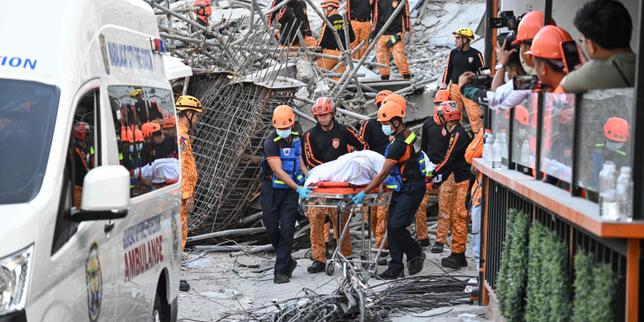
A nine-story building under construction in Angeles City, Philippines, collapsed in the early morning hours of May 24, 2026, killing a 65-year-old Malaysian tourist in an adjacent lodging house and leaving over 20 workers trapped or missing beneath a mountain of pulverized concrete and twisted steel.
The structural failure occurred around 2:30 a.m. in the crowded entertainment district of Barangay Balibago, 80 kilometers north of Manila. While 26 individuals have been pulled from the debris alive, including two workers pinned under heavy beams, the catastrophic failure of a mid-rise project points to systemic regulatory oversights, rushed commercial development, and the deadly consequences of compromised construction materials in regional economic hubs.
The Midnight Rumble in Balibago
Disaster strikes when accountability is asleep. When the nine-story structure pancaked, it did not just bury the laborers who were sleeping on the ground floor to save on rent. It sheared off the side of an adjacent apartelle, crushing Mohd Rezal bin Abdullah, a tourist from Sabah, Malaysia, who spent his final hours communicating with rescuers via mobile phone before succumbing to his injuries.
Initial local government reports attempted to blame a fierce nocturnal thunderstorm. Heavy rain and high winds undoubtedly add stress to an uncompleted frame. Yet, buildings engineered to standard do not implode because of a standard tropical downpour.
Angeles City Mayor Carmelo Lazatin II has since shifted focus, ordering a complete forensic audit into the building's soil testing data and material composition. Over 700 rescue personnel from the Bureau of Fire Protection, the military, and the Metropolitan Manila Development Authority are currently using thermal drones, life monitors, and listening devices to locate the remaining missing souls. The physical site is profoundly unstable. Huge chunks of fractured slab rest upon weak scaffolding, turning the recovery process into a high-stakes engineering puzzle where one wrong move could trigger a secondary collapse.
The Boomtown Blindspot
To understand why this happened, look past the rubble and look toward the local economy. Angeles City, once dominated by the presence of Clark Air Base until the early 1990s, has transformed into a hyper-kinetic commercial center. The adjacent Clark Freeport Zone attracts immense foreign capital, logistics hubs, and an influx of international travelers. This economic surge has created an insatiable demand for real estate.
Hotels, spas, cafes, and mid-rise residential properties are springing up overnight across narrow, historic neighborhoods like Balibago.
Angeles City Construction Boom Indicators
┌───────────────────────────┬────────────────────────────────────────┐
│ Economic Driver           │ Real-World Structural Impact           │
├───────────────────────────┼────────────────────────────────────────┤
│ Clark Freeport Spillovers │ Unprecedented demand for rapid lodging │
│ Compressed Timelines      │ Concrete curing times ignored or cut   │
│ Fragmented Subcontracting │ Diluted accountability across trades   │
└───────────────────────────┴────────────────────────────────────────┘
When speed becomes the primary metric of success, engineering rigor is frequently the first casualty. In the scramble to cash in on the tourism and industrial boom, the local construction ecosystem has outpaced the municipal regulatory mechanisms designed to keep it in check.
The Chemistry of Failure
A structural failure of this magnitude rarely has a single root cause. It is almost always a compounding series of failures. Veteran forensic engineers look closely at three main vulnerabilities when a concrete frame pancakes before completion.
Poor Quality Aggregate and Substandard Steel
The Philippines has long battled a black market for substandard building materials. Smuggled or poorly manufactured steel rebar lacks the required tensile strength to hold up multi-story loads. Worse, concrete mixes are regularly diluted with excess water or improper sand-to-cement ratios on-site to stretch margins, resulting in a compound that looks solid but possesses only a fraction of its rated load-bearing capacity.
Foundations on Unstable Ground
Balibago is densely packed, with new buildings frequently wedged into tight slots between older structures. If proper soil testing is skipped, or if the foundation is not engineered to handle the specific load-bearing capacity of the local water table and soil strata, the earth shifts. A heavy rainstorm can saturate uncompacted soil, causing a sudden foundation settlement that tears a weak frame apart within seconds.
The Scaffolding and Shoring Illusion
During construction, a building is at its most vulnerable. The concrete has not yet achieved its full compressive strength. If the temporary shoring and metal scaffolding are removed too early to be used on higher floors, or if they are improperly braced against lateral wind forces, the entire structural matrix becomes a house of cards.
The Regulatory Mirage
The local government has promised a thorough investigation. They will check the permits. They will verify the blueprints. But the uncomfortable truth is that paper compliance in regional provinces is a poor indicator of structural safety.
Local building official offices are understaffed and frequently lack the specialized engineering personnel required to conduct rigorous, unannounced field testing on high-yield commercial sites. Inspections are often reduced to bureaucratic check-boxes performed from an office desk.
Furthermore, the practice of subcontracting dilutes accountability. A primary developer hires a general contractor, who then hires a sub-contractor for concrete work, who subsequently hires a labor broker. When the dust settles, every entity points the finger at the other, leaving the victims and their families trapped in a labyrinth of legal delays. Joamel Angcao, an 18-year-old student whose parents remain trapped beneath the Balibago site after their coffee cart was crushed, represents the real human collateral of this systemic negligence.
A Blueprint for Survival
This tragedy cannot be dismissed as an isolated accident or an act of God. It must serve as a turning point for how the Philippines manages its urban expansion.
Municipalities across Central Luzon must implement immediate, third-party structural audits for all ongoing commercial projects exceeding five stories. Handing this responsibility back to internal municipal engineers who cleared the original permits is an exercise in self-policing that yields no real truth.
Testing laboratories must be deployed directly to construction sites to conduct random core drilling and non-destructive testing on concrete strength. If a developer cannot prove their structural integrity within 48 hours, the project must be shuttered.
The National Building Code of the Philippines, though structurally sound on paper, requires teeth. Penalties for utilizing substandard materials or bypassing mandatory soil mechanics testing must move away from minor financial penalties and toward mandatory prison terms for corporate officers and developers. Until the cost of negligence exceeds the profit of cutting corners, the ground beneath the Philippine construction boom will remain terrifyingly unsafe.


