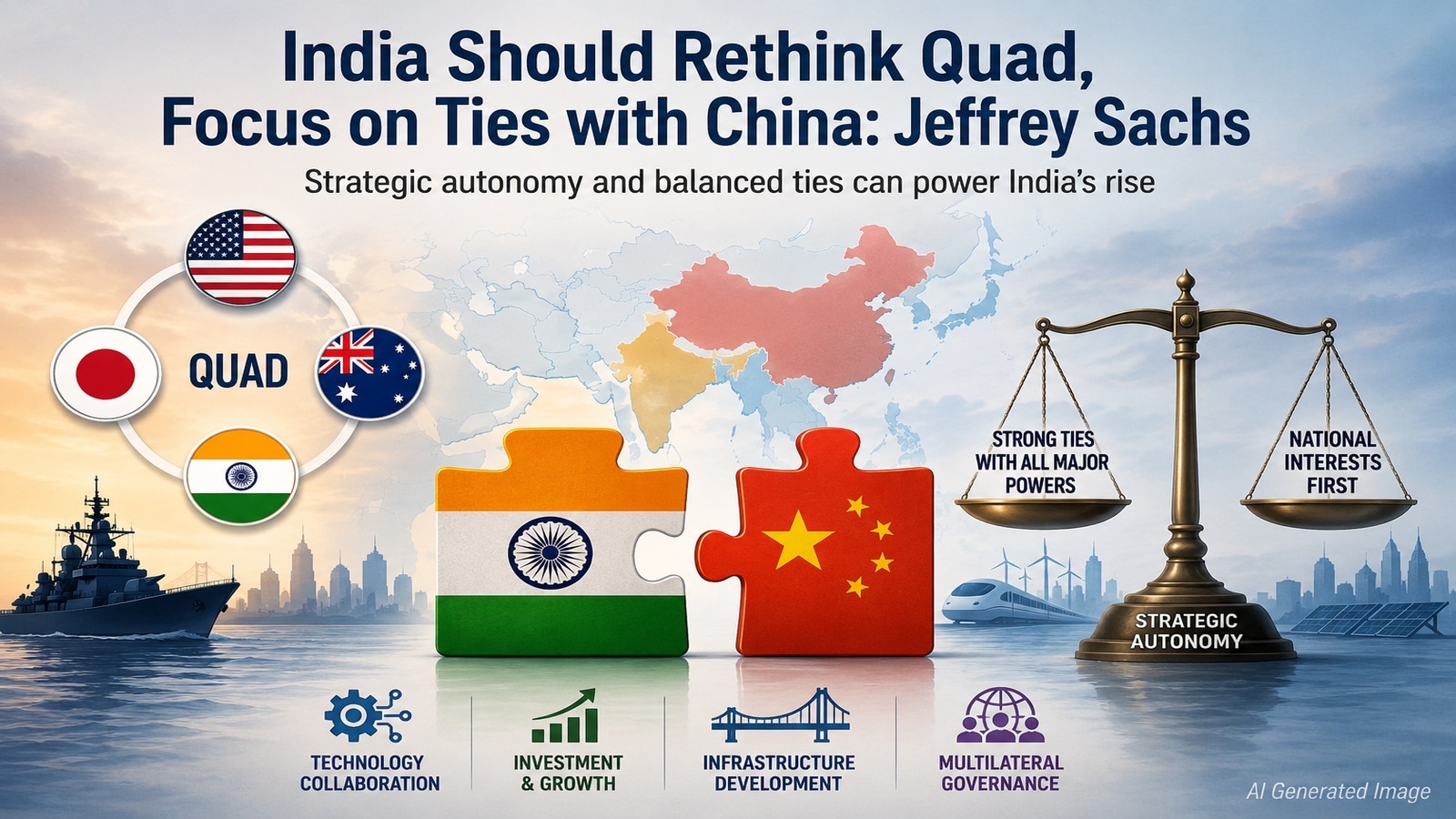
Washington wants you to believe that the Quadrilateral Security Dialogue, or the Quad, is a benign club of democracies keeping the Indo-Pacific free and open. Jeffrey Sachs thinks that's complete nonsense. The prominent American economist and Columbia University professor has a habit of dropping truth bombs that make Western foreign policy elites squirm, and his latest take on India's strategic alignment is no exception.
Sachs is bluntly advising New Delhi to walk away from the Quad, calling the alliance a dangerous American maneuver designed purely to contain and isolate China. For India, a country trying to navigate its own economic rise while managing a tense 2,100-mile border with its northern neighbor, the advice sounds radical. It also happens to strike at the absolute core of India’s biggest geopolitical dilemma: Should it pull closer to the West to counter Beijing, or chart a fiercely independent path?
The reality behind the DC rhetoric is simple. Washington needs India to act as a regional counterweight to China. But Sachs warns that getting dragged into America's geopolitical games will ultimately compromise New Delhi’s autonomy, disrupt its economic growth, and trap it inside a zero-sum conflict that serves Western hegemony rather than Asian stability.
The Quad Is a Trap for Strategic Autonomy
The fundamental issue with the Quad—which brings together the US, Japan, Australia, and India—is that its unwritten mission statement conflicts with India's long-term interests. Washington views the world through a bipolar lens. It's an old habit left over from the Cold War. In that view, you're either with the superpower or against it.
Sachs points out that the US comprises just about 4% of the world's population and roughly 14% of the global economy. Yet, Washington still operates under the delusion that it can dictate terms to the remaining 86%. When Donald Trump imposes sweeping protectionist tariffs or threats of secondary sanctions, it becomes obvious that American foreign policy is inherently self-serving and unpredictable.
Global Share Comparison (Approximate)
=====================================
US Population:       | 4.1%
Rest of the World:   | 95.9%

US Economy (GDP):    | 14%
Rest of the World:   | 86%
By embedding itself deeper into Western security frameworks, India risks trading its legendary strategic autonomy for the illusion of a privileged partnership with Washington. History shows that American alliances are highly transactional. The moment New Delhi’s national interests clash with Washington’s domestic politics—whether on trade protectionism or energy imports from Russia and Iran—the cracks appear. Relying on a volatile partner across the ocean to solve security issues next door isn't a strategy. It's a gamble.
The Myth of Friend Shoring and the China Plus One Illusion
Many Indian policymakers and business leaders look at Washington's aggressive decoupling from China and see a golden ticket. The narrative of "friend-shoring" or the "China+1" strategy suggests that global supply chains will naturally exit Chinese factories and land directly in India.
Sachs dismisses this as a glib slogan masking a harsher economic truth. The US government isn't trying to enrich India; it's trying to protect its own industrial base. If Indian manufacturing scales up to the point where its exports aggressively penetrate American markets, Washington will react with the exact same protectionist tools it used against Beijing. We are already seeing the US apply heavy tariffs on green tech, steel, and aluminum globally, proving that "friendly" nations aren't exempt from American economic nationalism.
More importantly, India’s path to a modern, digital, and green economy requires practical commercial engagement with its immediate neighborhood. China is the undisputed global leader in supply chains for solar panels, electric vehicle batteries, and digital infrastructure components. Trying to build a green transition while completely locking out the world's cheap manufacturing engine is economically illiterate. Cooperation, rather than artificial decoupling driven by Washington's anxieties, offers a far faster route to lifting millions of Indians out of poverty.
Normalizing the Border Is Harder But Essential
The immediate, valid pushback to Sachs’ argument is the line of actual control. How can India normalize relations with a neighbor that actively triggers border standoffs in Ladakh and Arunachal Pradesh? The memory of the 1962 war and recent clashes like Galwan Valley run deep. Trust between New Delhi and Beijing is at a historic low, and China’s refusal to respect territorial integrity makes any talk of cooperation a tough sell to the Indian public.
But a permanent state of hostility only serves to lock India into an expensive, exhausting multi-front defense posture that drains resources away from healthcare, education, and infrastructure. Sachs argues that India and China, together representing nearly 40% of humanity, share a massive, foundational common interest: ending the West’s centuries-long monopoly on global governance.
A realistic path forward requires hard-nosed, bilateral diplomacy completely separate from American influence. Beijing needs to understand that its aggressive border posturing is precisely what pushes India into Washington's arms. If China truly wants a multipolar world, it must take the first step by resolving these border disputes and actively supporting India’s rightful claim to a permanent seat on the United Nations Security Council. A stable Asia cannot be built if its two largest giants are permanently on the brink of war.
Stepping Out of the Superpower Shadow
The real alternative to the Quad isn't submission to Beijing; it's the aggressive expansion of non-aligned multilateralism. Platforms like BRICS and the Shanghai Cooperation Organisation (SCO) allow India to engage with the global south on its own terms. These forums are essential for developing non-dollar payment systems that shield developing economies from the weaponization of the Western financial system.
India is powerful enough to be a pole of its own in a multipolar world. It doesn't need to act as a regional sheriff for an aging superpower trying to maintain global hegemony from 8,000 miles away.
To safeguard its economic future and security, India should focus on concrete, independent actions:
- Diversify Export Markets: Expand trade aggressively across Africa, the Middle East, and Latin America rather than relying entirely on Western consumer markets.
- Insist on Bilateral Border Frameworks: Refuse any third-party mediation or American rhetorical involvement in border disputes with China, treating it strictly as an Asian security matter.
- Drive Non-Dollar Trade Experiments: Build up local currency settlement mechanisms within BRICS to insulate local industries from sudden secondary sanctions or Western banking restrictions.
- Leverage Geography: Focus naval resources on defending the Indian Ocean identity rather than getting entangled in South China Sea disputes that do not directly touch Indian shores.
True security doesn't come from signing up for soft military alliances designed in Washington. It comes from economic resilience, domestic strength, and the freedom to talk to everyone without asking for anyone's permission.
For a broader breakdown of how these shifting global dynamics affect local markets and regional stability, USA Economist Jeffrey Sachs Urges India–China Unity & Keep US Out of Bilateral Talks provides an in-depth look at his original remarks regarding the risks of American interference in Asian diplomatic affairs.