Republican Steve Hilton has officially consolidated his position as the general election challenger for the California governorship, securing second place in the state's top-two primary to face Democrat Xavier Becerra this November. The Associated Press called the race after a protracted week of ballot counting, establishing a stark battle lines between a veteran Democratic insider and a British-born former Fox News host turned populist crusader. Hilton's ascent knocked out billionaire progressive Tom Steyer, who spent over $215 million of his own fortune only to see his campaign collapse in the jungle primary.
While the headline suggests an unpredictable shakeup in America’s most populous state, a deeper look reveals that Hilton’s triumph is less about a conservative awakening and more about a masterclass in modern political branding. This is the story of how an architect of British austerity managed to sell himself as a working-class champion of the American West.
The Reinvention of Downing Street’s Barefoot Strategist
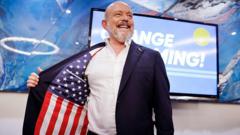
To understand the absurdity and the genius of Hilton’s current political trajectory, one must look back to London in 2010. Long before he was donning a suit jacket lined with the American flag at a watch party in Huntington Beach, Hilton was known in British political circles as the quirky, often barefoot director of strategy for Conservative Prime Minister David Cameron. He was a central figure in rebranding the UK Tory party, pushing a slick mix of environmental consciousness and aggressive fiscal discipline that ultimately led to deep cuts in Britain's public sector.
His transition from a European architect of state contraction to a MAGA-endorsed television personality on Fox News represents a dizzying pivot. Yet, the core strategy remains identical. Hilton has always been a merchant of anti-establishment sentiment, regardless of which establishment he is fighting.
By renouncing his British citizenship and leaning into his status as a naturalized American, he has weaponized his outsider status. In a state where the Republican brand has been toxic for nearly two decades—the GOP has not won a statewide race here since Arnold Schwarzenegger left office in 2011—Hilton realized that a standard partisan playbook was a dead end. Instead, he painted his yellow station wagon, hit the road, and framed himself not as a conservative ideologue, but as a pragmatic immigrant trying to rescue a failed state.
The Financial Demolition of the Billionaire Left
The casualty of Hilton's disciplined, lean campaign was Tom Steyer, whose failed gubernatorial bid brings his total personal political spending over the years to more than half a billion dollars without a single electoral victory to show for it. Steyer attempted to blanket the California airwaves with a progressive populist message, hoping to force an all-Democratic runoff against Becerra.
California Gubernatorial Primary Results (Approximate Vote Share)
+------------------+-----------------------+--------+
| Candidate        | Party                 | Vote % |
+------------------+-----------------------+--------+
| Xavier Becerra   | Democrat              | 27.9%  |
| Steve Hilton     | Republican            | 25.0%  |
| Tom Steyer       | Democrat              | 22.6%  |
+------------------+-----------------------+--------+
Steyer’s defeat proves that throwing endless capital at a saturated media market yields diminishing returns when the electorate is experiencing deep voter fatigue. While Steyer fragmented the progressive base, Becerra quietly consolidated institutional Democratic support, and Hilton cornered the market on dissatisfaction. Hilton didn’t need hundreds of millions of dollars; he needed an angry, motivated core of voters who felt alienated by Sacramento's policy direction.
The Trump Endorsement Double-Edged Sword
Hilton's strategy hinges heavily on the endorsement of Donald Trump, a factor that helped him survive the primary but could paralyze his general election prospects. In the primary, Trump's backing served as an essential megaphone, instantly aligning the state's fractured conservative base behind Hilton's platform of tax elimination and deregulation.
However, California remains a state where registered Democrats outnumber Republicans nearly two-to-one. In recent presidential cycles, the state voted against Trump by massive margins. By fully embracing the former president—even defending the relationship as a way to secure federal funding for California—Hilton has boxed himself into a corner.
He cannot win the governorship on conservative votes alone. To pull off an upset against Becerra, he must win over a significant portion of moderate independents and suburban Democrats who are frustrated by the high cost of living but deeply repulsed by the national GOP platform. Balancing his loyalty to Trump while courting voters who despise Trumpism is an almost impossible legislative tightrope.
The Aggressive Platform and Its Math Problem
Hilton’s campaign promises are explicitly designed to appeal to the financial anxieties of middle-class Californians. His signature proposal is a sweeping tax overhaul.
- Complete elimination of the state income tax on the first $100,000 of earnings.
- A flat tax rate for all income generated above that threshold.
- Rolling back state environmental mandates and expanding domestic oil drilling to lower gas prices.
While these proposals sound attractive to families squeezed by inflation and historic housing costs, the fiscal reality is messy. The state income tax is the lifeblood of California's massive public infrastructure, funding everything from universal healthcare initiatives to public school systems. Hilton has promised an economic analysis to adjust these numbers, but removing the tax burden from a massive segment of the population would create a multi-billion-dollar revenue crater that no amount of deregulation could easily fill.
The Post-Election Voting Bureaucracy Battle
Hilton has already found his next major narrative engine by focusing on California's notoriously slow ballot-counting process. Because the state relies heavily on mail-in ballots that can be postmarked on Election Day, it regularly takes over a week to finalize close races.
Hilton used this lag to pitch his Emergency Election Count Accelerator Plan, demanding strict voter ID laws and a hard cutoff for mail ballot reception. It is a brilliant piece of political theater. It allows him to mirror national conservative talking points about election integrity while tapping into a very real, bipartisan frustration shared by everyday citizens who wonder why the world's fourth-largest economy cannot count pieces of paper in a timely manner.
Facing the Institutional Machine
In November, Hilton will square off against Xavier Becerra, a man who is essentially the human embodiment of the California Democratic apparatus. Becerra has served as a congressman, the state’s attorney general, and the federal Secretary of Health and Human Services. He knows every lever of power in Sacramento and Washington.
"We can't keep voting the same way and expect different results," Hilton declared upon advancing, attempting to frame Becerra as a political relic responsible for the state's homelessness crises and regulatory bloat.
But Becerra's campaign will not be fought on policy granularities. It will be a structural war. The Democratic machine will spend the next five months reminding voters of Hilton’s ties to Fox News, his history with British conservative austerity, and his endorsement by Donald Trump. They will frame Hilton as a foreign transplant trying to import an alien ideology into a progressive sanctuary.
Hilton’s primary victory proves his talent for political reinvention remains sharp, but the math of the Golden State remains unyielding. To turn his yellow station wagon into a vehicle for genuine statewide power, he has to do something far more difficult than winning over the conservative base. He has to convince millions of voters who lean left that the barefoot strategist from London is the only one who can fix their American dream.