The scheduled arrival of Chinese Commerce Minister Wang Wentao in Brussels marks a critical inflection point in a trade conflict that is rapidly outpacing the bureaucratic mechanisms designed to contain it. Officially, the bilateral talks aim to formalize what Beijing smoothly terms a soft landing regarding the European Union's anti-subsidy tariffs on electric vehicles. Beneath the diplomatic veneer, however, lies an uncomfortable reality for European policymakers. The defensive wall erected by Brussels is already failing.
While the European Commission engineered additional duties reaching up to 35.3 percent on top of the baseline 10 percent tariff, the underlying trade dynamics have shifted. The protectionist firewall has not stopped the bleeding. It has merely altered the form of the incoming supply shock.
The Mathematical Failure of Tariff Barriers
Trade statistics reveal that Brussels is playing a lagging game. In April, Chinese electric vehicle brands crossed a historic threshold, capturing more than 15 percent of Europe’s electric vehicle sales. Brand volumes from manufacturers like BYD and Chery doubled year-on-year. The assumption that defensive tariffs would price out Chinese imports neglected the vast structural cost imbalances built into the domestic Chinese manufacturing engine.
Two compounding factors have neutralized the intended friction of the European duties.
- Currency Depreciation: The steady depreciation of the renminbi against the euro over the past eighteen months has effectively neutralized a massive portion of the tariff penalty. When the exchange rate absorbs 10 to 15 percent of a border tax, the retail price impact on consumer goods shrinks significantly.
- Severe Domestic Overcapacity: China’s industrial apparatus is facing a massive manufacturing surplus driven by weak domestic consumer demand and long-term state capitalization. Facing razor-thin margins at home, Chinese factories are forced to treat the European market as an essential volume valve. They can absorb structural losses that would bankrupt a western public company because maintaining production volume is an existential requirement for industrial survival.
The result is a market reality where the price gap remains wider than the regulatory fixes can bridge. In markets like the United Kingdom, which applies no equivalent import penalties, Chinese brands have reached nearly 10 percent of the total automotive market in a remarkably short timeframe. Even within the tariff-bound Eurozone, the pricing pressure remains relentless.
The Component Trap and Invisible Reliance
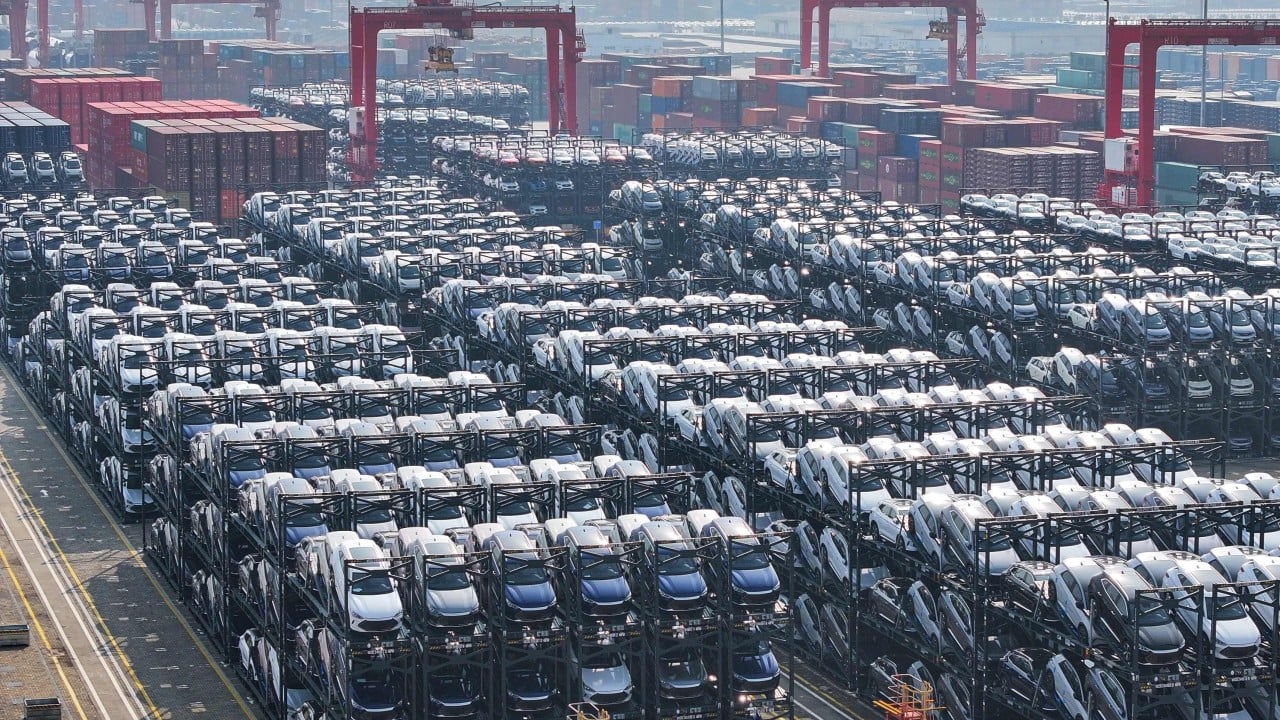
European industrial associations frequently focus on finished goods. This focus misdiagnoses the true vulnerability of Western manufacturing infrastructure. The real lever of economic leverage held by Beijing does not sit in the cargo holds of automotive roll-on/roll-off ships filled with completed SUVs. It resides in the tier-two and tier-three supply chains that feed European factories.
Europe’s dependence on Chinese industrial components has quietly deepened despite the high-profile narrative of de-risking. The European Union relies on China for more than 90 percent of its rare earth element processing. When Beijing restricted the export of these critical minerals for military and dual-use applications, it demonstrated exactly how quickly it could throttle Western industrial production.
+-------------------------------------------------------------------------+
|                  THE TWIN LEVERS OF BEIJING'S STRATEGY                 |
+-------------------------------------------------------------------------+
|  1. THE VOLUME PUNCH                                                    |
|     Sustained manufacturing overcapacity and currency adjustments       |
|     that allow finished goods to absorb tariff penalties.               |
|                                                                         |
|  2. THE SUPPLY THROTTLE                                                 |
|     Monopoly control over intermediate components and rare earth        |
|     refinement, rendering Western factories structurally dependent.     |
+-------------------------------------------------------------------------+
Wang Wentao arrives in Brussels holding both of these levers. The negotiation is not a plea for leniency; it is a presentation of terms. Beijing is offering a structured system of price undertakings—minimum sales prices coupled with voluntary annual quotas—in exchange for the systematic dismantling or suspension of the tariff regime. The European Commission has already set a dangerous precedent by granting exemptions to individual brands, such as Volkswagen’s Cupra Tavascan produced in China, under the guise of specialized pricing agreements. This piecemeal negotiation strategy has effectively fractured the united front that Brussels attempted to present.
Subverting the Wall from Within
The structural failure of European industrial defense is further accelerated by a trend that traditional trade barriers cannot easily address: Western legacy automakers are now actively subverting their own regional protections.
Faced with punishing domestic production costs and a lack of competitive localized supply chains for battery cells, a growing contingent of European, American, and Japanese brands are shifting their manufacturing footprints. Companies ranging from Nissan and Mazda to European industry giants are utilizing their joint-venture facilities inside China to build vehicles destined for export back into the European market.
This creates a bizarre regulatory loop. The European Commission finds itself levying punitive anti-subsidy duties on vehicles commissioned, branded, and sold by its own domestic corporate champions. When the very industry the tariffs were designed to protect chooses to manufacture behind the opponent's lines to capture the benefits of subsidized supply chains, the policy framework ceases to function.
The Long Gap to Legislative Relief
The structural deficits plaguing European industry require immediate, decisive intervention, yet the policy response from Brussels is mired in multi-year bureaucratic timelines. The proposed Industrial Accelerator Act, aimed at boosting domestic green manufacturing, and the upcoming updates to the Cyber Security Act designed to allow the exclusion of Chinese technology on national security grounds, look solid on paper.
They do not exist in reality. Neither framework will enter into full force until 2027 at the earliest.
This leaves an extensive regulatory gap during which the current market trends will solidify permanently. European member states lack the political appetite to engage in another grueling round of tariff negotiations. The capital, political will, and bureaucratic energy expended to pass the current EV duties achieved a result that has proved fundamentally inadequate.
When Wang Wentao sits down with European trade officials at the end of June, the true balance of power will be evident. Brussels wanted a defensive wall. What it built was a speed bump, and the Chinese industrial machine is already driving right over it.