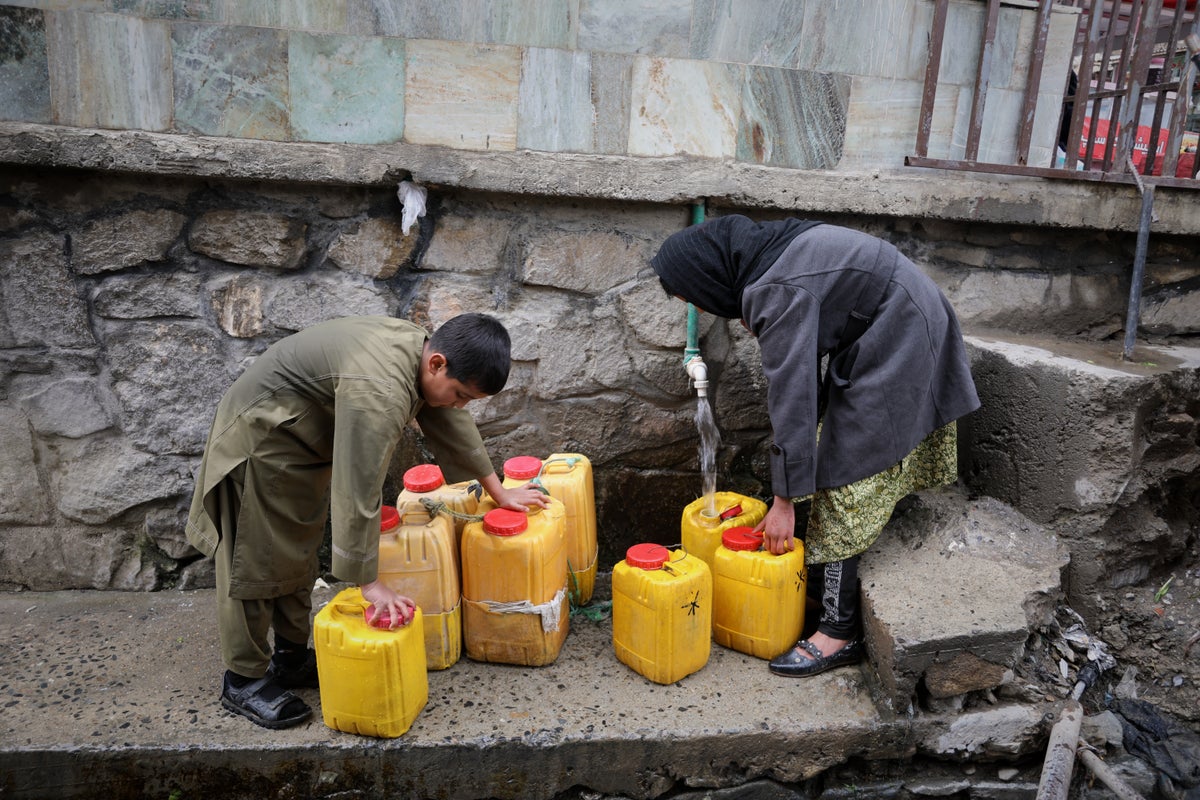
Kabul’s water crisis is not a temporary shortage but a terminal collapse of the city’s hydro-geological balance. The capital's water table is dropping at a rate of 1.5 to 3 meters annually, driven by a fatal intersection of rapid demographic scaling and archaic extraction methods. The current situation represents a textbook case of the "Tragedy of the Commons," where individual rational actors (residents drilling private wells) are collectively destroying the shared resource (the aquifer) that ensures their survival.
The Hydro-Geological Infrastructure Failure
The Kabul Basin is a closed system. It relies on the infiltration of snowmelt and rainfall into underground aquifers—essentially geological sponges made of sand and gravel. This system is governed by a simple input-output function:
$$R - E = \Delta S$$
In this equation, $R$ represents Recharge (rainfall and snowmelt), $E$ represents Extraction (pumping and evaporation), and $\Delta S$ is the Change in Storage. When $E$ consistently exceeds $R$, the storage $(\Delta S)$ enters a negative trajectory. In Kabul, the extraction rate has decoupled from the recharge rate due to three specific technical bottlenecks:
1. The Perched Aquifer Depletion
Kabul utilizes two primary layers of groundwater. The "shallow" or perched aquifer, typically found at 20 to 50 meters, has been effectively exhausted in high-density districts. This layer is highly susceptible to surface contamination. As this shallow supply fails, residents and commercial entities are drilling "deep wells" into the confined aquifers (100+ meters). This creates a permanent structural deficit because deep aquifers recharge on geological timescales—meaning we are currently "mining" water that was deposited thousands of years ago.
2. Impermeable Urban Growth
As the city expands, it covers its natural recharge zones with concrete and asphalt. The Paghman and Qargha regions, which serve as the primary "lungs" for water infiltration, are seeing increased surface runoff. Instead of soaking into the ground to replenish the water table, precipitation is lost to evaporation or channeled into open sewage drains, carrying pollutants with it.
3. Energy-Water Nexus Distortion
The availability of cheap, imported solar technology has ironically accelerated the crisis. Previously, the cost of manual pumping or intermittent grid electricity limited the volume of water extracted. The proliferation of solar-powered pumps allows for continuous extraction at zero marginal cost. Without a price signal or regulatory cap, there is no economic incentive to conserve, leading to "over-pumping" beyond actual household needs.
The Contamination Vector: Vertical Leakage
The crisis is qualitative as much as it is quantitative. Kabul lacks a centralized sewage system. Instead, the city relies on traditional "soak pits"—unlined holes in the ground where domestic waste is deposited.
This creates a Contamination Gradient. Nitrates and fecal coliforms from soak pits seep downward. In a healthy system, the soil acts as a natural filter. However, as the water table drops, the distance between the bottom of the soak pits and the top of the water table shrinks. In many districts, the shallow aquifer is now chemically indistinguishable from raw sewage.
When residents drill deep wells to escape the surface pollution, they often fail to properly seal the boreholes. These unsealed pipes act as vertical conduits, allowing the contaminated surface water to bypass the natural clay barrier and pollute the pristine deep aquifers. This effectively "bankrupts" the city’s last remaining clean water reserves.
The Economic Elasticity of Water Access
The burden of this crisis is distributed unevenly, creating a tiered class system based on hydraulic access.
- The Connected Elite: Those with the capital to drill 150-meter boreholes and install high-capacity filtration systems. They currently capture a disproportionate share of the remaining deep-water storage.
- The Tanker-Dependent Middle: Residents whose wells have gone dry but have the liquidity to purchase water from private tankers. These tankers often extract water from the city's periphery, merely shifting the depletion zone geographically.
- The Water Poor: Families relying on communal hand pumps or public taps. As the water table drops below the reach of these manual pumps (typically 30-40 meters), these populations face total displacement or acute health crises.
The price of water from private tankers has risen by an estimated 25% to 40% in certain districts over the last 24 months. This is a classic supply-side shock. As the "depth to water" increases, the energy cost to pump that water increases, and the time required for tankers to find viable extraction points grows.
The Failure of Current Mitigation Strategies
Current efforts to address the shortage are largely reactive and technically insufficient. The distribution of water by tankers or the digging of deeper public wells are "stop-gap" measures that address the symptom (lack of immediate supply) rather than the cause (aquifer depletion).
Large-scale infrastructure projects, such as the proposed Shatoot Dam, face two significant hurdles. First, the capital expenditure required is immense and currently unavailable due to the geopolitical isolation of the administration. Second, even if a dam were built, the distribution network in Kabul is 70% non-existent or dilapidated. The "Physical Loss" rate—water lost to leaks before it reaches a tap—would likely exceed 40%, rendering the project inefficient.
Structural Interventions for Hydraulic Stabilization
To prevent Kabul from becoming a ghost city, the strategy must shift from supply expansion to demand management and recharge optimization.
Targeted Aquifer Recharge (MAR)
The most viable technical solution is Managed Aquifer Recharge (MAR). This involves the construction of "recharge wells" and "infiltration basins" specifically designed to catch seasonal floodwaters and inject them directly into the ground. Instead of allowing the Kabul River's spring surge to flow out of the basin, it must be diverted into high-permeability zones.
Decentralized Wastewater Treatment
Since a centralized sewer system is decades away, the city must mandate the use of lined septic tanks and decentralized "greywater" recycling. If domestic water used for bathing or washing is filtered and used for irrigation or toilet flushing, the per-capita demand on the aquifer could be reduced by 30%.
Zoning and Borehole Licensing
The unregulated drilling of deep wells must be halted. This requires a transition to a "Metered Access" model. By capping the amount of water a commercial or high-income residential property can extract, the city can slow the rate of depletion. Without a regulatory floor, the deepest pockets will simply pump the city dry.
The trajectory for Kabul suggests that within the next five to seven years, several high-density districts will reach a state of "Hydraulic Zero"—where the cost of extraction exceeds the economic value of the property. This will trigger internal migration patterns that the city's surrounding provinces are unprepared to absorb. The survival of the capital depends entirely on whether it can transition from a mining economy (taking water out) to a circular hydraulic economy (putting water back in).
The immediate priority is the mapping of the "Basement Rock" topography to identify exactly where the remaining pockets of water are stored. This data is currently fragmented or outdated. Without a precise 3D model of the Kabul Basin's subsurface, any intervention is merely guesswork. The administration must prioritize hydro-geological surveying as a matter of national security, treating the aquifer as a strategic reserve rather than an infinite tap.