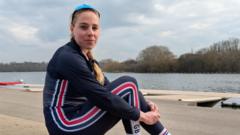
Olympic dreams usually come with a calorie count that would stagger an average person. For the elite rower, the engine requires thousands of units of energy just to maintain the explosive power needed to drag a carbon-fiber shell through the water. But in the specialized world of lightweight rowing, that physiological math is flipped on its head. Athletes like Team GB’s Daisy Wilde find themselves caught in a brutal paradox where the requirement for peak physical performance crashes into a rigid, uncompromising scale. The result is a quiet epidemic of disordered eating that the sporting world is only beginning to acknowledge.
This is not merely a story about one athlete's struggle. It is an indictment of a system that treats the human body as a mathematical variable rather than a biological entity. When Wilde describes her eating disorder as her "normal," she isn't just speaking for herself. She is describing a standardized culture of deprivation that has been baked into the infrastructure of high-performance rowing for decades.
The Weight Category Trap
Rowing is divided into two primary camps: open weight and lightweight. In the lightweight category, men must weigh no more than 72.5kg and women no more than 59kg. These are not suggestions. They are hard limits enforced with the clinical precision of a boxing weigh-in, often occurring just hours before a race.
For an athlete standing nearly six feet tall, like many female rowers, maintaining a body mass under 59kg is not a matter of "eating clean." It is a sustained battle against biology. The body possesses a set-point, a biological range it fights to maintain for survival. When an elite athlete forces their weight significantly below this point while simultaneously training three times a day, the endocrine system begins to shut down.
The "why" behind this is simple and devastating. The sport rewards the highest possible power-to-weight ratio. If two rowers produce the same wattage but one weighs five kilograms less, the lighter rower's boat will sit higher in the water and move faster. This creates a perverse incentive to starve. Coaches often look the other way because the results on the water justify the methods in the kitchen.
Normalizing the Abnormal
Wilde’s revelation that she viewed her behavior as standard highlights the most dangerous aspect of the sport’s culture: the social contagion of disordered eating. When everyone in your training group is weighing their spinach and obsessing over water retention, the individual loses their internal compass for what constitutes health.
In these environments, a teammate collapsing from low blood sugar isn't seen as a medical emergency. It is often framed as a sign of "commitment" or "making the sacrifices necessary for the podium." This psychological reframing is how professional sports organizations bypass their duty of care. By rebranding starvation as discipline, they insulate themselves from the reality that they are presiding over a slow-motion health crisis.
The Mechanics of REDs
Medical professionals now categorize this phenomenon as Relative Energy Deficiency in Sport, or REDs. It occurs when an athlete’s energy intake is insufficient to support both the demands of their training and the basic functions of their body.
- Bone Density Decay: Low estrogen levels caused by extreme dieting lead to brittle bones and stress fractures.
- Metabolic Slowdown: The body begins to consume its own muscle tissue to survive.
- Cognitive Fog: The brain, which consumes roughly 20% of the body's energy, begins to lag, leading to depression and anxiety.
The irony is that REDs eventually destroys the very performance the athlete is trying to protect. A starved rower might be light, but they are also fragile. They are one missed meal away from a season-ending injury or a mental breakdown.
The Failure of Governance
British Rowing and other national bodies have introduced guidelines to manage athlete weight, but these often feel like a coat of paint on a crumbling house. As long as the lightweight category exists in its current form, the pressure to cut weight will remain.
Critics argue that the category was created to allow smaller nations and smaller people to compete in a sport dominated by "giants." While the intent was inclusivity, the outcome has been the creation of a weight-loss subculture that mirrors the darkest corners of the modeling industry. We have to ask if the existence of a specific medal category is worth the permanent physiological damage being done to the competitors.
The oversight is frequently reactive. Support staff often only intervene when an athlete’s performance dips, rather than when their relationship with food becomes toxic. This "performance-first" metric means that as long as you are winning, no one asks how many meals you skipped to get there.
The Social Media Magnifier
For the modern rower, the pressure isn't just coming from the coach or the scale. It is coming from the screen. The rise of "fitspo" and the constant broadcasting of lean, muscular physiques on social media adds a layer of aesthetic pressure to an already fraught situation.
Athletes are now expected to be both world-class performers and brand-friendly influencers. This dual demand makes it nearly impossible to separate the functional necessity of being light from the social desire to look a certain way. For Daisy Wilde and her peers, the "normal" wasn't just about the boat; it was about fitting into a world that rewards thinness above all else.
Moving Beyond the Scale
Fixing this requires a fundamental shift in how we value athletes. If we continue to treat weight as a performance lever, we will continue to see athletes break.
- De-emphasize Weigh-ins: Move toward long-term health monitoring rather than daily or weekly scale checks.
- Mandatory REDs Screening: Every elite athlete in a weight-sensitive sport should undergo regular bone density and hormonal testing.
- Coaching Accountability: Coaches whose athletes consistently show signs of disordered eating must be held responsible, rather than celebrated for their "tough" standards.
The tragedy of the lightweight rower is that they are often too successful for their own good. Their willpower is their greatest asset and their greatest enemy. They are capable of pushing through pain that would stop anyone else, including the pain of hunger.
We must stop praising the "sacrifice" of athletes who are clearly suffering. When a rower tells us that an eating disorder was their normal, we shouldn't just offer sympathy. We should look at the medals on the wall and ask what they truly cost. The sport needs to decide if it wants athletes who are healthy or athletes who are merely light enough to win.
The next time you see a crew gliding perfectly across the water, don't just look at their synchronization. Look at their faces. Look at their frames. Ask yourself if the grace of the movement is hiding a much grittier, darker reality behind the scenes.
Demand that your national sporting bodies prioritize biological reality over the arbitrary numbers on a scale.