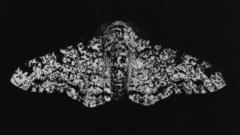
We used to find them tucked inside the pages of old encyclopedias. They were paper-thin, chalky-white things that fell out like pressed flowers when you shook the binding. If you grew up in a drafty house with an attic that smelled of damp wool and cedar chips, you knew them intimately. They were the background noise of summer nights. They were the pale smudges fluttering around the porch light, mindless and fragile, easily crushed between a thumb and a forefinger.
We treated them like a nuisance. Or worse, like a metaphor for insignificance.
Then the world warmed up, the concrete spread, and the white smudges started to vanish. In their place came something tougher. Darker. If you look closely at the brick walls of our cities right now, you can see them waiting. They match the soot. They match the stained asphalt. They have rewritten their own genetic code while we were busy looking at our phones.
A few months ago, I stood in a dimly lit museum gallery, surrounded by hundreds of tiny wooden drawers. Each drawer held rows of insects pinned to white foam, spanning over a century of collection. It was part of a quiet, remarkable exhibition tracking how these creatures are rewriting their survival strategies in real-time. Walking through that room felt less like studying science and more like reading a crime ledger of the Anthropocene. The sheer speed of what these creatures are doing should make us stop breathing for a second.
We are watching an ancient design print a new blueprint, right in front of our eyes.
The Watcher in the Woods
To understand the scale of what is happening, you have to look at a single life spent watching them. Let us create a composite figure based on the researchers who spent decades in the field—we will call him Arthur.
Arthur spent forty years walking the same stretch of oak woodland every June. In the 1980s, his notebooks were filled with descriptions of the Peppered Moth (Biston betularia). He recorded them as light, speckled creatures blending perfectly into the lichens on the tree bark. It was a classic textbook example of natural selection. When coal smoke killed the lichens during the Industrial Revolution, the moths turned black to match the soot. When the air cleaned up, they turned white again.
Simple. Linear. A pendulum swinging back and forth.
But three years ago, Arthur noticed the pendulum had broken. The lichens had not returned to his woods—the air was clean of coal, but the summers were blistering, dry, and plagued by sudden, torrential downpours. The trees themselves were changing, stressed by shifting water tables. The moths he caught were no longer just white or black. They were emerging in strange, intermediate shades of charcoal and olive.
Nature was not just picking an option from a binary menu anymore. It was inventing new colors.
This is where the standard news reports get it wrong. They treat adaptation like a slow, majestic train that takes thousands of years to arrive at the station. They print headlines about how resilient nature is, as if it is a comforting bedtime story. But resilience is a violent process. For every dark moth that survives on a soot-stained wall, thousands of lighter ones are ripped apart by birds. Adaptation is not a victory lap. It is an escape room where the clues keep moving.
The Cost of the Light
The exhibition brought this reality home through a series of macro-photographs that made the insects look like armored knights. When you see a moth magnified a thousand times, you stop thinking of it as a delicate pest. You see the sensory hairs on the antennae, vibrating to catch the scent of a mate miles away. You see the scales on the wings, arranged like shingles on a roof to deflect water.
Consider the physical cost of these changes. Imagine a hypothetical scenario where an engineer is told to completely redesign a aircraft's camouflage while the plane is mid-flight, using only the spare parts already inside the cabin. That is the biological reality of rapid adaptation.
When a population of insects shifts its color profile to survive in a concrete environment, it is not a free upgrade. Making pigment requires metabolic energy. A moth that spends its internal resources producing heavy melanin to stay dark against a urban backdrop has less energy to allocate toward egg production or immune defense.
- The Melanin Trade-off: Darker wings provide safety on dirty urban brickwork but absorb more solar radiation, risking overheating during heatwaves.
- The Flight Dilemma: Changing body mass to cope with erratic wind patterns in high-rise corridors means altering muscle distribution, which often reduces overall lifespan.
- The Sensory Shift: Artificial light from street lamps creates a massive evolutionary pressure, selecting for individuals that are less responsive to light—essentially creating a generation of moths that fly slower and forage less efficiently.
We are forcing these creatures to make desperate trades. We have turned their environments into high-stakes casinos where the rules change every hour, and they are playing with their last chips.
The Night is Raveling
There is a common question that pops up whenever people look at these exhibitions, a question whispered by visitors looking into the glass cases: Why should we care about a bug that ruins our sweaters?
First, let us correct the record. The moths changing out there in the woods and cities are not the tiny clothes-moths that eat your silk scarves. Those are a couple of specific domestic species. The vast majority of the world's moths are the invisible infrastructure of the night. They are the pollinators that operate when the bees are asleep. They are the primary food source for migratory birds, bats, and small mammals.
If you pull the thread on the moth, the whole night ravels.
If Arthur’s notebooks are right, the timing is slipping out of gear. Because the springs are arriving earlier and hotter, the caterpillars are hatching weeks before the oak buds open. They are waking up to a empty table. The birds that fly thousands of miles from the south to feed their chicks on those caterpillars are arriving to find the feast is already over.
The adaptation we are witnessing is a frantic attempt to re-synchronize a system that we have shaken out of its rhythm. It is a messy, beautiful, terrifying scramble.
The Ink on the Wall
I kept returning to one particular display at the end of the gallery. It was a simple collection of specimens collected from a three-mile radius around a major shipping port over the last fifty years.
The early specimens were varied—some large, some small, some patterned with intricate waves of grey and cream. As the decades advanced toward the present day, the variety withered away. The modern specimens were uniform. They were smaller, darker, and structurally identical. They looked like they had been manufactured on an assembly line rather than born in the grass.
They had adapted. They had survived the port, the diesel fumes, the sulfur, and the headlights. But they had paid for that survival with their individuality. They had become exactly what the environment demanded of them: invisible, hardened, and stripped of excess beauty.
That is the true lesson hiding behind the glass cases. The danger is not always that life will vanish entirely from the earth. Life is incredibly stubborn. The danger is that the world will become less interesting. We are editing the poetry out of the landscape, leaving only the functional prose.
The next time you sit on your porch and a dark, heavy-bodied moth thuds against the screen door, do not just swat it away. Look at it. Look at the dull, industrial shade of its wings. It is wearing the clothes we made for it. It is a living mirror reflecting the world we are building, a small, frantic heartbeat trying to find a way to stay alive in the ruins of our peace.