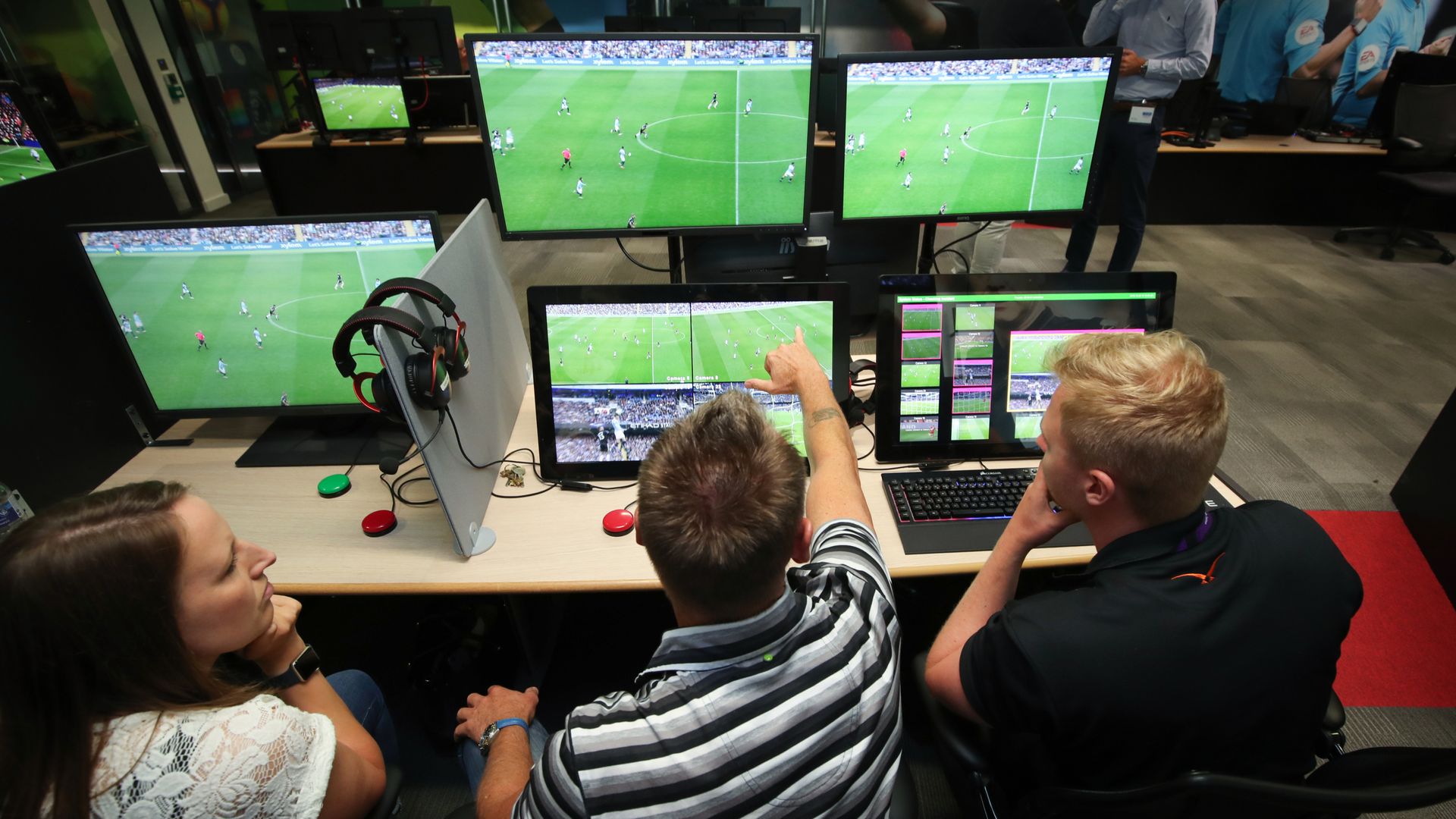
The honeymoon phase for Video Assistant Referees (VAR) didn't just end. It imploded. What started as a promise to eliminate "clear and obvious errors" has morphed into a weekly ritual of frustration that leaves supporters staring at frozen frames on stadium big screens for minutes on end. A massive survey of over 10,000 match-going fans recently confirmed what anyone sitting in a cold plastic seat at 3 PM on a Saturday already knew. Three quarters of fans oppose the use of VAR in the Premier League.
That isn't a small minority of luddites complaining about change. It’s a systemic rejection of how the modern game is being officiated. When 75% of your core audience tells you the product is broken, you don't just "tweak the protocol." You have a crisis of soul.
The data from the Football Supporters’ Association (FSA) paints a bleak picture for the PGMOL and the Premier League hierarchy. Only one in 20 fans who have experienced VAR in person say they enjoy the experience. Let that sink in. We've introduced a technology that almost nobody actually likes using, yet it’s treated as an inevitable evolution of the sport. It's not. It's an elective choice that is actively draining the joy out of the stadium.
The Death of the Goal Celebration
The biggest casualty of the VAR era isn't accuracy. It's the "limbs" moment. You know the one. The ball hits the net, the roar starts, and you lose your mind for thirty seconds. Now, that moment is tainted by a subconscious "wait for it" reflex. You look at the referee. You look at the linesman. You look at the big screen. By the time the green checkmark appears, the adrenaline has evaporated.
Fans feel this loss deeply. In the survey, the impact on the "spontaneity of goal celebrations" was cited as the single biggest reason for the opposition. If you take away the raw, uninhibited joy of scoring, what are you actually selling? A spreadsheet? A geometry lesson?
We’ve traded the soul of the game for the pursuit of a perfection that doesn't even exist. Even with multiple angles and slow-motion replays, we still spend Tuesday mornings arguing about whether a toe was offside or if a "subjective" foul was "clear and obvious." VAR hasn't ended the controversy. It has just moved the goalposts.
Precision vs. Flow
Football is a game of flow and momentum. It isn't American Football or Cricket, where natural breaks are baked into the DNA of the sport. When a referee stands with a finger to his ear for three minutes, the energy in the stadium dies. Players get cold. Fans get restless. The rhythm of the match is shattered.
The survey highlighted that fans are particularly annoyed by the lack of communication. If you’re watching at home, you get the replays and the commentary. If you’re in the stands, you’re often kept in the dark. You see a "VAR Check" graphic and... nothing. It’s isolating. It makes the match-going fan feel like a secondary character in a TV production.
The Premier League tried to fix this by having referees explain decisions over the PA system. Honestly, it hasn't helped much. Hearing a referee say "Penalty awarded for a handball" doesn't explain why that specific handball was different from the one ignored twenty minutes earlier.
The Offside Obsession
The most pedantic application of the technology involves offsides. We're talking about armpits and heels being millimeters over an invisible line drawn by a guy in a van in Stockley Park.
- Frame Rate Issues: Cameras capture 50 frames per second. A player can move several centimeters between frames.
- Point of Contact: Deciding exactly when the ball leaves the passer's foot is a guess at best.
- The Spirit of the Law: Offside was meant to stop goal-hanging, not to penalize a striker for having a slightly larger shoe size than the defender.
Semi-automated offside technology is supposed to speed this up, and it likely will. But it doesn't solve the fundamental problem. Fans don't want to win or lose based on a pixelated line. They want the benefit of the doubt to go back to the attacker. They want the game to feel human again.
Why the Premier League Won't Listen
Despite the overwhelming opposition, don't expect the Premier League to scrap VAR anytime soon. There’s too much money involved. Broadcasters love the drama. The league wants to be seen as the "best" in the world, which they equate with being the most "technologically advanced."
There’s also a fear of the "what if" scenario. Without VAR, we go back to the days of Thierry Henry’s handball against Ireland or Frank Lampard’s ghost goal against Germany. The league hierarchy is terrified of a high-profile mistake deciding a title or a relegation battle. They'd rather have a slow, soul-crushing system that is 98% accurate than a fast, exciting one that is 95% accurate.
But they’re missing the point. Football isn't a lab experiment. It's entertainment. If the fans—the people paying for the tickets and the subscriptions—hate the experience, the accuracy percentage is irrelevant.
Fixing a Broken System
If they won't scrap it, they have to change it radically. The current "Clear and Obvious" threshold is a mess. It's too subjective. One VAR official thinks a nudge is a foul; another thinks it's just "physicality." This inconsistency drives people crazy.
Here is what actually needs to happen to win back the 75% of angry fans:
- Time Limits: If you can't find a definitive error in 60 seconds, the original decision stands. No more five-minute forensic investigations.
- In-Stadium Audio: Let fans hear the conversation between the referee and the VAR room in real-time, just like in Rugby. Transparency builds trust.
- Simplify Offside: Use a "daylight" rule or a thicker line. If you need to zoom in 500% to see it, it isn't an advantage.
- Referee Accountability: Make officials speak to the media after the game to explain their logic.
The FSA survey is a wake-up call that the Premier League is currently ignoring. You can't sustain a sport by alienating three quarters of its most loyal followers. The "product" might look shiny on a 4K broadcast in a different time zone, but in the stadiums of England, the vibe is turning sour.
Start by pressuring your club's fan representatives. These surveys matter because they provide the hard data that clubs use in shareholder meetings. If you want the "limbs" back, you have to make sure the voices of the 75% are too loud to ignore. Demand a return to a game where the referee's whistle is the final word, not a suggestion pending a video review. Stop accepting the "technicality" of a goal as a substitute for the "feeling" of one. The next time you're at the ground, make your feelings known when that VAR graphic hits the screen. Change only happens when the cost of staying the same becomes higher than the cost of admitting you were wrong.