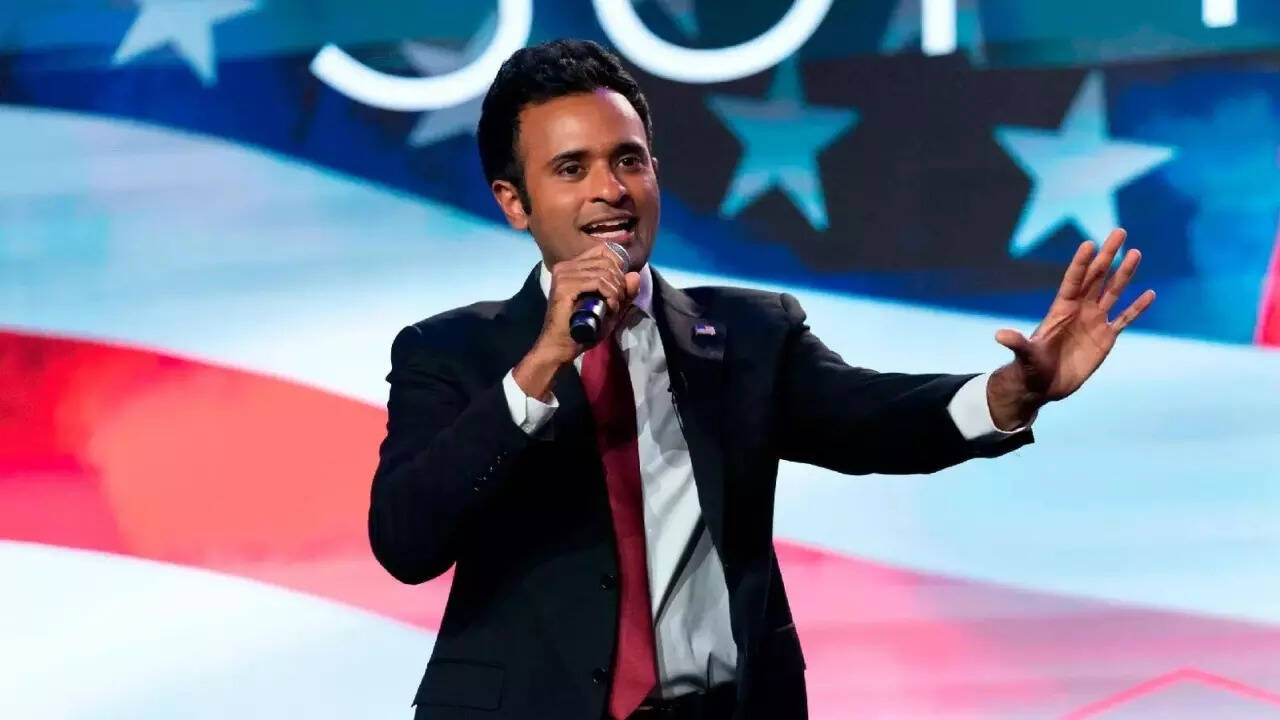
In the sweltering heat of an Iowa town hall, a single vowel became the most significant political hurdle for Vivek Ramaswamy. When asked about his Hindu faith, the biotech entrepreneur turned political firebrand told a voter that Jesus Christ was "a" son of God, not "the" son of God. To the casual observer, it was a semantic nuance. To the gatekeepers of the American religious right, it was a theological chasm.
The resurfacing of this exchange in early 2026 has reignited a debate that many thought was settled when John F. Kennedy addressed the Greater Houston Ministerial Association in 1960. While the Constitution explicitly forbids religious tests for public office, the reality on the ground is far more complex. Ramaswamy is not just fighting for a seat at the table; he is navigating a landscape where political viability is often measured by one’s proximity to evangelical orthodoxy.
The Semantic Trap of Moral Monotheism
Ramaswamy’s defense is a masterclass in theological bridge-building. He frequently leans on the concept of Advaita philosophy, suggesting that the underlying moral architecture of Hinduism is indistinguishable from Judeo-Christian values. By framing his beliefs through the lens of "one true God in many forms," he attempts to neutralize the "polytheistic" label that has been used as a cudgel against him by certain factions of the GOP.
However, the "a" versus "the" distinction remains a sticking point for voters who view the divinity of Christ as a non-negotiable prerequisite for leadership. For these voters, the presidency is not merely an administrative role; it is a position of moral stewardship that requires a specific spiritual alignment. Ramaswamy’s counter-argument—that he is "not running to be pastor-in-chief"—is a sharp rhetorical pivot, but it fails to address the deep-seated anxiety of a voting base that views secularism and non-Christian faiths with equal suspicion.
The Hindu American Defensive Front
The backlash against the "pastor test" has galvanized a diverse coalition of Hindu Americans. Organizations like the Hindu American Foundation (HAF) have pointed out that the scrutiny Ramaswamy faces is a form of "street corner proselytization" dressed up as political vetting. They argue that demanding a non-Christian candidate affirm Christian dogma is a betrayal of the American founding.
This defensive posture isn't just about faith; it's about the broader integration of Indian Americans into the upper echelons of the Republican Party. For decades, the community was seen as a dependable, if quiet, donor class for Democrats. Ramaswamy’s rise, alongside figures like Nikki Haley and Bobby Jindal (both of whom converted to Christianity), represents a shift. But Ramaswamy is the first to attempt this ascent while remaining a practicing Hindu.
The "Indiasplaining" accusations leveled against him by some conservative commentators highlight a friction point: can the MAGA movement, which is heavily rooted in Christian nationalism, truly accommodate a candidate who views divinity through a Vedic lens?
The Ohio Primary and the Identity Crisis
Nowhere is this tension more palpable than in the current Ohio gubernatorial primary. Ramaswamy’s rivals have discarded the dog whistles in favor of air horns. Opponents like Putsch have gone so far as to use insecticide imagery in digital ads, depicting Ramaswamy as an "alien" element to the state’s culture.
The strategy is clear: depress turnout among the faithful by suggesting that a Hindu governor cannot effectively lead a "Christian state." It is a brutal, scorched-earth approach that forces Ramaswamy to spend more time defending his heritage than his policy platform.
The Mechanics of Political Conversion
Historically, the path for non-Protestant candidates has involved one of two routes:
- The Kennedy Route: Declaring that your religion is a private matter and will not influence public policy.
- The Jindal Route: Full conversion to the majority faith.
Ramaswamy is attempting a third, unproven route: The Alignment Route. He is betting that if he can prove he is "more conservative" on social issues than the Christian candidates—shouting about two genders and the "God is real" mantra louder than anyone else—voters will overlook the specific name he uses for the Creator.
The Economic Stakes of Religious Purity
Beyond the theological sparring, there is a hard-nosed business reality to this conflict. The Indian American community is the highest-earning ethnic group in the United States. They are a powerhouse of innovation and capital. By subjecting Ramaswamy to a religious purity test, the GOP risks alienating a demographic that should be its most natural ally in the "meritocracy" wars.
If the party of "freedom of religion" becomes the party of "one specific religion," it creates a ceiling for its own growth. Ramaswamy’s struggle is a canary in the coal mine for a GOP that is trying to expand its tent while its base is busy tightening the stakes.
The irony is that Ramaswamy’s policy positions—from dismantling the "administrative state" to his stance on H-1B visas—are often more radical than those of his Christian counterparts. Yet, for a significant portion of the electorate, his white papers matter less than his prayer room.
The Ghost of 1960
When JFK told those ministers in Houston that he was not the "Catholic candidate for president" but "the Democratic Party’s candidate for president who happens also to be a Catholic," he broke a barrier. Ramaswamy is trying to do the same for the 4.5 million Hindus in America.
But the 2026 landscape is not 1960. The blurring of the line between church and state has made the "religious test" an unofficial but mandatory part of the primary process. Ramaswamy’s insistence that his faith is "compatible" with Christian values is a tactical necessity, but it also exposes the fragility of his position. He is a man caught between two worlds, trying to convince one that he belongs, while the other watches to see how much of himself he is willing to sacrifice to get there.
The real question isn't whether Ramaswamy can convince a voter in Iowa that Jesus is "a" son of God. The question is whether the American political system has actually progressed since 1960, or if we have simply swapped one set of exclusions for another.
The ballot box has always been a place where we exercise our highest ideals, but it is also where we hide our deepest prejudices. As the primary season enters its final, most aggressive phase, the "Hindu problem" will not be solved by clever rhetoric or Vedic quotes. It will be solved by whether the Republican voter cares more about the candidate's vision for the future or his interpretation of the ancient past.
For Ramaswamy, the math is simple: he needs the votes of people who believe he is going to hell. That is a political calculation that requires more than just a sharp mind; it requires a level of cultural gymnastics that would exhaust even the most seasoned diplomat.
The American experiment is supposedly built on the idea that anyone can lead, regardless of their origin or altar. Ramaswamy is putting that theory to its most rigorous test yet. The results of the upcoming primaries will tell us if that promise is still active, or if it was just a nice sentiment written on a piece of paper that we no longer know how to read.
Vivek Ramaswamy addresses his faith and Jesus Christ
This video provides the direct context of the specific town hall exchange where Ramaswamy clarifies his theological perspective on Jesus to a voter.
http://googleusercontent.com/youtube_content/1