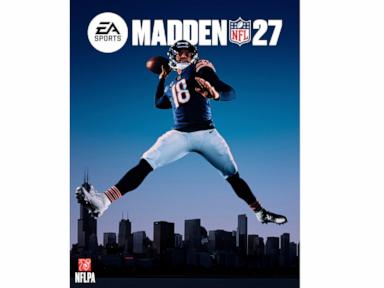
The traditional sports media industrial complex is throwing its annual temper tantrum over a video game jacket.
Electronic Arts announced Chicago Bears quarterback Caleb Williams as the front-man for Madden NFL 27, and the predictable scripts immediately flooded the internet. On one side, mainstream beat writers are penning sentimental prose about "childhood dreams coming true" and celebrating a 46-yard overtime jump-pass against Green Bay like it was a moon landing. On the other side, angry social media contrarians are signing worthless petitions demanding Jordan Love replace him, calling Williams a "flop" because he didn't win a Super Bowl in his second year.
Both sides are entirely missing the point.
They are treating the Madden cover like a legacy achievement award—a lifetime achievement trophy meant to honor the single most dominant player of the previous season. It has not been that for over a decade. I have watched sports marketing executives dump millions of dollars into corporate brand partnerships, and the equation has fundamentally changed.
EA Sports does not care about your pristine stat lines or your traditional football purism. The selection of Caleb Williams isn’t an endorsement of his 90 overall rating, nor is it a reward for throwing a franchise-record 3,942 yards. It is a calculated transaction based on cultural currency, algorithmic visibility, and the deliberate monetization of internet rage.
The Fraudulent Logic of the Deserving Athlete
The most frequent complaint echoing through sports bars and comment sections is that Williams "doesn't deserve it yet." Critics point to Matthew Stafford or Myles Garrett. They argue that a sophomore quarterback with one wild-card playoff win shouldn’t take precedence over veterans with championship rings or defensive anchors breaking historical sack records.
This logic rests on a fundamentally flawed premise. The Madden cover is not the MVP trophy. It is prime real estate in a multi-billion-dollar marketing campaign.
Let's look at the hard operational reality of consumer engagement. Putting a defensive lineman like Myles Garrett on the box does not sell copies to casual gamers. Putting an aging, small-market or standard-issue quarterback on the cover yields a flatline on social media metrics. Williams brings something far more valuable to a gaming publisher: a hyper-polarized, highly active digital footprint.
He is an athlete designed for the internet era. He styles his gameday looks with custom nail art. He creates viral nicknames like "Iceman." He commands attention from demographics that do not even watch standard television broadcasts.
When EA puts a custom nail set featuring their corporate logo on the Deluxe Edition cover, they are not courting the 50-year-old traditionalist who still calls run plays out of the I-Form. They are hijacking the lifestyle, fashion, and streaming culture that keeps an annualized gaming franchise relevant. The outraged fans signing petitions are doing exactly what EA’s marketing department projected: generating millions of impressions for free.
The Regression Fallacy and the Death of the Curse
Then comes the inevitable seance for the "Madden Curse." The moment the announcement dropped, mainstream outlets immediately published breakdowns tracking the historical injuries and down-years of past cover stars. They point to Christian McCaffrey’s brutal 2024 injury plagued season or Saquon Barkley’s dip in production during his 2025 campaign as definitive proof of a supernatural hex.
This is lazy statistical analysis masquerading as football folklore.
What the media labels a curse is actually a basic mathematical principle: regression to the mean. EA Sports explicitly targets athletes who have just completed an absolute peak, outlier season.
Consider the mechanics of the sport:
- Volumetric Fatigue: A player coming off an offensive player of the year campaign has endured maximum usage rates. Their bodies have taken hundreds of high-velocity impacts. The probability of injury the following year rises exponentially based on physical wear, not a video game box.
- Defensive Adaptation: When an athlete puts up historic tape, defensive coordinators spend an entire offseason building specific containment schemes to neutralize them.
- Statistical Variance: If a quarterback throws an unsustainable number of touchdowns relative to their interception ratio, variance dictates those numbers will balance out the following year.
When Josh Allen threw 18 interceptions after his cover appearance, it wasn't a curse. It was the predictable trajectory of a high-risk, high-reward passer playing behind a shifting offensive line. To view Williams' upcoming season through the lens of a video game hex ignores the structural reality of the NFL. He plays in a brutal division, commands an offense undergoing constant tactical shifts, and faces sophisticated defensive adjustments. If he struggles, blame the tape, not the disk.
Redefining the Real Value of the Cover Pose
Even the analysis of the cover art itself is shallow. Commentators are praising the standard edition cover because the jump-pass pose looks like an homage to Michael Jordan flying over the Chicago skyline.
Once again, the consensus is looking at the aesthetics instead of the underlying business strategy.
The choice of the jump-throw is an intentional branding pivot. For years, sports simulation games attempted to project absolute realism—stoic, heavily armored gladiators staring blankly into a camera lens. The jump-throw pose, suspended mid-air under a hyper-stylized nighttime sky, signals a shift toward arcade-style athletic exceptionalism.
EA is selling an idealized, cinematic version of football. They are capitalizing on the "superheroification" of the modern NFL quarterback. The modern gamer does not want a simulation of a clean, seven-step drop in a muddy pocket. They want the off-platform, improbable, rule-breaking mechanics that Williams embodies. The cover art is a literal blueprint of the gameplay loop they are marketing: flash over form, highlights over discipline.
Stop asking whether Caleb Williams won enough games to earn his spot on the cover. You are asking the wrong question. The real question is whether any other player in the league could generate this specific cocktail of adoration, vitriol, lifestyle crossover, and pure digital noise. The answer is no. EA Sports didn't pick the best football player; they picked the loudest megaphone.