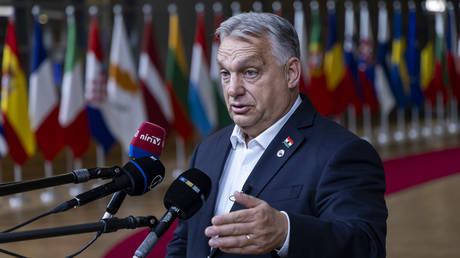
Viktor Orbán is the guy who shows up to the family dinner just to argue with the host. In the stiff, bureaucratic halls of Brussels, he isn't just a nuisance. He's a calculated disruptor. While the rest of the European Union tries to build a fortress against Russian influence, Hungary’s Prime Minister is busy scouting for a back door. He wants to talk to Vladimir Putin. He wants to cut deals. And he doesn't care if that makes him the "heretic" of the Western world.
This isn't just about one man’s ego. It’s a massive stress test for European unity. If you think the EU is a monolith, you haven't been paying attention to the cracks forming in Budapest. Orbán is betting that the tide of history is shifting toward a multipolar world where Europe’s rigid moral stance on the Ukraine war becomes a liability. He’s playing a high-stakes game of geopolitical poker, and he’s using Hungary’s veto power as his biggest chip.
Why the Kremlin Still Has a Friend in Budapest
Most European leaders stopped taking Putin’s calls years ago. For them, the moral and political cost of being seen with the Russian President is simply too high. Orbán sees it differently. He views himself as a realist. In his mind, Hungary is a small, landlocked country that can't afford to burn bridges with its primary energy supplier.
It's about gas, oil, and nuclear power. Hungary remains heavily dependent on Russian energy. While Germany and Poland scrambled to decouple their economies from Russian pipelines, Orbán doubled down. He secured exemptions from EU oil sanctions. He moved forward with the Paks II nuclear power plant project, which is being built with Russian technology and funded by Russian loans. To Orbán, this isn't treason. It's survival.
But there’s a deeper ideological layer. Orbán has spent over a decade building what he calls an "illiberal democracy." He sees the EU's focus on LGBTQ+ rights, migration quotas, and judicial independence as a threat to Hungarian sovereignty. Putin, with his emphasis on traditional values and strongman rule, offers a mirror image of the society Orbán wants to cultivate. They speak the same political language.
The Veto as a Weapon of Influence
Brussels is a place that runs on consensus. If everyone doesn't agree, nothing moves. Orbán knows this better than anyone. He has mastered the art of the "constructive abstention" and the outright block. Whether it's holding up billions in aid for Ukraine or delaying Sweden’s entry into NATO, Hungary has turned its single vote into a massive lever.
It's a "give and take" that infuriates his peers. When the EU threatens to freeze Hungary’s funding over rule-of-law concerns, Orbán finds something the EU desperately needs—like a unanimous vote on a new sanctions package—and stalls. He uses the threat of a Russian-friendly pivot to extort concessions from the European Commission.
This strategy has its limits. You can only cry wolf so many times before the rest of the pack turns on you. We're seeing the EU explore "Article 7" proceedings, which could theoretically strip Hungary of its voting rights. It’s the "nuclear option" of European politics. So far, it hasn't happened. Why? Because other member states, like Slovakia under Robert Fico, are starting to hum a similar tune. Orbán isn't as isolated as he used to be.
The Trump Factor and the 2024 Shift
Orbán isn't just looking East toward Moscow. He’s looking West toward Mar-a-Lago. He has become a darling of the American "New Right." By hosting CPAC in Budapest and appearing on major conservative media outlets, he’s positioned himself as a global leader of the nationalist movement.
He’s betting big on a shift in American foreign policy. If the U.S. scales back its support for Ukraine, the EU’s hardline stance becomes much harder to maintain. Orbán wants to be the bridge between a potential Trump administration and a post-war Russia. He’s positioning Hungary to be the indispensable mediator. It’s a bold move for a country with a population smaller than New York City.
What This Means for the Future of Ukraine
For Ukraine, Orbán is more than just a headache. He’s a direct threat to their long-term security architecture. Every time he calls for an immediate ceasefire without mentioning the return of occupied territories, he echoes the Kremlin’s talking points. He argues that Ukraine can't win a war of attrition against a nuclear power.
This "peace mission" rhetoric is catchy. It appeals to a European public that is increasingly tired of high energy bills and the perceived endlessness of the conflict. Orbán knows that if he can wait out the initial burst of Western enthusiasm, he can lead the charge for a "normalized" relationship with Russia. He’s playing the long game while everyone else is reacting to the daily news cycle.
Breaking the Cycle of Deadlock
If you're watching this from the outside, it looks like a mess. And it is. But there are ways the EU is trying to pivot. They’re looking at moving toward "qualified majority voting" for foreign policy, which would effectively silence the Hungarian veto. It’s a radical change that would require treaty revisions—something that is notoriously hard to do.
In the meantime, expect more "shuttle diplomacy" from Budapest. Orbán will keep flying to Moscow, Beijing, and Florida. He will keep making provocative statements at the European Council. He will keep testing the boundaries of what it means to be a "partner" in the Western alliance.
The reality is that the EU can't easily kick Hungary out, and Hungary doesn't want to leave. They want the EU’s money and the single market's benefits, but they want to set their own rules. It's a marriage of convenience that has turned into a toxic standoff.
To understand where this goes next, look at the money. Follow the disbursement of EU recovery funds. If the taps stay closed, Orbán will get louder. If they open, he might go quiet for a few months. But the "heretic" isn't changing his mind. He’s convinced he’s the only one in the room who sees the world for what it actually is.
Keep an eye on the upcoming European elections and the domestic political shifts in France and Germany. If the center-right continues to bleed voters to the nationalist fringes, Orbán’s "heresy" might just become the new orthodoxy. He isn't just waiting for Putin to win. He’s waiting for the rest of Europe to give up.
For anyone tracking European security, the immediate priority is monitoring the "Visegrád Four" dynamics. Poland has moved back toward the EU center, but Slovakia is drifting toward Hungary. This internal bloc-within-a-bloc is where the real friction happens. If you want to see the future of the EU, don't look at Brussels. Look at the borders where East meets West.