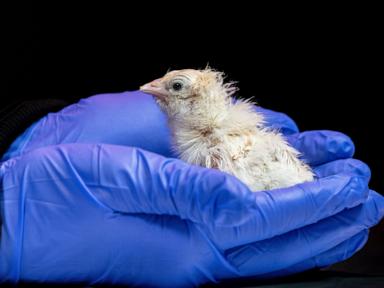
The room is silent except for the rhythmic, mechanical click of an incubator. It is a sterile environment, smelling of rubbing alcohol and filtered air, a place completely disconnected from the messy, chaotic world of nature. Inside a clear plastic dome sits something that looks like a high-tech kitchen experiment. It is an egg, but it has no shell. Instead, a translucent, synthetic membrane holds the yolk and the white together, stretched over a small frame. Inside that artificial cradle, a tiny pulse beats.
A heart.
To look at it is to feel a strange mix of awe and profound unease. For hundreds of millions of years, life has evolved to shield itself inside calcium walls. The shell is nature’s ultimate fortress, keeping moisture in and danger out. Now, humans have bypassed it entirely. A de-extinction company named Colossal Biosciences has successfully hatched live, healthy chicks from these artificial enclosures.
This is not a mere laboratory trick. It is a declaration of intent. By removing the biological requirement of a natural eggshell, scientists have unlocked a portal. They are trying to bridge the gap between what is gone and what could be. The immediate goal is to save endangered birds and, eventually, to resurrect icons of extinction like the dodo.
But as you watch that tiny heart beat through a window of plastic, the technical triumph fades into the background. A heavier, quieter question takes its place.
We are learning how to build the cradle. Do we actually know how to be parents to the ghosts we wake?
The Mechanics of the Unnatural
To understand why this matters, we have to look at the sheer, frustrating difficulty of avian reproduction. If you want to genetically engineer a mammal, you work with an egg inside a womb. It is accessible. You can modify a cell, implant it, and let nature do the heavy lifting of gestation.
Birds do not cooperate this way.
The moment a bird’s egg is fertilized, it moves down the oviduct and begins wrapping itself in stone. By the time it is laid, the genetic material is locked behind a calcium barrier. If you want to edit the genes of a bird to bring back an extinct trait, or to insert resistance to a deadly avian flu, you cannot easily do it through a hard shell. Scientists have spent decades trying to figure out a workaround.
The solution was to eliminate the shell completely. Imagine taking a raw egg, cracking it open, and instead of dropping it into a frying pan, placing it into a custom-engineered cup that mimics the exact gas exchange, humidity, and structural support of a natural nest.
For days, the embryo grows in the open air, visible to the human eye. You can watch the blood vessels web out across the yolk. You can see the eyes form as two dark spots. You can see the spine curve. It is a vulnerability that feels almost blasphemous to witness.
The engineering required to keep that exposed life alive is staggering. The synthetic membrane must breathe. It must allow oxygen in and carbon dioxide out at the exact rate a natural shell would, all while preventing bacteria from entering and turning the delicate proteins into toxic sludge. When the chick is fully formed, it does not peck its way out with an egg tooth. There is no shell to crack. Instead, the scientists gently assist the bird out of its plastic womb.
A wet, scrawny chick emerges. It breathes. It chirps.
It works.
The Missing Manual for the Dodo
The headline tells you that we can now grow birds outside of nature. The implication is that the dodo—that heavy, flightless pigeon of Mauritius that became the universal mascot for human carelessness—is practically walking among us again.
But a species is more than its DNA sequence.
Let us construct a hypothetical scenario to understand the invisible wall these scientists are about to run into. Suppose the genetic sequencing is perfect. The artificial eggshell technology functions flawlessly. A team of biologists sits in a lab, and before them stands a perfectly healthy, genetically accurate dodo chick.
Who teaches it how to be a dodo?
Behavior in animals is a complex tapestry woven from instinct and upbringing. A dodo chick raised by humans, or even by a surrogate species like the Nicobar pigeon, will not have a mother to show it which fruits are safe to eat. It will not have a flock to teach it the subtle social cues of its species. It will be an island of one, anatomically a dodo, but behaviorally an anomaly.
We often view de-extinction as a triumph of data, a simple matter of reading an old book and printing a new copy. But biology is messy. It relies on generational knowledge. When humans wiped out the dodo in the seventeenth century, we didn’t just destroy their bodies; we erased their culture. We broke the continuous line of learning that had passed from parent to offspring for millennia.
The artificial eggshell solves the housing problem of de-extinction. It does not solve the loneliness.
The Weight of the Mirror
There is an undeniable arrogance to this work, but there is also a desperate, frantic beauty. We are living through what scientists call the Anthropocene—an era defined by human impact on the planet, characterized by a rapid loss of biodiversity. It is easy to feel a crushing sense of paralysis when reading the statistics of extinction.
This technology is a counter-punch. It is an refusal to accept that the past is entirely written.
Consider the implications for birds that are currently teetering on the edge of the abyss. The pink pigeon of Mauritius, the kakapo of New Zealand, the Hawaiian crow. For these species, genetic bottlenecks are a death sentence. Inbreeding causes fertility rates to plummet, and a single disease could wipe out the remaining populations.
With the ability to grow embryos in artificial shells, conservationists can intervene directly. They can use gene-editing tools to reintroduce genetic diversity into a failing species. They can grow dozens of chicks simultaneously in a controlled laboratory environment, bypassing the predators, habitat loss, and unpredictable weather that kill wild nests.
It shifts the conversation from passive preservation to active restoration.
Yet, as we embrace this power, we have to confront our own motives. Are we doing this to heal the ecosystem, or are we doing it to soothe our collective guilt? Bringing back the dodo feels like a grand apology to the natural world. But an apology is meaningless if the home we are returning them to is still burning.
Mauritius today is not the Mauritius of 1600. The ancient forests are largely gone, replaced by sugar cane fields, urban development, and invasive predators like rats and macaques that would make quick work of a ground-nesting, defenseless bird. If we succeed in hatching a dodo, it cannot go home. Its home no longer exists. It will live in a sanctuary, behind glass, or in a highly managed park.
It will be a living exhibit of human capability, a monument to our ability to fix what we broke, even if the fix is entirely artificial.
The First Breath
The true test of this technology is not found in the grand pronouncements of corporate press releases or the speculative debates of ethicists. It is found in the quiet, mundane reality of a living creature.
Picture the chick that hatched from that plastic shell.
Its feathers dry, turning from damp spikes into a soft, yellow down. It opens its eyes to fluorescent laboratory lights instead of the dappled sunshine of a forest canopy. It looks up, not at the warm, protective breast feathers of a mother bird, but at a pair of blue nitrile gloves.
The chick does not care about the millions of dollars spent to create its cradle. It does not know that it is a milestone in the history of biotechnology. It only knows the immediate, urgent demands of being alive. It wants warmth. It wants food. It wants to exist.
We have proven that we can play the role of the shell. We can build the vessel, regulate the temperature, and protect the fragile spark of life from the cold realities of the outside world. We have mastered the physics of the beginning.
Now comes the hard part.
The chick stretches its legs, takes a clumsy step forward on the smooth laboratory counter, and chirps into the vast, empty room, waiting for an answer from a world that has forgotten how to reply.


