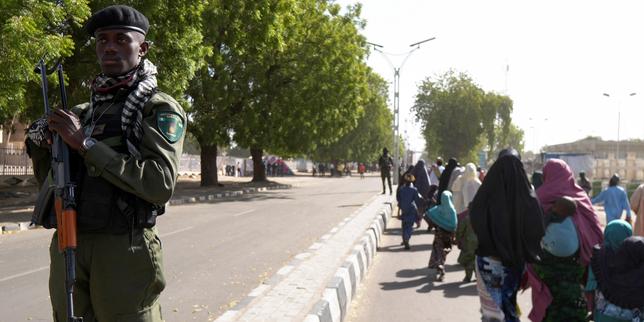
The wind in northeast Nigeria has a specific taste. It is dry, metallic, and heavy with the fine, ochre silt of the Sahel. For the people of Gubio, a small town sitting roughly 80 kilometers away from the flickering lights of Maiduguri, this dust is a constant companion. It settles into the creases of elbows and the deep lines of a grandfather’s face. But lately, the dust has carried something else. It carries the scent of spent brass and the sudden, jarring silence that follows a scream.
Silence is the loudest thing in Borno State.
When we talk about "five dead" in a news ticker, the numbers act as a shield. They turn a visceral human tragedy into a manageable statistic. Five is a small number to a world numbed by global conflict, yet to a village, five is an earthquake. Five empty chairs at a dinner of tuwo shinkafa. Five voices missing from the morning call to prayer. Five lives that were, until a few nights ago, preoccupied with the price of beans or the health of a newborn calf.
The attack in Gubio wasn't a grand military maneuver. It was a predatory strike. Assailants, identified by local security sources as members of a jihadist faction—likely ISWAP—slipped into the community under the cover of a moonless sky. They didn't come for territory. They didn't come to raise a flag. They came to remind the people that peace is an illusion.
The Geography of Fear
To understand why this keeps happening, you have to look past the maps. On paper, the Nigerian military has made "significant gains." They have cleared forests and reclaimed highways. But the "bush"—that vast, scrubby expanse of acacia trees and hidden gullies—belongs to those who are willing to live like ghosts.
Consider a hypothetical farmer named Musa. Musa knows the military has a checkpoint five miles down the road. He knows the soldiers have rifles and uniforms. But Musa also knows that the soldiers sleep at night, and the bush does not. When the motorcycles roar in the distance, the five miles between the checkpoint and Musa’s hut might as well be five thousand.
This is the psychological tax of the insurgency. It is a slow, grinding erosion of the soul. You don't just lose your life in an attack; you lose the ability to believe in tomorrow. When five people are killed in a raid, the remaining five thousand in the town stop dreaming about expansion. They stop planting extra rows of crops. They shrink.
The attackers arrived on motorcycles, the preferred cavalry of the modern desert insurgent. Motorcycles are fast, quiet enough to approach undetected through the sand, and easy to hide under a tarp when the drones hum overhead. They moved with the practiced efficiency of men who have turned murder into a routine. By the time the local Civilian Joint Task Force (CJTF) could mobilize their mismatched weapons and incredible bravery, the earth was already wet.
The Invisible Stakes
Why Gubio? Why now?
The timing is never accidental. As the Nigerian government pushes for the resettlement of Internally Displaced Persons (IDPs), the insurgents use these "minor" attacks to signal that the "safe zones" are anything but. It is a gruesome game of PR played with human pawns. Every time a village is raided, the message sent to the camps in Maiduguri is clear: Stay where you are. Do not come home. We are still here.
The five who fell in Gubio were more than just casualties of a religious war. They were the victims of a logistical nightmare. The northeast is a place where the infrastructure of the 21st century—cell towers, paved roads, reliable electricity—is stripped away, leaving only the ancient dynamics of predator and prey.
We often speak of "counter-terrorism" as if it were a math problem to be solved with more boots and more bullets. But you cannot shoot an ideology that feeds on the vacuum of governance. When a young man in a remote village sees no path to a wedding, a house, or a dignified life, the man with the rifle and the promise of a "divine mission" starts to look less like a monster and more like an employer.
The tragedy isn't just the death. It is the recruitment.
The Weight of the Aftermath
In the wake of the Gubio attack, the ritual of mourning begins. In the West, we have the luxury of prolonged grief. In Borno, burial must be swift. The bodies are washed, wrapped in white shrouds, and returned to the earth before the heat of the next day can claim them.
There is a specific sound to a village the morning after. It is the sound of sweeping. Women take their brooms to the dirt paths, obsessively clearing away the tracks of the motorcycles and the evidence of the struggle. It is a desperate, physical attempt to restore order to a world that has been violently disordered.
The military will issue a statement. They will vow to "hunt down the perpetrators." They will use words like "cowardly" and "desperate." But for the families in Gubio, these words are as thin as the Sahelian air. They have heard them for fifteen years. They heard them when the death toll was fifty, and they hear them now when it is five.
We must resist the urge to look away because the number is low. A "low" death toll is a success only for a statistician. For the mother who lost her eldest son in Gubio, the insurgency is 100 percent successful. Her world is ended. Her lineage is fractured.
The sun rises over Borno today just as it did yesterday. The heat will reach 40°C by noon. The markets will open, because people must eat, and the brave sellers will display their peppers and their dried fish on colorful cloths spread over the sand. They will smile at customers and haggle over kobo.
But beneath the commerce and the daily grind, there is a vibrating tension. Everyone is listening. They are listening for the distinct, rhythmic throb of a combustion engine cutting through the sound of the wind. They are watching the horizon for a cloud of dust that moves too fast to be natural.
The five from Gubio are gone, folded into the long, dark history of a conflict that the world has largely forgotten. They are not just news. They are a warning that as long as the "bush" remains a place of shadows and the villages remain islands of vulnerability, the dust will never truly settle. It will only wait for the next set of tires to kick it back into the sky.
Somewhere in the scrubland, a man is refueling a motorcycle. He is not a ghost. He is a product of a system that failed him, a theology that blinded him, and a war that defines him. He is waiting for the sun to go down. And in a small hut in a town like Gubio, a father is checking the bolt on a door that he knows will not hold.