The ink on a Colombian voting ballot has a distinct, sharp smell. It smells like vinegar and cheap chemicals, a scent that lingers on your index finger long after you leave the cardboard booth. For generations, that smell meant exactly the same thing. It meant choosing between two shades of the same conservative establishment. It meant a continuation of the old families, the old agreements, and the old ways of managing a country fractured by decades of war.
Not this time.
On a damp Sunday morning in Bogotá, the air felt heavy. The capital city, perched high in the Andes, usually meets election days with a mixture of festive street markets and heavy military presence. But the mood during this presidential runoff was different. It felt like a collective breath being held. People stood in long lines, wrapping their wool ruanas tightly against the mountain chill, staring at their phones. They were not looking at traditional news broadcasts. They were watching short, erratic videos of a seventy-seven-year-old construction tycoon shouting from his kitchen.
The choice before the nation was terrifyingly simple, yet entirely unprecedented. On one side stood Gustavo Petro, a cerebral senator and former urban guerrilla who had spent his entire life trying to drag the nation toward the political left. On the other side was Rodolfo Hernández, an unpredictable millionaire who had bypassed the entire political system by broadcasting populist tirades on TikTok.
The traditional ruling class had not just lost the election. They had been completely erased from the ballot.
The Anatomy of the Breaking Point
To understand how a nation arrives at such a crossroads, you have to look away from the capital. You have to travel to places like Chocó, a region on the Pacific coast where the jungle meets the ocean, and where the promises of the central government have always arrived late, if they arrived at all.
Consider a woman named Maria. She is a hypothetical compilation of the dozens of mothers I spoke with along the muddy banks of the Atrato River, but her exhaustion is entirely real. For Maria, the grand macroeconomic debates occurring in air-conditioned television studios in Bogotá meant nothing. What mattered was the price of a sack of rice, which had skyrocketed after the global pandemic. What mattered was the lack of a paved road to bring her harvest to market. What mattered was the constant, low-grade terror that her teenage son might be recruited by one of the armed groups still roaming the countryside despite the historic 2016 peace accords.
For decades, voters like Maria were told to be patient. They were told that stability was the prerequisite for progress. But patience is a luxury for those who are not hungry.
When the social discontent boiled over into mass street protests a year prior, the response from the sitting government was heavy-handed and defensive. The tear gas cleared, but the anger remained. The political establishment viewed those protests as a law-and-order crisis. They failed to see them for what they actually were: a funeral for the status quo.
The Leftist and the Firebrand
When the first round of voting eliminated the establishment candidate, the country scrambled to understand the two men left standing.
Gustavo Petro carried the weight of history on his shoulders. He was an intense man with thick glasses and a serious, unblinking gaze. In his youth, he had belonged to the M-19, a guerrilla movement that eventually laid down its arms to help write the country's 1991 constitution. For his critics, that past was unforgivable. They painted him as a dangerous radical who would transform Colombia into a neighboring Venezuela, collapsing the economy and stripping away private property.
But Petro had grown older and more pragmatic. He knew he needed to calm the fears of the urban middle class. On the campaign trail, he spoke less like a Marxist revolutionary and more like a European social democrat. He promised to halt new oil exploration to protect the environment, to tax unused agricultural land, and to build a safety net for single mothers. His running mate, Francia Márquez, was a formidable force in her own right—a Black environmental activist from a rural mining town who had survived assassination attempts. For millions of marginalized Colombians, seeing Márquez on the stage was the first time they felt reflected in the halls of power.
Then there was Rodolfo Hernández.
If Petro was a textbook of complex social theories, Hernández was a sledgehammer. He was a wealthy businessman from the northern department of Santander who ran a campaign almost entirely devoid of specific policy proposals. He did not hold massive rallies. He did not participate in late-campaign debates. Instead, he filmed videos from his home, wearing casual clothes and speaking in a gruff, grandfatherly tone that mixed folksy wisdom with shocking vulgarity.
His message was singular: the politicians are thieves, and I am rich enough not to steal.
It was a brilliant strategy. It allowed voters to project whatever desires they wanted onto his blank slate of a platform. Conservatives who feared Petro flocked to Hernández, viewing him as a capitalist shield. Disaffected youth who simply wanted to see the system burn loved his anti-establishment energy. He became known as the King of TikTok, turning a serious presidential race into a series of viral, fifteen-second clips.
The irony, of course, was thick. The man campaigning on a platform of pure anti-corruption was himself facing a scheduled trial for alleged irregularities in a waste-management contract during his time as a city mayor. But in the theater of modern politics, performance often matters more than performance records.
The Tension in the Air
On the afternoon of the runoff, the streets of Bogotá emptied out. The yellow taxis that usually clog the avenues sat parked. Everyone was waiting.
The anxiety was palpable because the stakes were invisible yet total. This was not a disagreement over tax rates or municipal budgets. This was an existential argument about the identity of the nation. If Petro won, Colombia would elect a leftist president for the first time in its modern history, breaking a century-old taboo. If Hernández won, the country would hand the keys of the state to an unpredictable corporate outsider with no established political party and an openly authoritarian streak.
I walked past a small bakery where a group of men stood huddled around a portable radio. One of them, an elderly man with calloused hands from a lifetime of construction work, was arguing with his nephew, a university student. The older man was voting for Hernández out of sheer terror of what a leftist government might do to his modest pension. The nephew was voting for Petro because he believed that continuing under the current economic system was a form of slow suicide.
They were not shouting. They were speaking with a quiet, desperate intensity. It was the same conversation happening at millions of dining tables across the country.
The Verdict
The results came in with surprising speed. The digital counting system used by the national registry left no room for prolonged agony.
Gustavo Petro won.
He secured the presidency by a razor-thin margin of roughly two percentage points. The map of the victory told a profound story. Hernández had dominated the conservative heartland and the agricultural center of the country. But Petro had built an immovable wall of support in the forgotten fringes: the Pacific coast, the Caribbean north, and the dense, working-class neighborhoods of Bogotá.
It was a victory driven by a historic voter turnout. Millions of people who had long believed that their votes did not matter walked through the rain and through the heat to mark their ballots. They did not just vote for a man; they voted for the possibility that the state might finally notice their existence.
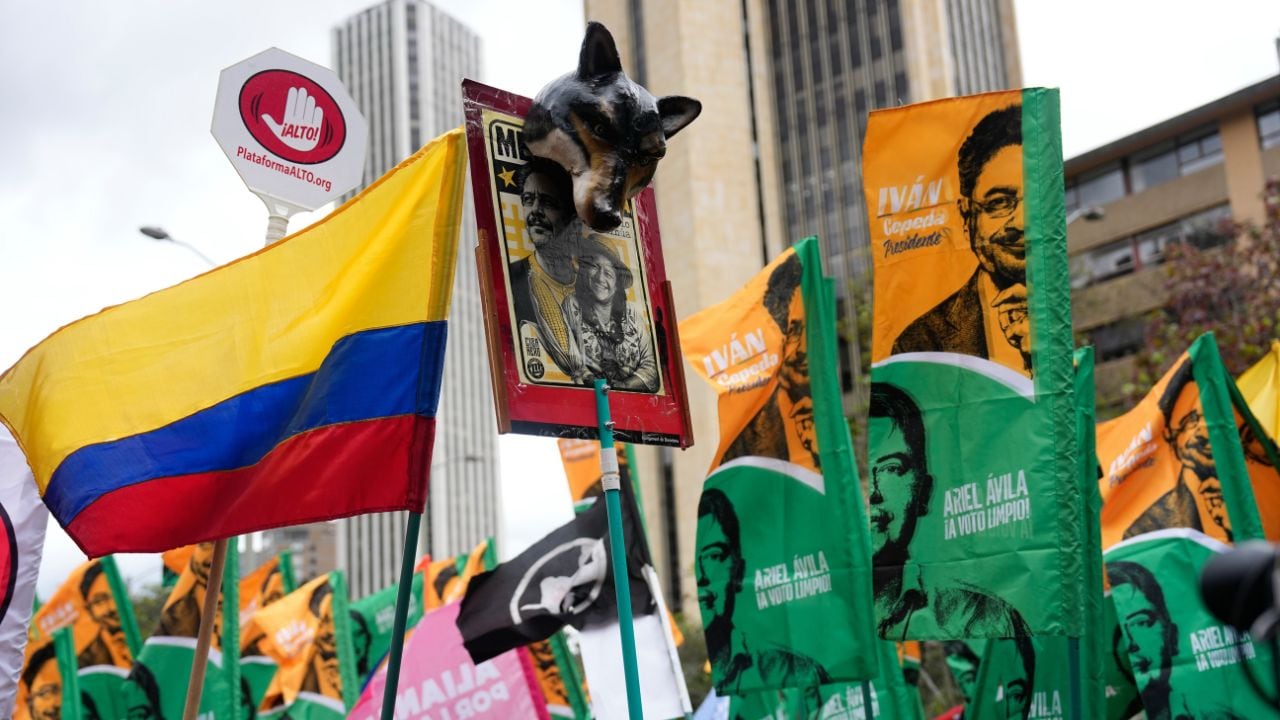
As night fell, the heavy silence of Bogotá shattered into a symphony of car horns, cheers, and vallenato music. Thousands of people flooded into the streets, carrying the yellow, blue, and red flag of Colombia. Women were crying. Young men were hugging strangers.
But underneath the euphoria, the reality of the challenge ahead was already taking shape. Petro was inheriting a deeply divided nation, an inflation rate creeping toward historic highs, and a congress where his coalition did not hold an absolute majority. The fears of the business community had not vanished; they were merely waiting to see his first cabinet appointments.
The celebration in the public squares eventually quieted down as the midnight rain began to fall. The crowds dispersed, leaving behind empty plastic cups and wet banners on the asphalt. The country had taken a massive, irreversible step into the dark. No one could predict whether this new chapter would bring the healing the nation desperately needed or create deep new fractures.
But as the streetlights reflected in the puddles of the capital, one thing was certain. The old Colombia, governed by the quiet agreements of the few, was gone. It had been voted out of existence.