The Colombian government has placed a record $1.4 million reward on the head of Ivan Mordisco, the elusive leader of the Estado Mayor Central (EMC), following a horrific bombing on the Pan-American Highway that claimed at least 19 lives. This massive bounty is not just a price tag on a guerrilla’s head; it is a desperate admission that the state’s "Total Peace" strategy has collapsed into a new era of narco-terrorism.
The Highway Massacre
On Saturday, April 25, 2026, the restive department of Cauca became the site of one of the deadliest attacks in recent years. Assailants blocked the critical Pan-American Highway near Cajibio, forcing traffic to a standstill before detonating a bomb-laden bus and a "chiva" rural transport vehicle. The blast was so powerful it carved a massive crater into the asphalt and flipped surrounding passenger cars like toys.
Among the 19 dead were five minors, a detail that has galvanized public fury just weeks before the May 31 presidential election. While initial reports placed the death toll at 14, forensic teams in Popayán confirmed 19 fatalities as they sifted through the mangled wreckage. President Gustavo Petro has explicitly blamed Ivan Mordisco, a former FARC commander who rejected the 2016 peace deal and now controls a sprawling criminal empire fueled by cocaine and illegal mining.
The Price of a Ghost
Offering $1.4 million (roughly 6 billion Colombian pesos) marks a significant escalation in the state’s tactics. For years, Mordisco has been a ghost in the jungles of southeastern Colombia. In 2022, the previous administration even claimed he had been killed in a bombing, only for him to reappear months later in a polished camouflage uniform, mocking the government’s intelligence.
By setting the reward at this record level, the Ministry of National Defense is attempting to weaponize the internal greed of the EMC. The group is not a monolithic ideological front; it is a federation of "fronts" often at odds with each other. The government is betting that a seven-figure payout in U.S. dollars will finally tempt someone in Mordisco’s inner circle to trade a coordinate for a new life abroad.
A Campaign Trail Painted in Blood
This escalation is inseparable from the high-stakes presidential race to succeed Petro. Security has become the defining issue after a year of unprecedented violence.
- The Left: Senator Ivan Cepeda, the architect of many of the current administration's negotiation efforts, is struggling to defend the policy of dialogue as bombs go off in Cali and Cauca.
- The Right: Candidates like Abelardo de la Espriella and Paloma Valencia are using the highway massacre as proof that "Total Peace" was a fantasy that allowed rebels to re-arm.
- The Trauma: The ghost of Miguel Uribe Turbay, the frontrunner assassinated in Bogota last June, hangs over every campaign stop.
The bombing in Cauca was not an isolated incident. In the 48 hours surrounding the blast, over 26 distinct attacks were recorded across the Valle del Cauca and Cauca departments, including a strike on a military base in Cali. This is coordinated strategic violence designed to prove that the government does not control the national territory.
The Logistics of Terror
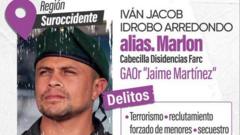
Military intelligence suggests the attack was orchestrated by the "Marlon" column of the EMC, a unit known for its expertise in improvised explosive devices (IEDs). By targeting the Pan-American Highway, the rebels hit the jugular of the Colombian economy, cutting off the primary artery for goods moving toward the Ecuadorian border.
The use of a "chiva" bus is a particularly cruel tactical choice. These brightly colored, open-air buses are the lifeblood of rural Colombia, used by farmers, students, and indigenous communities. Turning a symbol of rural life into a weapon of mass casualty is a psychological warfare tactic intended to cow the local population into total submission.
The Escobar Comparison
President Petro’s decision to compare Mordisco to Pablo Escobar is a deliberate shift in rhetoric. By stripping away the "rebel" label and replacing it with "narco-terrorist" and "fascist," the administration is signaling the end of the diplomatic honeymoon. However, labeling a man the next Escobar is a double-edged sword. It acknowledges his power and the failure of the billion-dollar security apparatus to contain a single individual.
The military has deployed 246,000 personnel to secure polling stations, but the Cajibio bombing proves that sheer numbers are ineffective against decentralized, high-impact terror. The reward for Mordisco is a high-stakes gamble. If it fails to produce a lead, it further cements his image as an untouchable warlord. If it succeeds, the government still faces the hundreds of mid-level commanders ready to take his place in the lucrative vacuum of the coca trade.
The coming weeks will determine if Colombia can break this cycle or if the $1.4 million bounty is simply the opening bid in a much longer, more violent auction for the country’s future. Reach for the checkbook, but keep the boots on the ground; the jungle doesn't give up its kings cheaply.