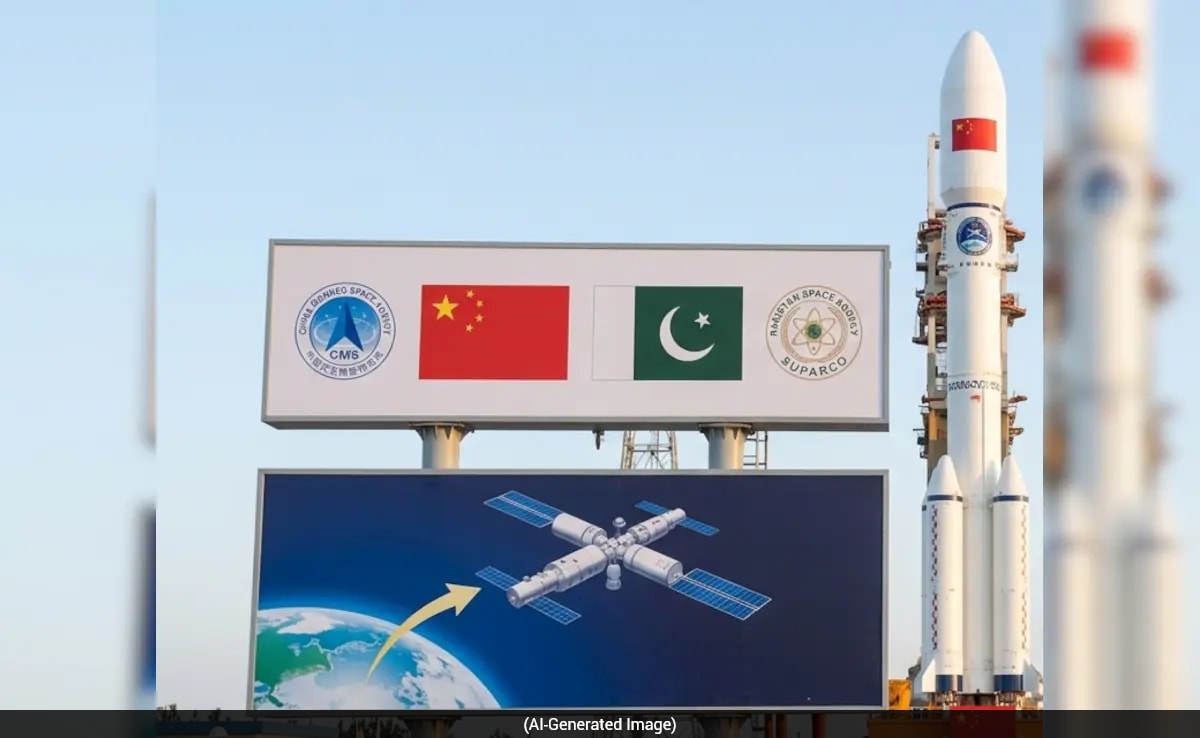
The era of Western dominance in low-Earth orbit is fracturing. Pakistan has officially committed to a training pipeline that will send its first national astronauts to China’s Tiangong space station, a move that signals far more than a simple scientific partnership. This is the solidification of a "space bloc" that challenges the long-standing monopoly of the International Space Station (ISS) and the U.S.-led Artemis Accords. While the world watches billionaires launch joyrides into the upper atmosphere, Islamabad and Beijing are quietly engineering a permanent geopolitical shift in the stars.
This agreement does not just put a Pakistani flag on a jumpsuit. It integrates Pakistan’s Space and Upper Atmosphere Research Commission (SUPARCO) directly into the Chinese Manned Space Agency (CMSA) framework. For Pakistan, this is a shortcut to elite status. For China, it is the ultimate soft-power play, proving that the Tiangong is the world’s new inclusive neighborhood in orbit.
The Geopolitics of the High Ground
Space has never been about "peace for all mankind," despite what the plaques say. It is about the high ground. Pakistan’s decision to hitch its wagon to the Tiangong station is a direct result of being frozen out of other avenues. India’s recent successes with the Chandrayaan missions and its deepening ties with NASA through the NISAR project have left Islamabad feeling a distinct orbital chill.
Beijing has stepped into that vacuum with a "no-strings-attached" offer that looks remarkably like its Belt and Road Initiative (BRI). By providing the hardware, the launch vehicle, and the station itself, China ensures that the first Pakistani in space will be entirely dependent on Chinese infrastructure. This creates a legacy of technical dependency. Every bolt, every software interface, and every communication protocol these astronauts learn will be Chinese.
This isn't a one-off flight. This is the establishment of a parallel space ecosystem. As the ISS nears its scheduled deorbiting toward the end of the decade, Tiangong might soon be the only game in town. By training now, Pakistan is securing a seat at the table for the 2030s, while Western-aligned nations scramble to figure out what follows the ISS.
Inside the Training Gauntlet at Jiuquan
The training regimen for these astronauts is brutal and specifically designed to bridge the gap between SUPARCO’s theoretical knowledge and the harsh reality of long-duration spaceflight. Candidates are not just being taught how to flip switches. They are undergoing a total immersion into the Chinese aerospace philosophy.
Most of the training occurs at the Astronaut Center of China (ACC) in Beijing and the Jiuquan Satellite Launch Center. The curriculum includes:
- Centrifuge Endurance: Pulling high G-loads to simulate the violent ascent of the Long March 2F rocket.
- Neutral Buoyancy Training: Spending hours underwater in massive pools to mimic the weightlessness required for Extra-Vehicular Activities (EVAs), or spacewalks.
- Systems Mastery: Learning the intricate life-support systems of the Tianhe core module, which differ significantly from Soviet-era or American designs.
There is a language barrier that cannot be ignored. While international aviation typically relies on English, the Tiangong is a Mandarin-native environment. Pakistani candidates are required to achieve fluency in technical Chinese. This adds a layer of cognitive load that few other national astronaut programs face. They are translating life-critical data in real-time while their bodies are under extreme physical stress.
Why Science is the Cover Story
Official press releases will focus on microgravity experiments, seed mutation, and crystal growth. These are legitimate scientific pursuits, but they are secondary. The real value of this mission lies in Electronic Intelligence (ELINT) and Earth Observation.
A Pakistani presence on Tiangong allows for a unique vantage point over the South Asian subcontinent. While satellites provide snapshots, a manned presence offers flexibility. The ability to test high-resolution imaging hardware and communication relays in a live orbital environment is invaluable for SUPARCO. It allows Pakistan to refine its indigenous satellite programs using the Tiangong as a high-altitude laboratory.
Furthermore, there is the matter of the "China-Pakistan Space Corridor." This is the digital and orbital equivalent of the China-Pakistan Economic Corridor (CPEC). It involves the integration of the BeiDou Navigation Satellite System into Pakistan’s military and civilian infrastructure, reducing reliance on the American GPS. Training astronauts for Tiangong is the crowning achievement of this integration.
The Cost of the Ticket
Space is expensive. There is no such thing as a free launch. While the exact financial terms of the Pakistan-China space agreement remain classified, the "cost" is likely paid in strategic alignment.
Pakistan provides China with something money cannot easily buy: a dedicated partner in a volatile region and a terrestrial footprint for tracking and control stations. The Ground Station in Karachi and the facilities in the north are essential nodes for China’s deep-space network. By sending a Pakistani astronaut to Tiangong, Beijing is rewarding a loyal partner and ensuring that the relationship remains anchored in the highest possible stakes.
Critically, this partnership circumvents the Wolf Amendment, a U.S. law that prohibits NASA from collaborating directly with China. By building its own bloc, China is rendering such Western sanctions irrelevant. If Pakistan can get everything it needs—training, launch, and station access—from Beijing, the influence of Western space agencies in the region evaporates.
The Risk of Orbital Dependency
There is a danger in this lopsided partnership. If Pakistan does not develop its own launch capabilities, it remains a passenger in its own space program. Relying on the Shenzhou spacecraft means that Pakistan’s access to space is subject to Beijing’s political whims.
We have seen this before. In the 1970s and 80s, many nations relied on the Soviet Interkosmos program. When the Soviet Union collapsed, those national space ambitions stalled for decades. Pakistan is betting that the Chinese Communist Party will remain a stable, well-funded patron for the next fifty years. It is a massive gamble.
Moreover, the technical divergence is real. The more Pakistan integrates with Chinese systems, the harder it becomes to collaborate with the West. It is the "Huawei effect" applied to the thermosphere. Once your ground stations, your code, and your astronauts are calibrated to Beijing’s standards, switching back to Western or even Russian hardware becomes a multi-billion dollar headache that most developing nations cannot afford.
Breaking the "Developing Nation" Stigma
For the Pakistani public, this mission is a potent symbol of pride. It serves as a distraction from internal economic struggles and political volatility. A national hero floating 400 kilometers above the Earth is a powerful tool for national cohesion.
But high-end journalism requires us to look past the ticker-tape parades. We have to ask if this investment in "prestige science" translates to down-to-earth benefits for the citizens of Lahore or Karachi. Supporters argue that the spinoff technologies—better telecommunications, improved weather forecasting for agriculture, and advanced materials science—justify the cost. Skeptics point out that you don't need a man in orbit to improve a weather app.
The reality is that space is the new frontier for the Great Power Competition. You are either a space-faring nation or you are a client state. Pakistan has chosen to be a space-faring nation by becoming a primary client of the new orbital superpower.
The Technical Reality of Tiangong
The Tiangong station is not a carbon copy of the ISS. It is smaller, more modular, and in many ways, more modern. It uses a different docking mechanism and a highly automated cargo delivery system. For the Pakistani trainees, the learning curve is steep because they are stepping into a system that was built from the ground up to be independent of international standards.
Hardware Comparison
| Feature | ISS | Tiangong |
|---|---|---|
| Primary Language | English / Russian | Mandarin |
| Power System | Large Solar Arrays (120kW) | Flexible GaAs Solar Wings |
| Resupply | Dragon, Progress, Cygnus | Tianzhou |
| Orbit Inclination | 51.6 degrees | 41.5 degrees |
The lower inclination of Tiangong’s orbit makes it slightly more accessible for launches from China’s southern sites, but it also dictates what parts of the Earth are most frequently visible. This orbit is particularly well-suited for monitoring the "Global South," reinforcing China’s narrative that Tiangong is the station for the developing world.
A New Definition of Sovereignty
In the past, sovereignty was defined by borders on a map. Today, it is defined by the ability to access and utilize the "global commons"—the sea, the internet, and space. By sending astronauts to train for the Tiangong, Pakistan is asserting a form of orbital sovereignty that few other nations can claim.
However, this sovereignty is mediated through Beijing. The "Historic First" is not just about a person in a suit; it is about the birth of a formalized, alternative space power structure. The West can no longer dictate the terms of engagement in orbit. The training of Pakistani astronauts is the first clear signal that the vacuum of space is being filled by a new, eastern-led order.
The rockets are on the pad. The contracts are signed. The first Pakistani astronaut will look down at the Earth from a Chinese window, using Chinese oxygen, and communicating through Chinese satellites. This is the new reality of the 21st-century space race. It is no longer a race to see who gets there first; it is a race to see who can build the biggest, most exclusive club in the sky.
Pakistan has just paid its membership dues.