The ambition is staggering in its scale. China is currently pouring billions into a fundamental restructuring of its national energy infrastructure, moving away from human-centric maintenance toward a massive, coordinated fleet of autonomous robots. This is not a futuristic concept or a pilot program confined to a few laboratories in Shanghai. It is a massive industrial deployment designed to solve a math problem that the West is still trying to ignore.
The problem is distance. China’s energy wealth—its massive wind farms in the Gobi Desert and hydroelectric dams in the southwest—is located thousands of miles away from the coastal megacities that consume the most electricity. To bridge this gap, the State Grid Corporation of China (SGCC) has built the world’s most extensive Ultra-High Voltage (UHV) network. These lines operate at pressures exceeding 800,000 volts. At that level, the margin for error vanishes. A single failure in a remote mountain pass can trigger a cascading blackout across a province of 100 million people. Humans cannot safely or efficiently monitor these thousands of miles of wire. Robots can.
The Mechanical Backbone of the State Grid
The shift toward automation is driven by necessity. Maintaining a traditional power grid involves linemen climbing towers or hovering in helicopters. It is slow, dangerous, and expensive. In the UHV era, the physical risks to human workers are amplified by the sheer scale of the hardware. China’s "robot army" consists of three distinct classes of machines working in a layered defense system.
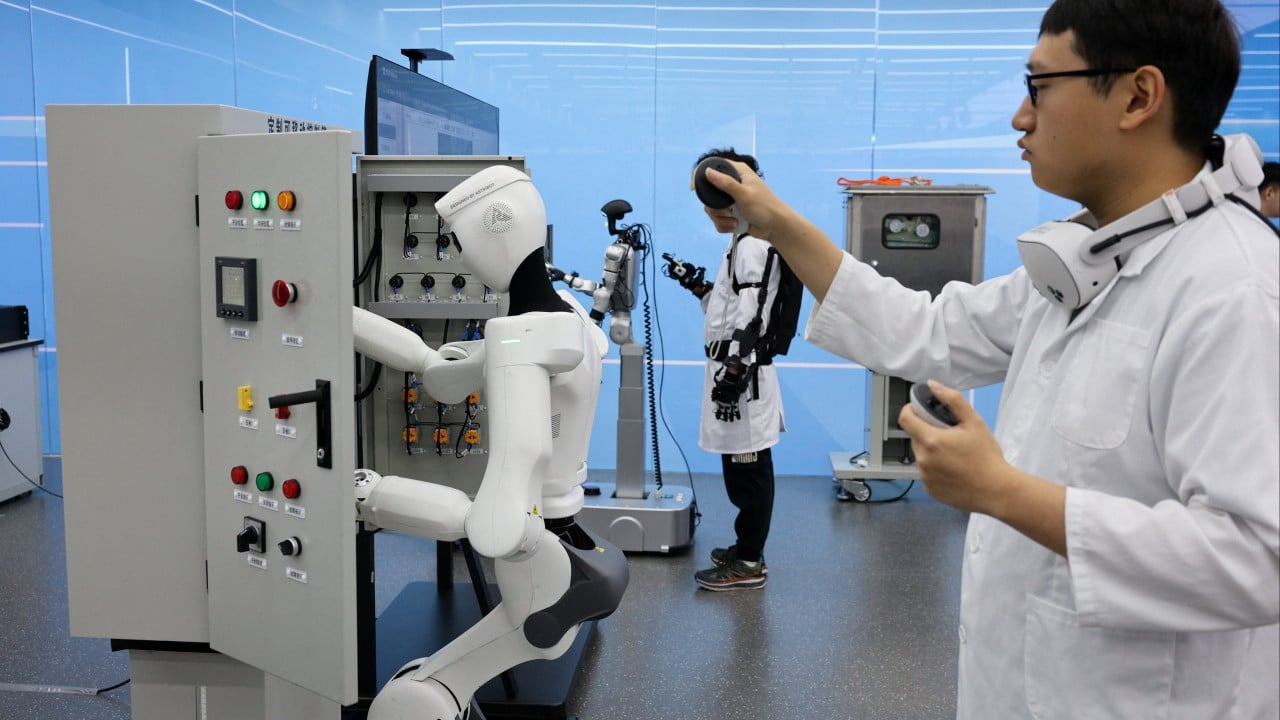
First are the line-walking robots. These machines resemble oversized industrial spiders that latch onto the actual power lines. They crawl along the wires at heights of several hundred feet, using high-definition cameras and LiDAR to detect "hot spots" or structural fraying before a break occurs. They don't need to sleep. They don't get tired in the heat of a Xinjiang summer.
Second are the substation crawlers. These are ground-based units equipped with infrared sensors and acoustic monitors. They roam through the forest of transformers and circuit breakers, "listening" for the specific hum of a failing component. By the time a human technician would notice a visual defect, the equipment is often already beyond repair. These robots identify the failure in its embryonic stage.
Third, and perhaps most critical, are the autonomous drones. Unlike consumer drones, these units are integrated into a centralized AI command structure. They fly pre-programmed routes through difficult terrain, using "flame-throwing" attachments to burn away debris or nesting materials from lines without requiring a power shutdown.
The Economic Engine Behind the Shift
This is not just a technological flex. It is a calculated business move. The Chinese government is treating the power grid as the literal hardware of its economy. If the power fails, the factories stop. If the factories stop, the social contract frays.
By investing an estimated $600 billion in overall grid modernization through 2030, a significant portion of which is earmarked for automation, China is betting that the upfront cost of robotics will be dwarfed by the savings in operational efficiency. We are seeing a transition from reactive maintenance—fixing things when they break—to predictive maintenance.
The cost-benefit analysis is clear. A manual inspection of a major substation might take a team of five engineers two days. A coordinated robot team can complete the same sweep in under an hour with higher data accuracy. This efficiency allows the State Grid to operate with much tighter tolerances, pushing more electricity through the same wires than would be possible if they were relying on human eyes and periodic manual checks.
The Geopolitical Stakes of Energy Control
There is a deeper layer to this story that goes beyond simple utility management. Control over the power grid is control over the future of the nation. By automating the grid, China is insulating its energy security from the vulnerabilities of a shrinking workforce. Like many industrial powers, China faces an aging population. The number of young people willing to spend their lives climbing 200-foot towers in rural Gansu is dwindling.
Automation fills the labor gap. But it also creates a massive export opportunity. China isn't just building these robots for itself. It is positioning itself as the global standard-setter for UHV technology and the automated systems required to run it. Through the Belt and Road Initiative, China is exporting this "grid-in-a-box" model to nations across Southeast Asia, Africa, and Latin America.
When a country buys Chinese grid technology, they aren't just buying copper and steel. They are buying into a proprietary ecosystem of Chinese software, Chinese sensors, and Chinese robotics. This creates a long-term dependency that is much harder to break than a simple trade agreement. It is a form of "infrastructure diplomacy" that secures China's influence for decades.
Risks in the Silicon Wires
However, this total reliance on automation introduces a new breed of risk. When you remove the human from the loop, you create a system that is only as resilient as its code.
Cybersecurity becomes the ultimate bottleneck. A grid run by robots is a grid that can, theoretically, be hijacked by a keyboard. If an adversary gains access to the command-and-control nodes of the robot fleet, they wouldn't need to bomb a substation to take out the lights. They could simply tell the robots to stop.
There is also the issue of data sovereignty. The massive amounts of telemetry data generated by these millions of sensors are being fed into centralized machine-learning models. While this allows for incredible efficiency, it also creates a single point of failure. If the central "brain" of the grid misinterprets a signal—or if it is fed "poisoned" data—it could trigger a systemic collapse that no human could stop in time.
The Human Cost of High Tech
We must also look at the workers who are being replaced. While the official narrative focuses on "freeing humans from dangerous tasks," the reality is a massive displacement of skilled manual labor. The veteran linemen who spent decades learning the "feel" of the grid are being sidelined in favor of data scientists in white coats who may have never touched a live wire.
This loss of "tribal knowledge" is a hidden danger. There are nuances to electrical engineering that are not yet captured in a training manual or a dataset. When a freak weather event occurs—something outside the historical data used to train the AI—the robots may not know how to react. In those moments, the absence of a human with thirty years of experience could be the difference between a minor flicker and a month-long blackout.
A Blueprint for the Rest of the World
The West is watching China’s experiment with a mix of envy and apprehension. In the United States, the power grid is a patchwork of aging infrastructure owned by hundreds of different private utilities. It is a bureaucratic nightmare that makes large-scale automation almost impossible to implement quickly.
China’s advantage is its centralized command. When the SGCC decides to automate, it happens across the entire country. They have the ability to force standardization, ensuring that a robot built in Shenzhen works perfectly on a line in Tibet.
This level of integration allows for Dynamic Line Rating (DLR). Most countries run their power lines at a fixed capacity based on the "worst-case" weather scenario to prevent overheating. China’s robot-monitored lines use real-time weather and temperature data to adjust the load instantly. If a cool breeze is blowing across a mountain range, the system knows it can safely push 20% more power through the wires. Over a national network, that 20% represents the output of several dozen coal plants.
The Technical Reality Check
To understand how this works on the ground, consider a hypothetical scenario where a landslide occurs in a remote valley. In a traditional system, the grid would detect a drop in voltage, and a crew would be dispatched—perhaps hours later—to find the break.
In the automated Chinese model, the sequence is different:
- Sensors on the towers detect the vibration of the landslide instantly.
- Drones from the nearest automated "hive" launch within seconds to provide a live video feed.
- Edge computing units at the site determine if the line can stay live or if the load needs to be rerouted.
- Robotic repair units are dispatched with the exact parts needed, potentially arriving before a human supervisor has even finished reviewing the initial alert.
This is the "closed-loop" system that China is spending billions to perfect. It turns the power grid into a self-healing organism.
The Unseen Competition
The real battle isn't over who has the most robots. It's over who owns the data that trains them. China’s State Grid is currently sitting on the world’s largest dataset of high-voltage operations. This data is the "fuel" for the next generation of AI-driven energy management.
Every time a robot crawls a wire or a drone scans a transformer, the system gets smarter. It learns how different materials age, how different climates affect conductivity, and how to spot the "digital fingerprint" of an impending short circuit. This is an compounding advantage. The more you automate, the more data you get; the more data you get, the better your automation becomes.
Other nations are struggling to keep pace because their data is fragmented across different companies and jurisdictions. China’s unified approach means they are building a "Digital Twin" of their entire national energy infrastructure. They can run simulations, test stress points, and predict failures in a virtual environment before they ever happen in the real world.
The Future of the Frictionless Grid
We are entering an era where the physical and digital worlds are becoming indistinguishable. The Chinese power grid is the first major example of this on a national scale. It is a move away from the "mechanical age" of gears and switches into the "algorithmic age" of sensors and logic gates.
The goal is a frictionless grid. A system where power moves from a wind turbine in the desert to an EV charger in Beijing with zero human intervention and minimal waste. It is a vision of absolute efficiency, but it comes at the cost of absolute complexity.
The billions being spent today are a down payment on a future where the state no longer manages people, but manages the machines that manage the people. It is a bold, risky, and incredibly expensive bet that the future belongs to the automated. Whether this "robot army" can withstand the unpredictability of a changing climate and the shifting sands of global politics remains the defining question of the next decade.
The robots are already on the lines. They aren't going back.