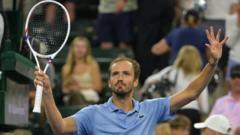
The air inside the arena didn’t just carry the scent of expensive cologne and recycled oxygen. It carried the smell of an impending coronation. Carlos Alcaraz walked onto the court with the heavy, golden aura of a man who had already won. He smiled that wide, gap-toothed grin—the one that suggests tennis isn’t a job, but a playground. Across the net stood Daniil Medvedev. He looked like a man who had forgotten to turn off the oven at home. He was lanky, awkward, and profoundly unbothered by the fact that the entire world had already written his obituary.
Everyone knew the script. Alcaraz was the future, a blur of drop shots and 100-mile-per-hour forehands that defied the laws of physics. Medvedev was the "Wall," a defensive specialist whose time was supposedly up. But tennis isn't played on paper. It’s played in the six inches between a player's ears, and on this night, those inches became a labyrinth.
The Geometry of Despair
To understand what happened, you have to understand how Daniil Medvedev sees a tennis court. Most players see a rectangle. Medvedev sees a grid of shifting vulnerabilities. He stands so far back to return serve that he is practically in the lap of a front-row spectator. It looks ridiculous. It looks desperate.
It is a trap.
By standing thirty feet behind the baseline, Medvedev turns the court into a vast ocean. He dares you to hit through him. He invites you to try and find an angle that doesn't exist. Early in the first set, Alcaraz took the bait. The Spaniard swung with the violence of a man trying to chop down an oak tree. He hit corners. He hit lines.
The ball kept coming back.
Medvedev didn't just return the ball; he processed it. He absorbed the pace and sent back a low, skidding "nothing ball" that forced Alcaraz to manufacture his own power. It was like trying to punch a ghost. You swing with everything you have, and your momentum carries you into the void. The crowd, which had come to see a massacre, began to murmur. The Bullfighter was missing his mark, and the Chessmaster was slowly taking the pieces off the board.
The Weight of Being the Favorite
There is a specific kind of pressure that comes with being a phenom. When you are Carlos Alcaraz, you aren't just playing an opponent; you are playing against your own highlight reel. Every point has to be spectacular. Every winner has to be louder than the last.
Medvedev, conversely, is perfectly happy being ugly. He hits forehands with a hitch that would make a club coach weep. He moves like a folding chair being tossed down a flight of stairs. But he is efficient. While Alcaraz was burning through emotional and physical fuel, sprinting for every ball, Medvedev was lurking.
The first set tiebreak was the pivot point. Alcaraz blinked. A missed volley here, a tight forehand there. Suddenly, the invincibility cracked. You could see it in the way Alcaraz looked at his box. The grin was gone. Replacing it was the realization that he was locked in a room with a man who wasn't afraid of him.
People often ask how a "pusher" beats a "power player." The answer is friction. Medvedev creates friction in his opponent's mind. He makes them second-guess the shot they’ve hit a thousand times. When Alcaraz realized his best stuff wasn't enough to end the point quickly, he started pressing. He started rushing.
A Masterclass in Suffocation
The second set wasn't a contest; it was an interrogation. Medvedev broke early and never looked back. He served with a cold, mechanical precision that gave Alcaraz no rhythm. On the baseline, the rallies grew longer. Twenty shots. Twenty-five shots. Each one felt like a minute underwater for the Spaniard.
Medvedev was playing "Big Target" tennis. He wasn't aiming for the lines; he was aiming for the middle of the court with enough depth to keep Alcaraz pinned. It was a suffocating strategy. Alcaraz tried to serve-and-volley, a brave move that usually works against deep returners. But Medvedev’s passing shots were lasers.
Imagine trying to solve a Rubik’s Cube while someone is throwing tennis balls at your head. That was Alcaraz’s reality. He was trying to find a tactical solution while his lungs were screaming and the scoreboard was ticking away. He wasn't losing because he was playing poorly; he was losing because Medvedev was dictating the terms of the engagement.
The Ghost of Jannik Sinner
As the match progressed toward its inevitable conclusion—a four-set victory for the underdog—a new shadow loomed over the court. The final wasn't just a trophy; it was a date with Jannik Sinner.
Sinner is the modern evolution of the power-baseliner. He hits the ball harder than Alcaraz but with the disciplined margins of Medvedev. For Medvedev, beating Alcaraz was the mountain. Facing Sinner in the final is the sky above it.
The irony of the night was palpable. To earn the right to play the most consistent player on tour, Medvedev had to play the most chaotic match of his life. He had to be the villain in the Alcaraz fairy tale. He had to endure the boos, the whistles, and the collective disappointment of a public that wanted a "New Gen" final.
The Loneliness of the Baseline
In the final games, Alcaraz showed why he is a champion. He saved match points. He roared. He whipped the crowd into a frenzy, trying to use their energy as a battery. It almost worked. The atmosphere turned electric, the kind of heat that usually melts players like Medvedev.
Instead, Medvedev got quieter. He didn't celebrate his winners. He didn't argue with the chair umpire. He simply stood there, waiting for the next ball. There is a terrifying power in that kind of silence. It says: I have been here before, and I am not leaving until you break.
When the final ball sailed long from Alcaraz’s racket, the silence in the stadium was deafening for a split second before the applause broke. It wasn't the roar of a crowd seeing their hero win. It was the respectful clap of an audience that had just watched a master technician dismantle a work of art.
Medvedev walked to the net. He didn't collapse. He didn't tear his shirt off. He gave a polite nod, a firm handshake, and a look that suggested he was already thinking about Sinner’s backhand.
Tennis fans often talk about the "passing of the torch." We are obsessed with finding the next Federer or the next Nadal. We want the sport to be a linear progression of talent. But nights like this remind us that tennis is also a sport of spoilers. It is a sport where the veteran can still pull the young king into the deep water and hold him there.
The lights in the stadium eventually dimmed, leaving the court in a soft, blue glow. The seats were empty, the towels cleared away, the drama resolved. But the image of Medvedev standing thirty feet back, waiting, remained. He had proved that you don't need to be the hero of the story to win the war. You just need to be the last man standing.
Somewhere in the locker room, Jannik Sinner was watching. He knew what was coming. The Chessmaster was done with his first game, and he was already resetting the board.