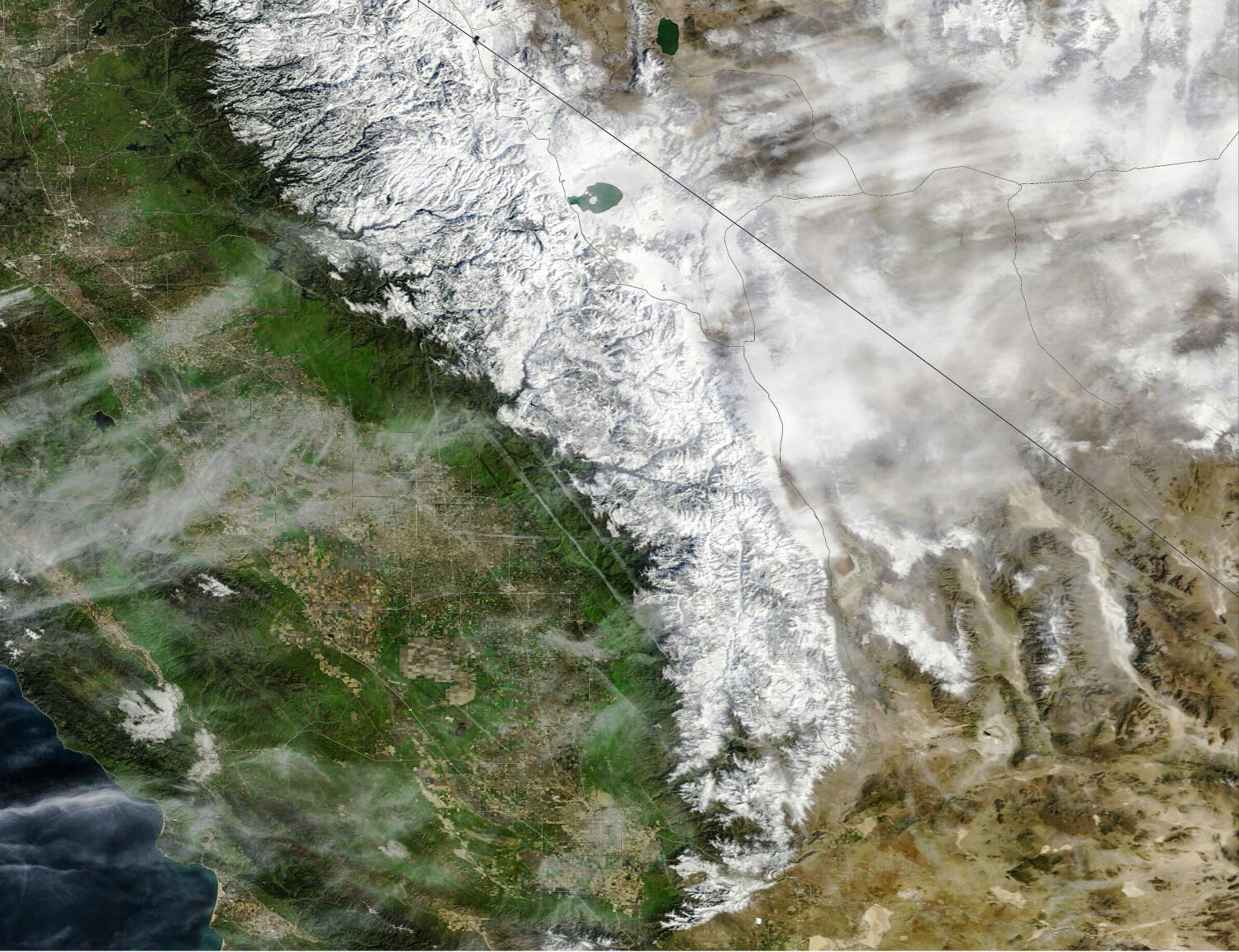
Stop staring at the satellite photos. The gleaming white peaks of the Sierra Nevada look spectacular on a 4K monitor, but they are a visual lie. Every time a major storm cycles through, the media treats these images like a financial bailout. We see "blanketed mountains" and think the debt is paid. We assume the drought is over because the "bank account" looks full.
It isn't. Not even close.
The obsession with "snowpack totals" is a relic of 20th-century hydrology that has no place in a world of volatile climate shifts. We are measuring the wrong thing, at the wrong time, for the wrong reasons. While the public celebrates a "miracle March," the actual infrastructure of the West is quietly failing to capture the only thing that matters: the runoff timing.
The Albedo Trap
Modern reporting treats snow as a static resource. It’s not. It is a thermodynamic battery, and that battery is leaking.
When you look at those high-resolution satellite images, you’re seeing albedo—the reflectivity of the Earth's surface. Yes, it’s white. Yes, it looks deep. But those images tell you nothing about the Snow Water Equivalent (SWE) versus the sublimation rate. In a warming atmosphere, we are seeing a terrifying trend where snow doesn't just melt into the rivers; it vanishes directly into the air.
I have spent years looking at the delta between "projected yield" and "actual reservoir inflow." The gap is widening. We are losing billions of gallons to "dry soil greed." Before a single drop of that "beautiful snow" reaches a faucet in Los Angeles or a farm in the Central Valley, the parched earth takes its cut. It’s a tax on the snowpack that the pretty satellite photos never account for.
The Myth of the "Slow Melt"
The entire California water system was engineered on a single, flawed premise: the Sierra Nevada acts as a natural "slow-release" reservoir. The idea was that snow would pile up in winter and gently melt through July, feeding the state during the dry months.
That system is dead.
We now face the "Great Compression." Instead of a gradual release, we are seeing massive, rain-on-snow events driven by atmospheric rivers. These aren't "storms"; they are fire hoses. When warm rain hits that "blanketed" snowpack, it doesn't add to the total. It acts as a solvent. It triggers a catastrophic, instant melt that overwhelms our mid-century dam infrastructure.
We are forced to dump water into the Pacific Ocean to prevent dam failures, only to find ourselves in a "drought" three months later. We are literally throwing away the "miracle" because our storage logic is built for a climate that no longer exists.
Stop Asking if the Drought is Over
The most common question I hear is, "How many of these storms do we need to end the drought?"
It’s the wrong question. It’s like asking a person with $10 million in debt how many $50 bills they need to find on the sidewalk to be "rich." California is in a state of permanent groundwater deficit.
The Central Valley has been pumped so dry that the land itself is sinking—a process called subsidence. In some areas, the ground has dropped 30 feet. When that happens, the underground aquifers collapse. They don't "refill" when it snows. The storage capacity is gone forever. You could cover the entire state in ten feet of snow tomorrow, and it wouldn't fix the structural bankruptcy of our aquifers.
The Brutal Math of Soil Moisture
Consider the $SWE$ (Snow Water Equivalent) formula used by the Department of Water Resources:
$$SWE = d \times \left(\frac{\rho_s}{\rho_w}\right)$$
Where $d$ is the snow depth, $\rho_s$ is the density of the snow, and $\rho_w$ is the density of water.
Even if $d$ is massive—the "dramatic blanket" the media loves—if the density is low (powder) and the soil below is at a massive moisture deficit, the effective yield for human use drops toward zero. We are currently operating at a deficit so deep that the first 10 to 15 inches of liquid equivalent in any given season are essentially "pre-paid" to the dirt. You’re looking at a photo of a full vault, but the floor is made of a sponge that hasn't been wet in a decade.
The Satellite Data Deception
NASA’s Airborne Snow Observatory (ASO) is the only group doing real work here. They use LiDAR to actually measure depth and density. Meanwhile, the general news media relies on MODIS or Sentinel-2 optical imagery.
Optical imagery is a psychological sedative. It’s designed to make you feel safe.
If you want the truth, look at the Vapor Pressure Deficit (VPD). This measures how "thirsty" the atmosphere is. Even in a high-snow year, if the VPD is high, the snowpack is being cannibalized by the air. We are currently seeing VPD levels that turn snowpacks into ghosts. You see them on Monday; they are gone by Friday, and the river gauges barely twitch.
Your Lawn is Still the Problem
The counter-intuitive reality of a "big snow year" is that it actually increases water waste.
When the "blanket" photos hit the front page, conservation efforts tank. People turn their sprinklers back on. Politicians stop pushing for hard-nosed desalination or wastewater recycling investments. "Nature fixed it," the narrative goes.
Nature didn't fix it. Nature just gave us a stay of execution.
We are addicted to the "Atmospheric River Lottery." We pray for a few weeks of chaos to save us from years of mismanagement. We treat water as a seasonal gift rather than a finite, circular commodity.
The Actionable Truth
If you want to actually understand California’s survival, stop looking at the mountains. Start looking at the subsidence maps and the pumping regulations.
The "blanket" is a shroud. It covers the fact that we have no way to move this water where it needs to go without destroying the Delta ecosystem or losing half of it to evaporation in open-air canals that belong in the 1800s.
We need to stop celebrating "snow totals" and start obsessing over:
- Managed Aquifer Recharge (MAR): We need to flood farm fields during storms to force water back into the ground, not just hold it behind concrete walls.
- Atmospheric River Diversion: Building high-flow bypasses that treat storm surges as an asset, not a flood risk.
- Ending the Optical Bias: Banning the use of "snow depth" as a metric for water security. It’s a useless number.
The next time you see a "dramatic" photo of a snowy mountain, don't feel relieved. Feel anxious. That snow is a ticking clock, and we are currently too distracted by the view to realize we don't have enough buckets to catch it when it turns to steam.
Turn off the sprinklers. The mountains are white, but the ledger is still red.