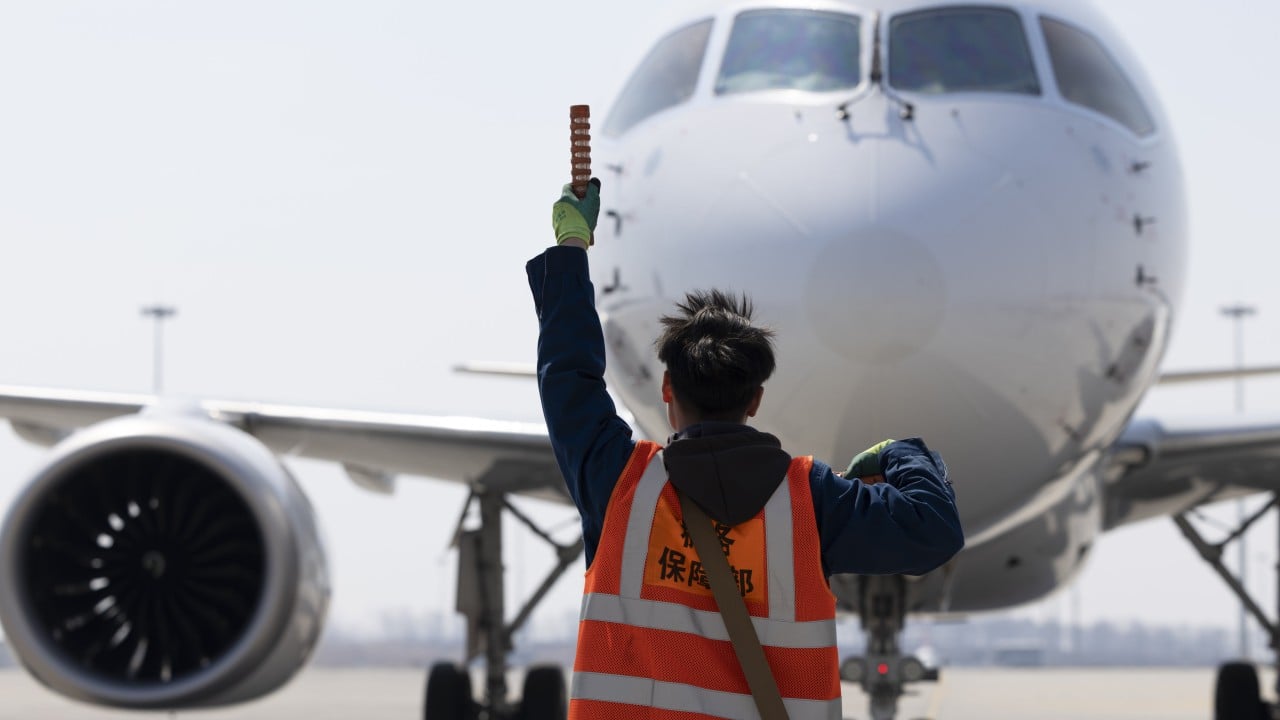
COMAC is learning a painful lesson that the global aerospace industry has known for a century. Building an airplane is relatively easy, but building a supply chain is a brutal, relentless grind. While the C919 has been hailed as China’s long-awaited answer to the Boeing 737 and Airbus A320, the narrow-body jet is currently caught in a logistical chokehold. The aircraft is grounded not by a lack of demand, but by a heavy reliance on the very Western technologies it was designed to replace.
The reality on the tarmac is stark. Delivery targets are slipping. Despite a massive backlog of orders from state-backed Chinese carriers, the actual rollout of the C919 remains a trickle. To understand why, one must look past the "Made in China" sticker and into the guts of the machine. The C919 is a global hybrid, and that hybridity is now its greatest vulnerability.
The Illusion of Domestic Independence
On paper, the C919 is a triumph of Chinese engineering. In practice, it is a masterclass in Western integration. Nearly every mission-critical system—the engines, the avionics, the landing gear, and the flight controls—is supplied by European or American companies. General Electric, Honeywell, and Safran are the silent partners in this endeavor. Without them, the C919 is a very expensive metal tube.
This dependency creates a friction point that Beijing cannot simply spend its way out of. When a component fails or a certification delay hits a Western supplier, COMAC has no fallback. They are at the back of a very long line. Boeing and Airbus, with their massive purchase volumes and decades-long relationships, command the attention of parts manufacturers. COMAC, despite its political backing, is a junior player in a market facing unprecedented shortages of raw materials and specialized labor.
The LEAP Engine Bottleneck
The heart of the problem is the LEAP-1C engine, produced by CFM International—a joint venture between GE and Safran. This is the same family of engines powering the newest Boeing and Airbus jets. The global aerospace market is currently cannibalizing itself for these engines. Supply chain disruptions triggered by the pandemic and exacerbated by geopolitical shifts have left engine manufacturers struggling to meet existing commitments.
When CFM has to choose between fulfilling an order for a legacy giant like Airbus or a newcomer like COMAC, the choice is dictated by contract volume and long-term risk. China’s push for "civil-military fusion" has also placed it under the microscope of US export controls. Every bolt, sensor, and software patch coming from the West requires a bureaucratic odyssey of licenses. If Washington decides to tighten the screws, the C919 production line stops. Period.
Certification and the Shadow of the FAA
A plane that cannot fly internationally is a domestic novelty, not a global competitor. To truly challenge the duopoly, COMAC needs certification from the FAA (Federal Aviation Administration) or EASA (European Union Aviation Safety Agency). This is not just a technical hurdle; it is a political one.
The technical standards for global aviation are written in blood and refined through decades of data. COMAC is attempting to bridge a fifty-year experience gap in less than a decade. While the Civil Aviation Administration of China (CAAC) has cleared the jet, Western regulators are much more skeptical. They require deep access to the proprietary data of the subsystems—data that often belongs to Western suppliers who are wary of intellectual property theft.
The Maintenance Nightmare
Even if COMAC solves the production delays, they face a secondary crisis: the "Aftermarket." An airline makes money when a plane is in the air. If a C919 in Singapore or Dubai needs a specific hydraulic actuator, COMAC must have a global logistics network ready to deliver that part in hours, not weeks.
Building this infrastructure takes decades. Boeing and Airbus have warehouses and certified technicians in every corner of the globe. COMAC has almost none outside of mainland China. For an international buyer, the risk of a "grounded" aircraft with no support path is a financial death sentence. This is why, despite the hype, the C919's order book is almost exclusively filled by Chinese state-owned enterprises that are essentially mandated to buy the plane.
The Strategic Miscalculation
Beijing’s strategy was to use the C919 as a "integrator" project—learn how to put a plane together using Western parts, then slowly swap those parts for domestic versions. This is the "CJ-1000A" engine dream. The problem is that jet engines are the most complex machines ever built by humans.
$$F = \dot{m} \times (V_e - V_0)$$
The physics of thrust are simple, but the metallurgy required to keep a turbine from melting at high altitudes is a closely guarded secret. China is still years, perhaps a decade, away from a domestic engine that matches the fuel efficiency and reliability of the LEAP-1C.
Every year that COMAC spends trying to catch up, Boeing and Airbus are moving the goalposts. They are already experimenting with hydrogen combustion, open-fan architectures, and advanced composites that will make the C919 obsolete before it even reaches its 500th delivery.
Geopolitics as a Production Factor
The C919 does not exist in a vacuum. It is a pawn in a larger trade war. The US "Entity List" is a constant shadow over COMAC’s headquarters. If the C919 is perceived as a threat to US national security or if its technology is diverted to military transport, the supply of Western parts will vanish overnight.
This creates a paradox. To succeed, the C919 needs Western technology. To be safe from Western sanctions, the C919 needs to get rid of Western technology. It cannot do both simultaneously.
The Cost of Delays
Time is the one resource China cannot manufacture. Each year of delay erodes the C919’s value proposition. Fuel prices fluctuate, but the demand for efficiency only goes up. The current C919 configuration is competitive with the current generation of jets, but it offers no "leapfrog" advantage. It is a "me-too" product in an industry that rewards "first-to-market" innovation.
The financial strain is also mounting. While the Chinese government has deep pockets, the sheer scale of subsidies required to keep COMAC afloat while it produces only a handful of jets per year is staggering. This isn't just about aviation; it’s about the opportunity cost of billions of dollars that could be spent on other high-tech sectors.
The Path Forward is Not a Runway
If COMAC wants to survive, it must stop acting like a government department and start acting like a lean manufacturer. It needs to decentralize its decision-making and build genuine, transparent partnerships with global suppliers that go beyond "buying and bolting."
The company also needs to be honest about its timeline. Admitting that the C919 is a transitional platform—a bridge to a more autonomous C929 or C939—would allow for a more realistic assessment of its success. Success for the C919 shouldn't be measured in units sold to Air China, but in the hours flown without a mechanical failure and the speed with which it can clear an EASA inspection.
The C919 is currently a bird with clipped wings. It has the shape of a contender and the backing of a superpower, but it lacks the independent circulatory system required to survive the harsh environment of global commercial aviation. Until China can manufacture the "brain" and the "heart" of the aircraft domestically, the C919 remains a hostage to the very global order it seeks to disrupt.
Forget the flashy airshow displays. Watch the spare parts lead times. That is where the real war for the skies is being won and lost.