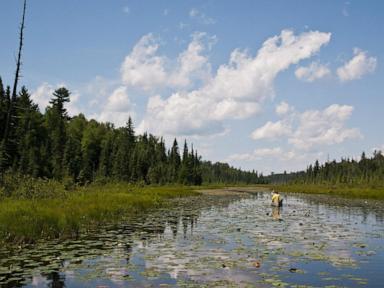
In a single signature on Monday, the federal government dismantled a 20-year firewall designed to protect the most visited wilderness in the United States. President Donald Trump, acting on a resolution passed by a razor-thin 50-49 Senate margin, signed into law a measure that effectively eviscerated the 2023 mineral withdrawal protecting 225,504 acres of the Superior National Forest. This move does not just invite industry back to the table; it hands the keys to the front door of the Boundary Waters Canoe Area Wilderness (BWCAW) to a foreign conglomerate that has spent years lobbying for this specific moment.
The narrative from the Iron Range is focused on "strategic autonomy" and "domestic mineral security." But the reality of the Twin Metals project, owned by the Chilean mining giant Antofagasta Minerals, is far more complex than a simple job-creation story. By utilizing the Congressional Review Act (CRA) to overturn the Biden-era moratorium, Congress and the White House have not only cleared a path for copper-nickel mining in a sulfide-ore watershed but have also ensured that no future administration can unilaterally reinstate these specific protections. This is a permanent shift in the sovereignty of American public lands.
The Mechanics of the Congressional Review Act Gambit
To understand why this is happening now, you have to look at the legislative machinery used to strip the protections. The CRA is often called the "nuclear option" of regulatory rollbacks. It allows Congress to overturn recently enacted federal rules with a simple majority, bypassing the usual 60-vote filibuster threshold in the Senate.
Normally, mineral withdrawals—the technical term for these mining bans—are administrative actions taken by the Department of the Interior based on years of environmental study. By reframing the 2023 withdrawal as a "rule" subject to the CRA, proponents like Representative Pete Stauber (MN-08) successfully bypassed the traditional environmental review process. This was a surgical strike. The resolution, H.J. Res. 140, specifically targets the 225,504-acre block, effectively declaring that the scientific concerns of the past two years are irrelevant to the current political mandate.
Why Copper-Nickel is the Ultimate Gamble
Northern Minnesota has a century-long history of iron mining. It is part of the cultural DNA of the region. However, the iron mining of the past is fundamentally different from the sulfide-ore copper mining proposed by Twin Metals.
Iron ore is generally found in oxide deposits. When you dig it up, the waste is largely inert rock. Copper, nickel, and platinum-group metals in the Duluth Complex are bound in sulfide minerals. When these minerals are exposed to air and water, they undergo a chemical reaction that creates sulfuric acid. This is known as Acid Mine Drainage (AMD).
In a water-heavy ecosystem like the Boundary Waters, where the watershed is a labyrinth of interconnected lakes and streams, there is no such thing as a "contained" leak. Water flows north from the proposed mine site directly into the heart of the wilderness. If the liners fail, or if the water treatment facilities are overwhelmed by a 100-year storm—events that are becoming statistically more frequent—the sulfuric acid and heavy metals like mercury and arsenic enter a system that has zero buffering capacity.
The Antofagasta Connection
The company behind the project, Antofagasta, is not a local startup. It is one of the largest copper producers in the world, controlled by the Luksic family, one of Chile's wealthiest dynasties. While the company promises "world-class" environmental standards, its track record tells a more nuanced story.
Just months ago, in early 2026, Chilean regulators fined Antofagasta’s Centinela mine nearly $775,000 for failing to comply with water monitoring rules. This is the core of the skepticism: if a company struggles to maintain rigorous water resource tracking in the arid landscape of Chile, how will they manage the complex, saturated hydrology of the Superior National Forest?
The financial stakes are massive. The Duluth Complex is one of the world's largest untapped copper and nickel deposits. As the world transitions toward electrification, these minerals are the new oil. This isn't just about Minnesota jobs; it’s about a global commodity play where the wilderness is the collateral.
The Economic Mirage
The primary argument for the mine is the infusion of jobs into the Iron Range. Proponents claim the project will bring hundreds of high-paying mining positions to Ely and the surrounding communities. This is an attractive promise for a region that has seen the boom-and-bust cycles of the iron industry leave towns hollowed out.
However, an independent study from Harvard University suggests that the long-term economic math doesn't add up. The Boundary Waters supports a $13.2 billion outdoor recreation economy. This economy relies on the "wilderness" brand. Once you introduce a massive industrial complex—complete with light pollution, heavy truck traffic, and the perpetual threat of water contamination—the value of that brand diminishes. The Harvard analysis found that over a 20-year period, a mining ban would actually lead to more jobs and higher personal income growth for the region by fostering a diversified economy based on tourism, amenities, and "Zoom-town" migration.
The Erosion of Public Input
Perhaps the most jarring aspect of the current reversal is the speed with which public sentiment was discarded. During the two-year study leading up to the 2023 ban, the Department of the Interior received over 65,000 public comments. The vast majority of those comments—over 90%—were in favor of protecting the watershed.
By using the CRA, the government essentially hit the "delete" key on that entire body of public discourse. The process has been moved from the realm of public science and community feedback into the realm of executive decree and legislative maneuvering. For those who live in the region, the feeling is one of whiplash. One year the land is protected for generations; the next, it is back on the auction block.
The Impending Legal War
Do not expect bulldozers to arrive at Birch Lake tomorrow. The lifting of the ban merely allows Twin Metals to re-submit their lease applications and begin the formal permitting process. This will trigger a legal and regulatory marathon that could last a decade.
Environmental groups, led by Save the Boundary Waters, have already signaled that they will challenge the legality of using the CRA to overturn a mineral withdrawal. They argue that the CRA was never intended to apply to land-management decisions of this type. Simultaneously, the State of Minnesota has its own set of environmental standards that the project must meet.
The battle has moved from the halls of Congress back to the courtrooms and the state agencies. The irony is that the "certainty" promised by the Trump administration may actually lead to years of additional litigation and stalemate.
The Boundary Waters is a rare commodity: a place where the water is still clean enough to drink straight from the lake. Once that purity is traded for industrial output, there is no way to buy it back. The decision signed this week confirms that in the current political climate, the immediate value of what lies beneath the ground has officially surpassed the infinite value of what sits on top of it.