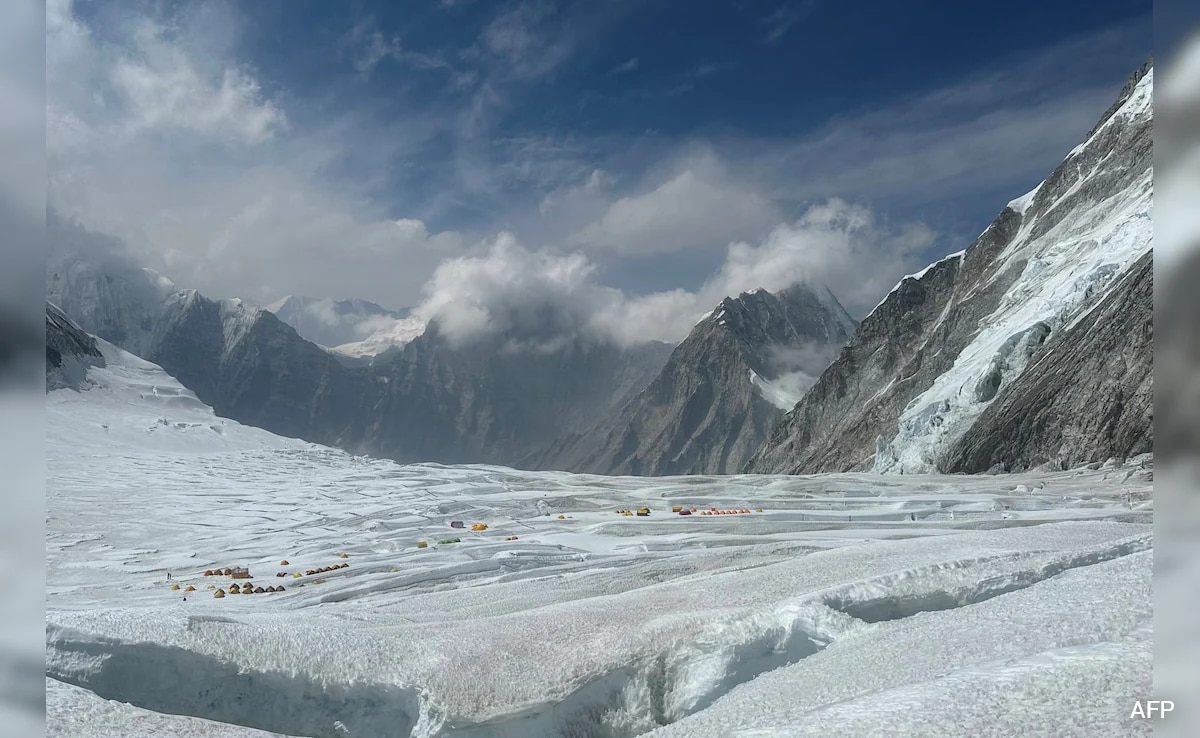
Mount Everest does not belong in the sky. If you stand at the base of the Khumbu Icefall and look up at the 8,848-meter monolith, you are staring at a geological anomaly that should, by all rights of gravity and fluid dynamics, be sitting at the bottom of a tropical sea. The summit of the world consists of marine limestone, filled with the fossilized remains of tiny ocean-dwelling creatures like crinoids and trilobites. This isn't just a quirky trivia point. It is the evidence of a violent, ongoing tectonic collision that turned a seabed into a skyscraper.
The mechanism is simple yet terrifying in scale. Roughly 50 million years ago, the Indian tectonic plate, moving at a speed that is lightning-fast in geological terms—about 15 centimeters per year—slammed into the Eurasian plate. Because both plates were composed of thick continental crust, neither would sink. Instead, they buckled. They folded. They forced the ancient Tethys Ocean floor into the stratosphere. For a different view, consider: this related article.
Everest is still growing. It is an active construction site, rising approximately 4 millimeters every year. While we treat the mountain as a static monument to human endurance, it is actually a dynamic pressure cooker of heat, friction, and unimaginable weight.
The Tethys Ocean and the Great Squeeze
Long before the first human stepped foot on the South Col, the space between India and Asia was a vast, warm waterway. This wasn't a barren void. It was a thriving ecosystem. As marine life died, their calcium-rich shells settled on the floor, layering over millions of years to form the Yellow Band—that distinct layer of marble and limestone visible just below Everest's summit. Related analysis on this matter has been provided by National Geographic Travel.
The transition from water to rock happened through a process called lithification. The weight of the ocean and subsequent sediment layers squeezed the organic remains into solid stone. When India began its northward sprint, it acted like a giant snowplow. It didn't just hit Asia; it pushed the sedimentary layers of the Tethys Ocean floor upward, crumpling them like a rug being pushed against a wall.
This wasn't a clean break. The crust didn't just pop up. It underwent crustal shortening. The earth’s skin literally bunched up, doubling in thickness. This is why the Tibetan Plateau is the highest and largest plateau on Earth. It is a massive block of "extra" crust that has nowhere else to go but up.
The Physics of Buoyancy
To understand why Everest stays up, you have to understand isostasy. Think of the Earth's crust as a piece of wood floating in a tub of water (the mantle). If you stack more wood on top, the bottom sinks deeper, but the top also sits higher.
Everest has a "root." For every meter of mountain you see above the clouds, there are several kilometers of thickened crust pushing down into the mantle below. The mountain is essentially floating on a sea of semi-solid rock. If that root weren't there, the weight of the mountain would cause it to collapse under its own gravity.
The Hidden Engine of Perpetual Growth
Most people assume the collision ended eons ago. It didn't. The Indian plate is still grinding into Asia, currently moving at about 5 centimeters per year. This persistent shove creates an incredible amount of tectonic stress.
When this stress exceeds the strength of the rocks, they snap. That snap is an earthquake. The 2015 Gorkha earthquake in Nepal actually moved Everest. It didn't just shake the ground; it physically shifted the mountain 3 centimeters to the southwest. However, while some quakes cause the mountain to drop slightly, the long-term trend remains upward.
The Erosion Paradox
There is a counter-intuitive force at play here. As Everest grows, the weather tries to tear it down. Glaciers, wind, and freezing cycles act like sandpaper, grinding away at the peak. You would think this would make the mountain shorter.
It does the opposite.
This is the Isostatic Rebound effect. When glaciers and rivers carve deep valleys into the sides of the mountain, they remove mass. Because the mountain is now "lighter," the buoyant force of the mantle pushes it even higher. It is a cycle where the very act of being eroded allows the mountain to rise further into the atmosphere. Recent studies suggest that the Arun River, which cuts a deep gorge through the Himalayas, has actually accelerated Everest's growth by several millimeters a year simply by removing the weight of the rock above it.
The Death Zone Geochemistry
The fact that the summit is limestone—a relatively soft rock compared to the granite found lower down—is a miracle of survival. Limestone usually dissolves in water. On Everest, the cold is so extreme that chemical weathering essentially stops. The rock isn't being eaten away by acid rain because the water never stays liquid long enough.
Instead, the mountain faces mechanical weathering. The "Freeze-Thaw" cycle is the primary enemy. Water seeps into microscopic cracks in the limestone, freezes, expands, and shatters the rock from the inside out. This creates the deadly scree fields and rockfalls that haunt climbers.
The Chemical Signature of the Summit
If you were to take a piece of the summit limestone and analyze it in a lab, you would find high concentrations of calcium carbonate ($CaCO_3$). This is the same stuff in an antacid tablet or a piece of chalk. It is a profound irony that the most formidable obstacle on the planet is made of the same material we use to write on blackboards.
The pressure required to turn seabed muck into this hard, greyish-yellow rock is immense. We are talking about pressures exceeding several kilobars. At these depths, the rock becomes "plastic"—it can flow and fold without snapping. This is why you see massive, swirling patterns in the rock faces of the Himalayas. They aren't just rocks; they are frozen waves of stone.
The Counter-Argument to Constant Growth
While the narrative of a "growing mountain" is popular, some geologists argue we are approaching a limit. There is a theoretical maximum height for a mountain on Earth. This limit is dictated by the strength of the rock at the base and the heat of the crust.
As the crust thickens, the bottom of the "root" gets closer to the hot mantle. Eventually, the rock at the base becomes too soft to support the weight above it. The mountain starts to "spread" laterally like a pile of warm fudge. Some analysts believe Everest is nearing this gravitational collapse point.
Furthermore, the "tectonic speed limit" is real. India is slowing down. The resistance from the massive bulk of the Himalayas is acting like a brake. We aren't looking at a mountain that will reach 10,000 meters anytime soon. We are looking at a system in a fragile, violent equilibrium.
The Human Impact of Geological Time
We view Everest through the lens of a two-month climbing season. Geology views it through the lens of fifty million years. The tragedy of modern Everest—the overcrowding, the trash, the commercialization—is a blink in the life of the Tethys seabed.
The mountain doesn't care about our flags or our oxygen bottles. It is a mass of displaced ocean floor that is still trying to find its level. Every time a climber steps on a fossilized brachiopod at 29,000 feet, they are touching a world that existed before the Himalayas were even a ripple on the horizon.
The Vertical Desert
The environmental reality of Everest is that it is a desert. Above 8,000 meters, there is almost no life. The air is too thin to hold heat, and the radiation from the sun is brutal. Yet, this graveyard of ancient sea life is the primary driver of the South Asian monsoon.
The sheer height of the Himalaya acts as a wall, forcing moisture-laden air from the Indian Ocean to rise and dump rain on the plains. Without the rise of Everest, the geography of Asia—and the lives of billions of people—would be unrecognizable. The mountain didn't just rise; it created a climate.
The Future of the Peak
The next few million years will be a tug-of-war. On one side, the relentless northwards shove of India. On the other, the grinding power of the Khumbu and Rongbuk glaciers.
Recent GPS data from permanent stations installed on the rock show that the mountain is moving horizontally more than it is moving vertically. It is being pushed into Asia like a blunt wedge. This suggests that the "Rise" may eventually give way to a "Slide." The crust is so thick now that it may be easier for the land to move sideways into Southeast Asia—a process called extrusion—than to keep stacking higher.
But for now, the seabed continues its upward journey. It remains a monument to the fact that on a long enough timeline, even the bottom of the ocean can touch the stars.
The mountain is a temporary structure. It is a captured moment of a collision that began before we existed and will continue long after we are gone. We are not "conquering" a peak; we are briefly visiting a seafloor that hasn't finished its ascent.
Observe the limestone on the next summit photo you see. That rock was once under thousands of feet of water, home to creatures that never saw the sun. Now, it sits in a place where the sun is the only thing that doesn't freeze. That is the only perspective that matters.