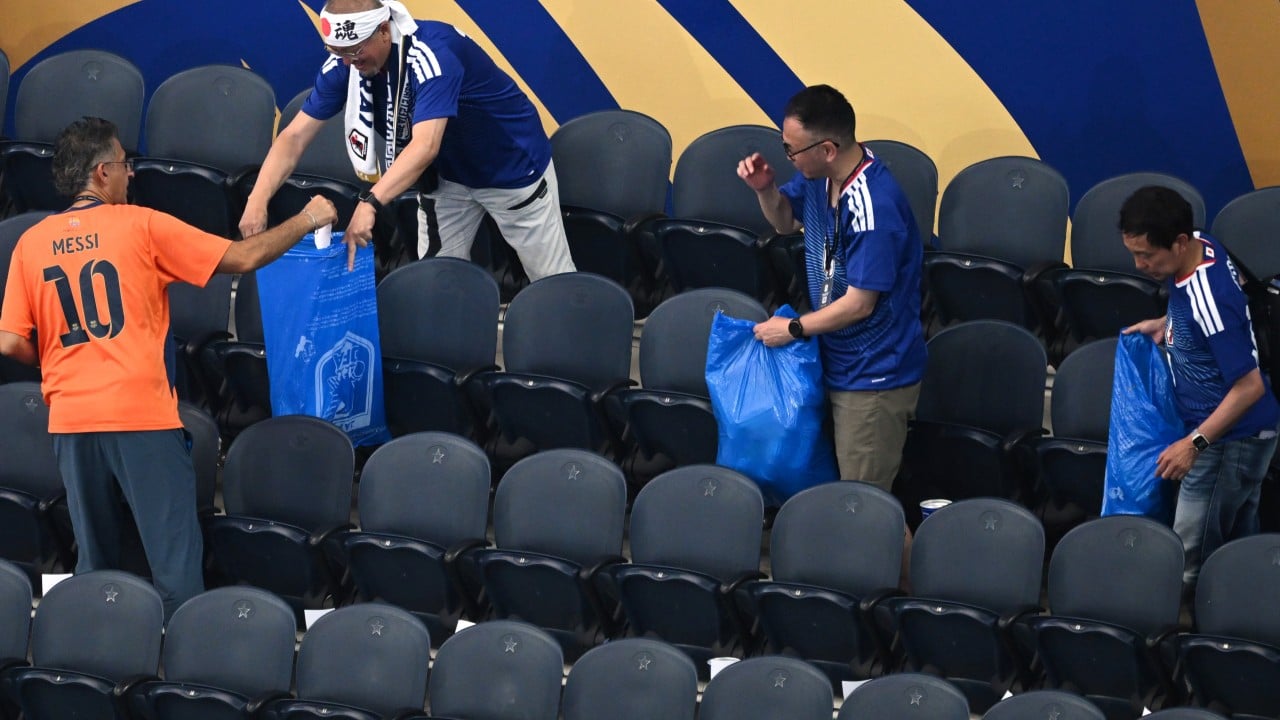
The whistle blows, and ninety minutes of systematic chaos evaporate into the desert air. Around you, eighty thousand people are experiencing the violent, predictable comedown of a World Cup match. It is a sensory assault of discarded plastic cups, crushed soda cans, torn flags, and the sticky, sweet stench of spilled beer baking under stadium floodlights. This is the modern sporting colosseum at its most honest. We came, we consumed, we left our trash for someone else to deal with.
Except for the corner of the stadium swathed in samurai blue.
While the rest of the arena funnels toward the exits in a dazed, tribal herd, a distinct group of people stays behind. They are not loitering. They are not waiting for the traffic to clear. Instead, they are unfolding large, blue plastic bags that they brought with them into the stadium. They begin to move down the rows of seats. Methodically. Quietly. Bent at the waist, picking up the debris left behind not just by their fellow countrymen, but by the very fans who had just spent the evening screaming in their faces.
To the uninitiated Western eye, it looks like a bizarre act of public penance. Why would someone pay thousands of dollars to fly across the world, spend a fortune on a match ticket, and then spend their post-game high doing the unpaid labor of a stadium janitorial crew?
The answer is a word that contains an entire worldview. Atarimae. It translates roughly to "the obvious," or "the natural state of things." But translation fails to capture its weight. It is a cultural gravity.
The Anatomy of an Clean Stadium
To understand why this happens on the world stage, you have to look at a small classroom in suburban Tokyo on a rainy Tuesday morning. There are no janitors here.
Imagine a seven-year-old child named Kenzo. The school bell rings, signaling the end of the day. But Kenzo does not run out to the playground. Instead, he grabs a broom. His classmate, Yui, grabs a cloth. For the next fifteen minutes, the entire student body scrubs the floors, wipes down the desks, and cleans the toilets. This practice, known as o-soji, is baked into the Japanese educational curriculum from kindergarten through high school.
It is not a punishment. It is a philosophy.
When you spend your formative years cleaning up after yourself, your relationship with public space fundamentally shifts. The stadium seat in Qatar or Russia is not a temporary rental to be abused; it is an extension of the home. To leave it dirty is to leave a stain on your own character.
During the World Cup, foreign journalists approached these cleaning fans with a mix of fascination and mild condescension, treating them like a heartwarming sideshow. The fans themselves seemed genuinely confused by the attention.
"We are not doing this for the cameras," one fan explained through a translator, his hands full of discarded food wrappers. "It’s just our way. We cannot leave a place less beautiful than we found it."
Consider the sheer friction of this act. The emotional reality of a football match is an unstable thing. If your team wins, you want to drink, dance, and lose your mind in the streets. If your team loses, the psychological weight is suffocating; you want to crawl into a dark room and forget the match ever happened. Yet, regardless of the scoreboard, the blue bags come out. The discipline overrides the dopamine.
The Invisible Labor
There is a unspoken contract in modern society that says money absolves us of responsibility. I paid for this ticket, therefore the cleanup cost is factored into the price. I created a job for a stadium worker, so I am actually doing them a favor by dropping my trash on the floor.
It is a comfortable lie.
What the Japanese fans demonstrate is a quiet rebellion against this exact brand of transactional nihilism. They expose the laziness of the rest of the world by simply doing what is decent. It is an act of radical empathy for the invisible workforce—the low-wage migrant laborers who typically spend the midnight hours scraping stale nacho cheese off concrete steps long after the spectators have gone to sleep.
But this isn't just about trash. It is about a concept called meiwaku, the deep-seated aversion to causing trouble or inconvenience for others.
In Japan, meiwaku governs everything from the eerie silence on a packed Tokyo subway train to the way people carry their garbage home with them because public trash cans are almost nonexistent. When you drop a plastic bottle in a stadium, you are creating meiwaku for the person who has to pick it up. You are shifting your burden onto someone else’s spine.
The ripple effect of this behavior is contagious. During recent tournaments, a fascinating psychological shift began to occur in the rows adjacent to the Japanese supporters. Fans wearing the colors of opposing teams—countries with entirely different cultural norms regarding litter—started asking for blue bags. They didn't speak the language, but the language of a clean row is universal. They began picking up their own trash.
This is the true power of the narrative. It wasn't enforced by security guards or incentivized by stadium management. It was driven by the sheer, awkward shame of being the only messy person in a room full of people who respect the floor they walk on.
The Locker Room Phenomenon
The culture does not stop at the grandstands. It runs down the concrete tunnels, past the security checkpoints, and directly into the inner sanctum of the athletes themselves.
After Japan's historic, logic-defying upset victory over Germany, the celebration in the locker room was undoubtedly chaotic. Yet, hours after the final whistle, FIFA officials entered the Japanese dressing room to find something that felt almost supernatural.
The floor was swept. The tactical whiteboards were wiped completely clean. The water bottles were lined up in perfect, military rows on the counter. And sitting in the center of the pristine room was a fleet of origami cranes—the traditional Japanese symbol of peace, longevity, and gratitude—accompanied by a handwritten note that read "Thank you" in both Japanese and Arabic.
Most elite sports teams leave locker rooms looking like war zones—torn athletic tape, discarded medical wraps, half-eaten protein bars, and pools of spilled energy drinks. The Japanese national team treated the space like a temple.
This is where the argument that this behavior is "just for show" completely falls apart. There were no television cameras allowed in that locker room when the players left. There was no PR firm directing them to fold paper cranes. They did it because of atarimae. Because who you are when no one is watching is the only version of you that actually matters.
The Weight of the Bag
It is easy to romanticize this. It is easy to look at these images from the comfort of a laptop screen and sigh at the beautiful, orderly nature of a distant culture. But practicing this level of mindfulness is exhausting. It requires an active, deliberate resistance against the natural human urge to be lazy.
Think about the last time you were in a crowded movie theater when the credits rolled. You looked at the empty popcorn bucket in your cup holder. You felt that micro-second of internal debate. Should I carry this out to the bin, or should I just leave it here? Everyone else leaves theirs.
Most of the time, the environment wins. We conform to the lowest common denominator of our surroundings. If the floor is dirty, we litter. If the floor is clean, we hesitate.
What the Japanese supporters bring to the global stage is a refusal to let the surrounding environment dictate their internal standards. They carry their culture with them in their luggage, packed tightly alongside their jerseys and scarves. They demonstrate that pride in your country isn't just about waving a flag or screaming a chant; it is about how you treat the dirt under your feet in a foreign land.
The match is over now. The stadium lights are shutting down, one bank at a time, plunging the massive structure into a cool, shadowed quiet. The thousands of noisy, passionate, messy human beings have scattered back into the night, chasing the next high, leaving behind nothing but the echoes of their cheers.
And a perfectly clean row of seats.