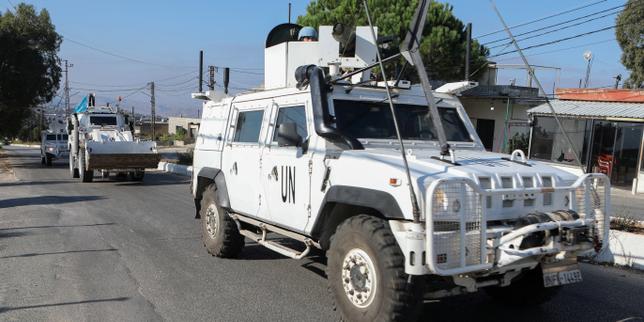
The metal of a UN military vehicle is a specific shade of blue. It is not the deep, rich azure of the Mediterranean Sea just a few miles to the west, nor is it the soft sky blue of a clear summer morning. It is a stark, synthetic hue, chosen precisely because it does not exist in nature. It is a color designed to scream one thing to anyone looking through a sniper scope or a drone camera: We are not part of your war.
But color is a fragile armor when the sky begins to fall.
In the southeastern hills of Lebanon, where the earth is scarred by ancient olive groves and modern craters, that blue paint recently met the gray reality of high-explosive artillery. A peacekeeping base, established to act as a human buffer between implacable enemies, became just another grid coordinate in a target acquisition system. When the smoke cleared, the United Nations Interim Force in Lebanon (UNIFIL) had to do what it has done far too many times since 1978. They had to draft a press release about a dead soldier.
Standard news reports cover these events with a detached, clinical brevity. They tell you the date, the general location, and the boilerplate expressions of deep concern from officials in New York or Geneva. They treat the incident like a sudden, unpredictable weather event. A storm passed through; a man died.
That perspective misses the entire point of what is happening on the shifting borders of our world. To understand the death of a peacekeeper, you have to look past the acronyms and the political statements. You have to understand the profound, almost absurd courage it takes to stand in the middle of a crossfire wearing a bright blue hat, holding a weapon you are legally forbidden to use except as a desperate last resort.
The Geography of Fire
To comprehend the reality on the ground, picture a map where the lines are drawn not in ink, but in historical grievances. Southern Lebanon is a beautiful, brutal maze of limestone ridges and deep ravines. For decades, this terrain has been the staging ground for a perpetual, low-intensity conflict that regularly threatens to boil over into something cataclysmic.
On one side of the line is a state with one of the most technologically advanced militaries on earth, possessing sensors that can track a footprint from miles away and artillery that can hit a coin from across a mountain range. On the other side is a deeply entrenched, highly motivated guerrilla force, woven into the very fabric of the local villages, utilizing tunnels, hidden launch sites, and asymmetric tactics.
Between them stands UNIFIL.
"Our presence is the only thing preventing total miscalculation," a veteran officer once remarked over lukewarm coffee in a concrete bunker. "We are the tripwire. But when someone decides to kick the wire, we are the ones who trip."
The recent bombardments in the southeast were not an anomaly. They were the mathematical result of escalating tensions. When rockets fly south and artillery shells fly north, the trajectory inevitably crosses the small, white-walled compounds flying the UN flag. These bases are not fortresses. They are observation posts. They are built to see, not to fight.
Consider the anatomy of an artillery strike on a peacekeeping position. It rarely starts with a direct hit. It begins with the sound—a low, tearing whistle that rips through the air like wet canvas being torn in half. Anyone who has spent time in a conflict zone knows that sound in their marrow. It gives you perhaps three seconds of warning.
Then comes the pressure wave, a physical wall of air that slams into your chest and forces the breath from your lungs before the noise of the detonation even registers. Dust, pulverized concrete, and the bitter, chemical stench of burnt cordite fill the air. In those seconds, the distinction between a combatant and a peacekeeper vanishes entirely. The shrapnel does not check your passport.
The Illusion of the Buffer Zone
There is a fundamental misunderstanding about what international forces actually do in these volatile zones. Many people look at a map, see a designated buffer area, and assume it functions like a security fence at an airport. They imagine a clean, controlled space where authorized personnel keep bad actors apart.
The reality is messy, frustrating, and chaotic.
The UN personnel live alongside the local population. They drive the same potholed roads, buy fruit from the same local markets, and breathe the same dust. Their mandate, defined by complex international resolutions that read like legal briefs, requires them to monitor violations of ceasefires, assist the local government in reasserting authority, and ensure that civilian populations are protected.
But they must do all of this while navigating a political minefield. To the local populations, the peacekeepers are often viewed with a mixture of gratitude and deep suspicion. Are they there to protect Lebanon, or are they acting as a shield for the other side? Every patrol, every checkpoint, and every glance is scrutinized for bias.
This creates a psychological pressure that is difficult to overstate. Imagine waking up every morning knowing that your survival depends on maintaining an immaculate neutrality that almost no one around you believes in. You are a symbol of an international community that often feels distant, powerless, and hypocritical to the people living on the front lines.
Then the shelling starts.
The recent strike that claimed the life of the UNIFIL soldier highlights the terrifying vulnerability of this position. When a sector comes under fire, the orders are precise: take cover, document the origin of the fire, report it up the chain of command, and wait. You do not return fire against an artillery battery located ten miles away. You do not launch a counter-offensive. You sit in a bunker, feeling the earth shake, and you hope the next shell lands fifty yards to the left.
The Human Behind the Acronym
We rarely learn the names of these fallen soldiers until long after the news cycle has moved on. When we do, they are names from places far removed from the Middle East—young men and women from Ireland, Fiji, India, Spain, or Ghana.
Why do they go? For some, it is the career progression of a professional soldier. For others, coming from developing nations, a UN deployment offers hazard pay that can transform their family's financial future back home. But for almost all of them, there is a quiet, underlying belief that their presence matters. That by simply standing there, they are holding back the dark.
Think of the family waiting for a WhatsApp message that will never come. They didn't send their son or daughter to fight a war; they sent them to keep the peace. There is a cruel irony in receiving a coffin wrapped in a blue flag, knowing that the person inside died not in the pursuit of victory, but in the stubborn, static defense of a line on a map.
The loss of a single peacekeeper ripples through the entire mission. It changes the way every other soldier looks at the hills surrounding their outpost. The next time a drone hums overhead—a sound that has become the background radiation of modern warfare—it won't be ignored as a routine surveillance flight. It will be watched with white-knuckled intensity.
The stakes are not abstract political concepts debated in New York council chambers. The stakes are the lives of nineteen-year-olds sitting in sandbagged observation towers, watching the horizon for a flash of fire that means they have seconds left to live.
The Cost of Staying
Every time a peacekeeper is killed, a predictable chorus of voices raises the same question: Why are we still there? If the parties involved are determined to destroy each other, why should young soldiers from neutral nations die in the crossfire?
It is a fair question. It is a question that every peacekeeper asks themselves during the long, sleepless nights in a bunker.
But consider what happens if they leave.
If UNIFIL pulls back, the thin, fragile layer of insulation between two heavily armed forces disappears instantly. The small misunderstandings—a farmer crossing a fence to retrieve a stray goat, a routine patrol taking a wrong turn down a dirt track—suddenly become potential triggers for a full-scale war. Without an international witness on the ground to say, “Wait, this was an accident,” the worst-case scenario becomes the default response.
The presence of those blue helmets provides a vital commodity in a crisis: time. It gives diplomats room to make phone calls. It gives cool heads a chance to prevail. It forces both sides to calculate the geopolitical cost of killing international troops, acting as a brake on total, unrestricted escalation.
That brake, however, requires friction to work. And that friction is paid for in human lives.
The death in southeastern Lebanon is a stark reminder that peace is not the absence of conflict; it is the active, dangerous management of it. It is a grueling, thankless task performed by individuals who have volunteered to be the buffer between hatreds they did not create.
The blue paint on those vehicles will be touched up. The concrete walls of the hit compound will be patched with fresh cement. A new soldier will be sent to stand in the tower, looking out over the same fractured landscape, watching the same hills. They will wear the same bright blue helmet, a target against the gray sky, standing between the spark and the powder keg.