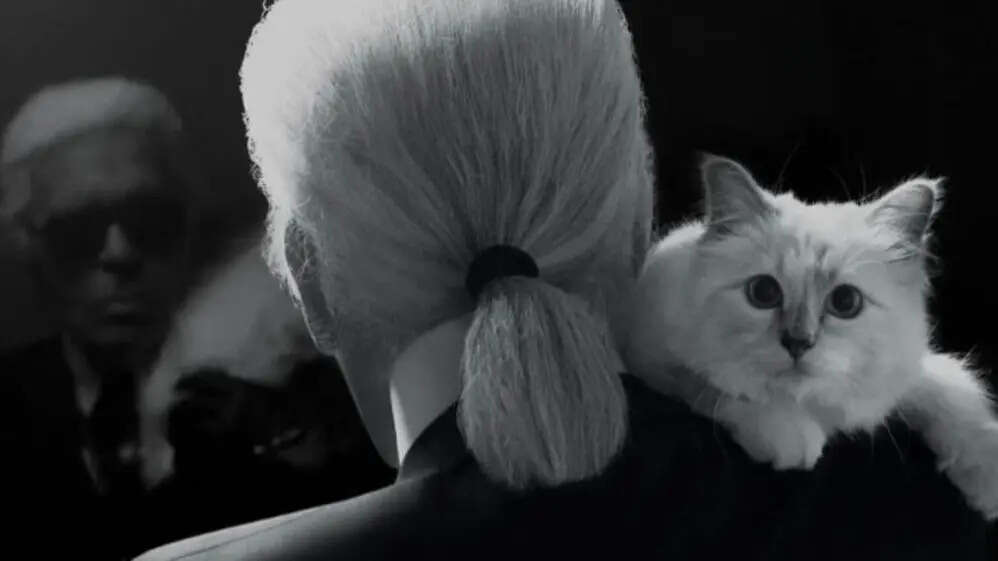
The studio was always too cold. Karl Lagerfeld preferred it that way, a crisp, clinical chill that kept the fabrics stiff and the assistants moving quickly. But on a Tuesday afternoon in Paris, the only sound breaking the silence of the rue Cambon was a soft, rhythmic purring.
Sitting dead center on a mahogany table, surrounded by sketches that would dictate global trends for the next decade, was a Birman cat. Her coat was the color of toasted meringue. Her eyes were two stark, impossibly bright chips of sapphire.
Her name is Choupette.
To the internet, she is a punchline, a symbol of high-society absurdity, or a bizarre trivia question. You have likely seen the headlines splashed across your feed, written in that detached, clickbait shorthand: Meet the $200 Million Cat. We read those numbers and we feel a familiar, cynical detachment. We roll our eyes at the excess of a billionaire designer leaving a fortune to a feline while the rest of the world struggles to pay rent.
But look closer at those blue eyes. The real story isn't about the money. It never was. It is about a lonely, brilliant man who found his only mirror in a creature that didn't care about Chanel, or Kaiser Karl, or the crushing weight of a fashion empire.
The Accidental Muse
Choupette was never meant to stay. In 2011, the French model Baptiste Giabiconi asked Lagerfeld’s bodyguard to cat-sit the two-month-old kitten for a few days while he went abroad.
Lagerfeld was reluctant. He was a man of rigid routines, a towering figure clad in high collars, fingerless leather gloves, and dark sunglasses. He was an institution, not a pet person.
Then, the kitten blinked.
When Giabiconi returned, he didn’t get his cat back. Lagerfeld told him, with characteristic finality, that Choupette now belonged to the house of Lagerfeld. The man who spent his life projecting an armor of aristocratic indifference had been utterly undone by less than three pounds of fluff.
What followed was a transformation that fascinated and baffled the fashion elite. Choupette did not just become a pet; she became an extension of Lagerfeld himself. She was his lunch companion, his travel partner, and eventually, his primary creative inspiration.
Consider the sheer scale of the shift. Lagerfeld began designing collections inspired by her eyes. A specific, icy shade of Choupette blue found its way onto the runways of Chanel. He refused to let her appear in commercials for cat food, declaring her "too sophisticated" for such common endeavors. Instead, she modeled for high-end Japanese cosmetics and German luxury cars, earning millions of dollars in her own right.
She had two personal maids, Françoise and Marjorie, who kept a detailed diary of her moods, her dietary intake, and her bathroom habits. She ate at the table with Lagerfeld, her food served on silver platters from Goyard. Her diet was curated by elite Parisian chefs, featuring a rotation of fresh pâté, diced chicken, and caviar.
It sounds grotesque. On paper, it reads like the ultimate manifestation of late-stage capitalist decadence. But if you strip away the silver platters and the private jets, a deeper, much more vulnerable human truth emerges.
The Armor of Karl
To understand why a man would elevate a cat to the status of a deity, you have to understand the isolation of extreme fame.
Karl Lagerfeld lived his life in the public eye, yet he was profoundly unknowable. He famously constructed a persona that acted as a shield. The powdered ponytail, the dark glasses, the sharp, often cruel wit—it was all designed to keep the world at a distance. He once remarked that he wanted to be a machine, an unstoppable force of work and creation.
But machines do not feel love. And humans cannot live without it, no matter how many walls they build.
Every person who surrounded Lagerfeld wanted something. They wanted a piece of his genius, a nod of approval, a job, a headline, a slice of his staggering wealth. His life was a dizzying carousel of hangers-on, muses who faded with the seasons, and intense, volatile professional relationships.
Except for the cat.
Choupette had no understanding of Chanel's quarterly profit margins. She did not know that the man holding her was a cultural icon. When Lagerfeld took off his glasses at night, in the quiet privacy of his apartment, she saw only a human. She offered the one thing that a man with billions of dollars could never buy: unconditional, unmanipulated affection.
The extravagance he showered upon her was not an act of arrogance. It was an act of desperate gratitude.
The Logistics of a Legacy
When Lagerfeld passed away in 2019 at the age of 85, the fashion world wept. The curtains closed on an era of unparalleled luxury. But almost immediately, the whispers began.
What happens to the cat?
The rumor mill spun out of control. Tabloids claimed Choupette had inherited the entirety of Lagerfeld’s estimated $200 million fortune. Legal experts scrambled to explain that under French law, you cannot leave money directly to an animal.
But laws are easily bypassed by the truly wealthy.
While Choupette did not inherit a bank account with her name on it, Lagerfeld ensured that her lifestyle would remain entirely unchanged. He allocated a massive, undisclosed portion of his estate to a designated caretaker—her longtime nanny, Françoise Caçote—specifically earmarked for Choupette’s ongoing maintenance, security, and medical care.
Imagine the reality of that responsibility. Françoise isn't just taking care of a pet; she is safeguarding a living monument to one of the most powerful designers in history.
Today, Choupette lives a quiet, protected life in the suburbs of Paris. She still has her agent. She still makes occasional, highly curated appearances, like her tribute moment at the 2023 Met Gala, where Jared Leto walked the red carpet in a giant, hyper-realistic costume of her likeness. She remains a millionaire in her own right, her image rights generating a steady stream of revenue that ensures her silver platters will never go empty.
The Ghost in the Room
There is a profound melancholy to Choupette's current existence.
She lives in comfort that human beings can only dream of. She sleeps on cashmere blankets. She is groomed daily. Her health is monitored by the finest veterinarians in Europe. Yet, the center of her universe is gone.
Cats are creatures of habit. They recognize scents, voices, and the specific cadence of a person's walk. For years, Choupette’s life was tethered to a man who doted on her with an intensity that bordered on obsession. Now, she is surrounded by the caretakers he bought for her, living inside a financial apparatus designed to simulate his care.
We look at her $200 million lifestyle and we envy it. We think of the freedom, the luxury, the absence of worry.
But Choupette is a reminder that wealth is a poor substitute for presence. All the silver platters in Paris cannot bring back the man who used to hold her while he sketched. She is a beautiful, pampered ghost inhabiting a world built for a ghost.
On a quiet afternoon in her Parisian villa, Choupette sits by the window, watching the rain hit the glass. Her blue eyes are as bright as ever, reflecting a room filled with expensive things, utterly empty of the only thing that mattered.