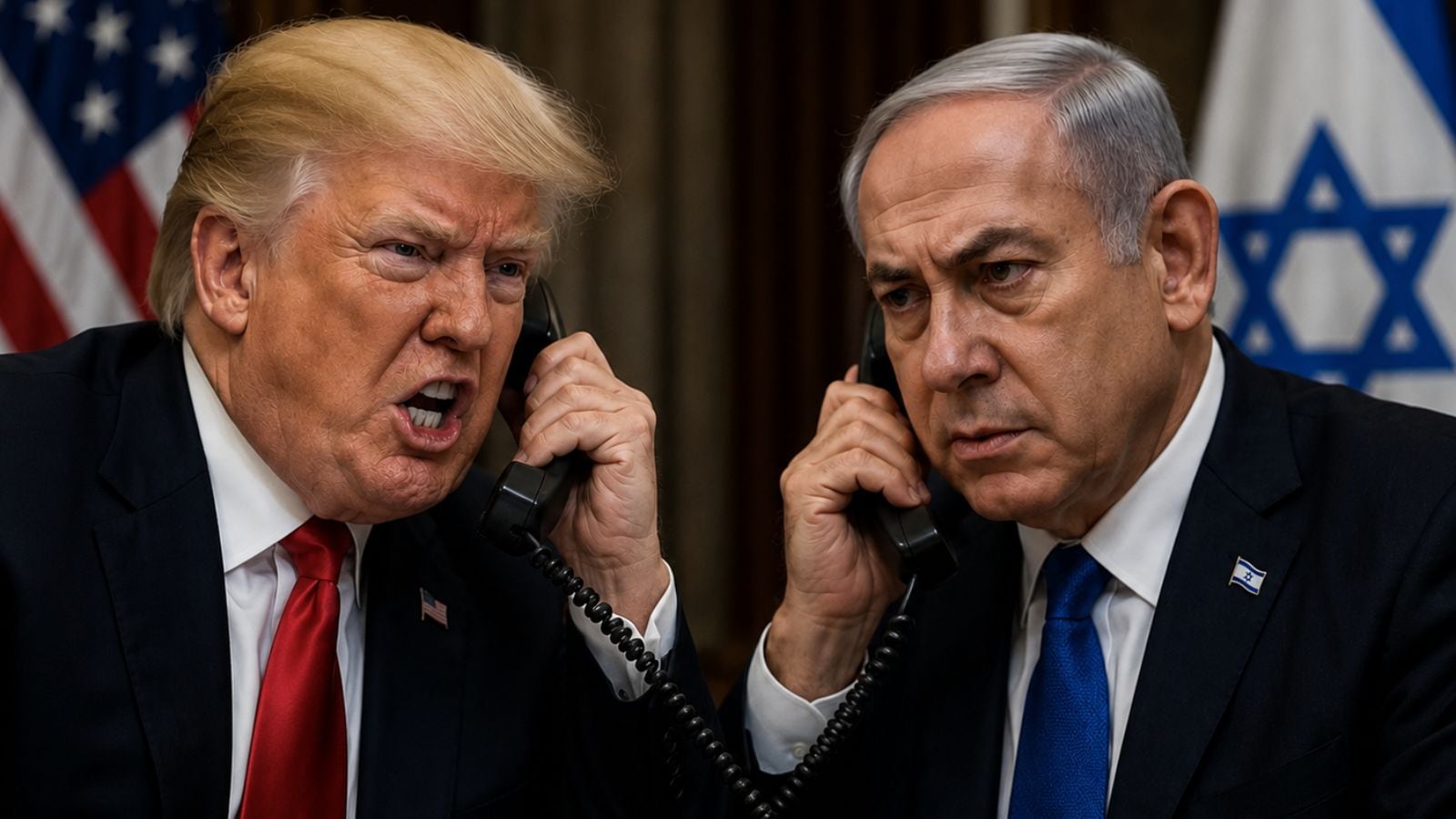
The political commentary machine is running its usual play. The narrative surrounding Donald Trump’s intervention to halt an Israeli strike on Beirut is already set in stone: Benjamin Netanyahu wanted to strike, Washington pulled the leash, and the Israeli Prime Minister is now suffering a humiliating domestic backlash for letting the White House dictate Israel's security borders.
It is a clean, dramatic story. It is also completely wrong.
The conventional wisdom treats Netanyahu like a frustrated hawk chained by American diplomacy. This view misunderstands the fundamental architecture of modern Middle Eastern warfare and the precise utility of American pressure to Israeli political survival. Netanyahu did not suffer a defeat when Trump halted the Beirut operation. He achieved a vital strategic escape hatch. The domestic backlash is not a threat to his coalition; it is the exact theater required to sustain it.
The Lazy Consensus of the Passive Protectorate
Mainstream analysis views the US-Israel relationship through a simplistic lens of dominance and submission. When Washington says "don't," and Jerusalem complies, the immediate assumption is that Israel has surrendered its sovereignty. Analysts point to anger within Netanyahu’s far-right cabinet coalition as proof of a leadership crisis.
This perspective ignores how leverage actually operates in high-stakes geopolitics. A military strike on a dense urban center like Beirut is never just a tactical decision; it is a massive geopolitical gamble with highly unpredictable escalatory loops. By allowing the White House to play the role of the global peacemaker who steps in at the eleventh hour, Netanyahu gets to check three boxes simultaneously: He signals absolute resolve to his base, avoids the catastrophic economic and military fallout of a total regional conflagration, and shifts the blame for inaction onto Washington.
It is an old play, yet observers fall for it every single time.
The Logistics of the Illusion
Let us break down the military reality that the mainstream press routinely glosses over. A sustained air campaign against Hezbollah infrastructure in Beirut requires an immense, continuous expenditure of precision-guided munitions. Israel possesses the most advanced military in the region, but its logistical backbone remains deeply tethered to American supply lines.
Consider the sheer mechanics of an aerial campaign of that scale. We are talking about hundreds of sorties, massive ordnance consumption, and the immediate activation of multi-layered air defense systems like the Iron Dome and David's Sling to counter the inevitable retaliatory barrage of heavy rockets. Every missile fired from an Israeli battery represents a finite resource that requires replenishment.
When an American administration signals a hard red line on an escalation of this magnitude, it is not just issuing a diplomatic request. It is reminding the Israeli security establishment of a stark reality: you cannot fight a multi-front, high-intensity war of attrition without an open logistical pipeline to the United States.
Netanyahu understands this perfectly. He has spent decades navigating the corridors of Washington. He knows that a direct, uncoordinated defiance of a sitting US president on a matter of global security would risk slowing down the very arms transfers that make Israeli military deterrence possible in the first place. By publicly bowing to American pressure, he preserves the structural foundation of Israel's defense while using the political friction to maintain his domestic posture.
Dismantling the Domestic Backlash Narrative
The press is currently obsessed with the fury of Netanyahu’s coalition partners. Hardline ministers are publicly venting, calling the halted strike a capitulation and demanding a hand-off approach from Washington. Commentators point to this as evidence that Netanyahu’s grip on power is slipping.
This is a fundamental misunderstanding of Israeli coalition politics. The outrage is the point.
In a parliamentary system built on fragile coalitions, performance art is a survival mechanism. The far-right ministers must express outrage to satisfy their own hardline voter bases. They need to show they are fighting for total victory. Netanyahu, meanwhile, needs to appear as the responsible statesman balancing raw ideological ambition with the cold realities of international diplomacy.
This domestic friction does not weaken Netanyahu; it insulates him. It creates a convenient scapegoat for the strategic limits of military force. When the public asks why Hezbollah has not been completely eradicated from the Lebanese capital, the answer is not that the Israel Defense Forces lacked the capability or that the strategic cost was too high. The answer becomes: "We were ready to go, but our indispensable superpower ally held us back."
It shifts the debate from a question of military capability to a question of diplomatic management. And on that terrain, Netanyahu always wins.
The Flawed Premise of Absolute Sovereignty
The public constantly asks variations of the same question: Why does Israel allow the United States to dictate its military strategy?
The question itself rests on a flawed premise. It assumes that absolute sovereignty exists for a nation state embedded in a globalized defense network. No state, no matter how powerful, operates in a vacuum.
If Israel were to launch a unilateral, uncoordinated strike on Beirut that triggered a full-scale regional war, the economic consequences alone would be devastating. Flights canceled, major cities under constant rocket fire, the tech sector ground to a halt, and foreign investment fleeing the country. By accepting the American intervention, Netanyahu avoids this scenario without having to admit to his electorate that a total war might be economically and socially unviable.
The real question we should be asking is not why Trump stopped the strike, but rather: How does the illusion of a forced halt benefit both leaders?
For Trump, the calculation is obvious. He gets to project the image of the ultimate dealmaker and strongman who can stop a war with a single phone call, fulfilling his core campaign promise of preventing foreign entanglements. For Netanyahu, he gets a temporary reprieve from a highly risky military gambit while maintaining his credentials as a leader who is willing to push the envelope to the absolute limit. It is a mutually beneficial transaction disguised as a diplomatic crisis.
The Cost of the Game
This strategy is not without its dangers. The downside of constantly relying on Washington to play the bad guy is that it erodes the long-term credibility of Israel's own independent deterrence. If adversaries believe that Jerusalem will always back down when the White House raises its voice, the psychological impact of Israel’s military threats diminishes.
Furthermore, this cyclical theater deepens the polarization within Israeli society. It breeds a toxic domestic discourse where any strategic restraint is viewed as treasonous capitulation rather than a calculated geopolitical move. It trains the electorate to demand maximalist military outcomes that are fundamentally unachievable through airpower alone.
But in the immediate term, the system works exactly as intended. The competitor's lament over a "lost opportunity" or a "humiliated prime minister" misses the entire point of modern statecraft.
Stop looking at the public statements. Stop analyzing the angry tweets from cabinet ministers. Look at the map, look at the supply lines, and look at the political survival calculus. Netanyahu did not want a protracted, total war in Beirut that would drain his resources and alienate his most important ally. He wanted the threat of a strike, and he wanted someone else to take the blame for pulling him back. Trump delivered exactly what was required.