The shift from the Apollo program to the Artemis missions represents more than a chronological gap; it is a fundamental pivot from an expeditionary model to an infrastructure-led paradigm. While Apollo was a geopolitical demonstration of technical capability defined by short-duration, high-risk sorties, Artemis is a logistical exercise in sustainable presence. The primary metric of success for Apollo was the safe return of a human crew; for Artemis, it is the establishment of a repeatable, economically viable supply chain to the lunar South Pole.
The Delta in Strategic Objectives
Apollo operated under a "Flags and Footprints" mandate. The technical architecture was optimized for the specific constraints of the 1960s: limited computing power, chemical propulsion limitations, and a single-use hardware philosophy. The Saturn V rocket was a vertically integrated solution where the entire vehicle, save for the Command Module, was discarded.
Artemis replaces this linear mission profile with a modular, distributed architecture. The objective is not merely to land, but to stay. This requires a three-part structural shift:
- Temporal Persistence: Apollo missions peaked at roughly three days on the lunar surface. Artemis targets 30-day surface stays, necessitating radiation shielding and life-support systems with significantly higher mean-time-between-failure (MTBF) ratings.
- Geographic Specificity: Apollo landed near the lunar equator for optimal lighting and simplified orbital mechanics. Artemis targets the South Pole, specifically the Shackleton Crater region, to exploit Permanently Shadowed Regions (PSRs) that contain volatile water ice.
- Economic Integration: Apollo was 100% government-funded and operated. Artemis relies on the Commercial Lunar Payload Services (CLPS) and Human Landing System (HLS) contracts, shifting NASA from a primary builder to a lead customer of private aerospace capabilities.
The Propulsion and Payload Calculus
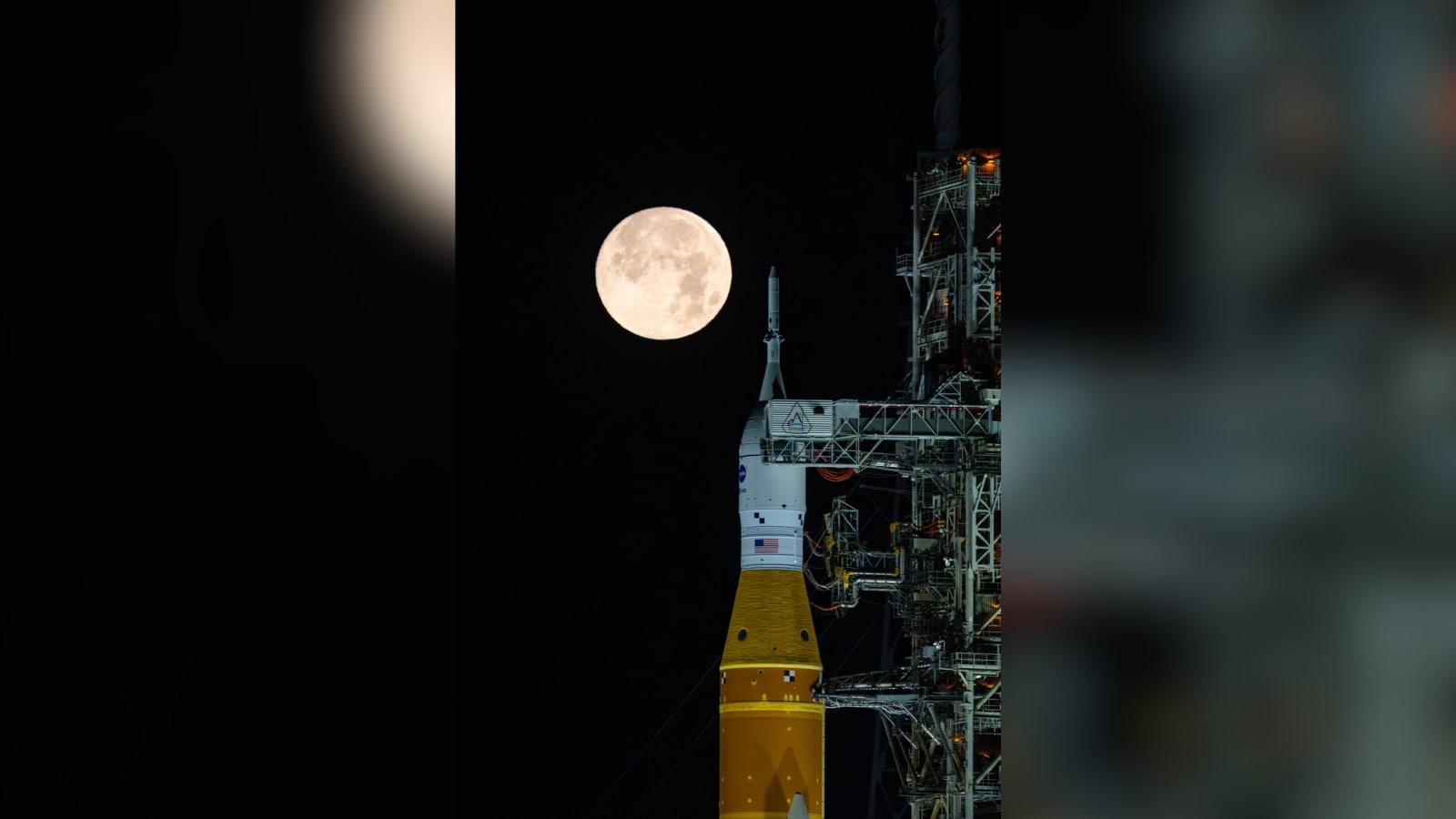
The mass-to-orbit requirements for Artemis dwarf those of Apollo. To understand the scale, one must look at the Initial Mass in Low Earth Orbit (IMLEO). The Saturn V could put approximately 140 metric tons into LEO. The Space Launch System (SLS) Block 1 delivers 95 metric tons, with Block 1B intended to reach 105 metric tons.
At first glance, the SLS appears less capable than its predecessor. However, the Artemis architecture utilizes In-Space Refueling and Distributed Launches. Unlike Apollo, which carried all its fuel from Earth's surface, Artemis intends to use multiple Starship HLS launches to aggregate fuel in orbit before the Orion spacecraft even departs. This decoupling of the crew launch from the fuel and cargo launch allows for a total mission mass that far exceeds the structural limits of any single rocket.
The SLS vs. Saturn V Mechanical Logic
- Propulsion Chemistry: Apollo relied on Rocket Grade Kerosene (RP-1) and Liquid Oxygen (LOX) for its first stage. SLS utilizes a combination of Liquid Hydrogen (LH2) and LOX, supplemented by Solid Rocket Boosters (SRBs). While LH2 provides a higher specific impulse ($I_{sp}$), it is significantly harder to manage due to its low density and cryogenic requirements.
- Orion vs. Apollo Command Module: The Orion capsule is 30% larger by volume than the Apollo Command Module. This volume is not for luxury but for the avionics and life support necessary for deep-space transit times that exceed the 8-day Apollo average.
Orbital Mechanics: The NRHO Constraint
One of the most significant technical deviations is the use of the Near-Rectilinear Halo Orbit (NRHO) for the Lunar Gateway. Apollo stayed in a Low Lunar Orbit (LLO), which was energetically expensive to maintain due to the Moon's uneven gravity (mascons).
The NRHO is a high-altitude, highly elliptical orbit that balances the gravitational pull of the Earth and the Moon. It offers several strategic advantages:
- Constant Communication: The orbit provides a nearly continuous line of sight to Earth, eliminating the communication blackouts Apollo crews experienced when behind the Moon.
- Thermal Stability: The spacecraft remains in sunlight most of the time, reducing the power drain of heating systems and maximizing solar array efficiency.
- Surface Access: While it takes more fuel to descend from NRHO to the surface than from LLO, the NRHO serves as a stable "parking lot" for the Gateway, allowing for easier docking of multiple international and commercial modules.
Resource Utilization and the Water Ice Hypothesis
The pivot to the South Pole is driven by the physics of In-Situ Resource Utilization (ISRU). In the Apollo era, the Moon was viewed as a dry, geologically dead rock. Modern spectroscopy has confirmed the presence of water ice in craters that never see sunlight.
The chemical equation for survival and propulsion relies on this ice:
- Life Support: Water can be purified for drinking and electrolyzed to produce breathable oxygen ($O_2$).
- Propulsion: Through electrolysis, water breaks down into Liquid Hydrogen ($H_2$) and Liquid Oxygen ($O_2$), the primary components of high-efficiency rocket fuel.
The "Cost per Kilogram" of lunar operations drops exponentially if the propellant does not have to be lifted out of Earth's deep gravity well. If Artemis successfully demonstrates ISRU, the Moon becomes a "gas station" for the solar system, reducing the mass-at-launch requirements for future Mars missions by an order of magnitude.
The Risk Profile: Redundancy vs. Complexity
Apollo was a masterpiece of "Critical Path" engineering. If any major component of the Saturn V or the Lunar Module failed, the mission was usually lost. Artemis introduces more points of failure through its reliance on docking, refueling, and multiple launch providers.
The complexity of the Artemis "handshake" is its greatest vulnerability:
- The SLS launches the crew in Orion.
- SpaceX or Blue Origin launches the HLS.
- The two must dock at the Gateway or in NRHO.
- The HLS must have been refueled by multiple "tanker" launches previously.
Each docking event and fuel transfer is a high-risk operation. However, this modularity also provides a form of systemic resilience. If one launch provider fails, the entire program does not necessarily grind to a halt, as was the case after the Apollo 1 fire or the Challenger disaster. The shift is from single-vehicle reliability to networked system reliability.
The Geopolitical and Legal Framework
Apollo was governed by the 1967 Outer Space Treaty, which prohibited sovereign claims on celestial bodies but lacked detail on commercial exploitation. Artemis operates under the Artemis Accords, a set of bilateral agreements led by the United States to establish "Safety Zones" around lunar operations.
The Accords attempt to solve the "Tragedy of the Commons" on the Moon. By defining how resources can be extracted and who owns them, the framework creates the legal certainty required for private investment. This is a sharp departure from the purely scientific and prestige-based motives of the 1960s. The presence of international partners (ESA, JAXA, CSA) in the Gateway further complicates the management but stabilizes the funding, making it harder for a single political administration to cancel the program.
Navigation and Communication Infrastructure
Apollo crews navigated using star sightings and ground-based radar. Artemis will utilize LunaNet, an extensible lunar internet and GPS-like positioning system. This infrastructure is required because the South Pole's terrain is treacherous, featuring long shadows and jagged craters that make visual navigation unreliable.
Autonomous landing systems (ALHAT) will replace the manual piloting that Neil Armstrong famously used to avoid boulder fields. These systems use LiDAR to build 3D maps of the surface in real-time, allowing for a landing precision of meters, compared to the kilometers-wide "ellipses" of the Apollo era.
The Long-Term Strategic Play
The transition from Apollo to Artemis is the transition from exploration to occupation. The true value of Artemis is not the lunar surface itself, but the development of the technologies required to operate in "Deep Space" for extended periods.
The operational bottleneck for any future Mars mission is not the distance, but the duration. Artemis serves as the "Long Duration" testbed for:
- Nuclear Surface Power: Moving away from solar dependence during the 14-day lunar night.
- Closed-loop Life Support: Achieving 98% or higher recycling rates for water and air.
- Autonomous Medical Care: Managing crew health without the possibility of immediate Earth-return.
The logistical framework established now determines the feasibility of every crewed mission for the next fifty years. The immediate priority must be the validation of the HLS refueling cycle and the successful deployment of the first Gateway modules. Without the orbital refueling infrastructure, the Artemis architecture remains a high-cost replica of Apollo; with it, the Moon becomes the first node in a permanent interplanetary trade route.