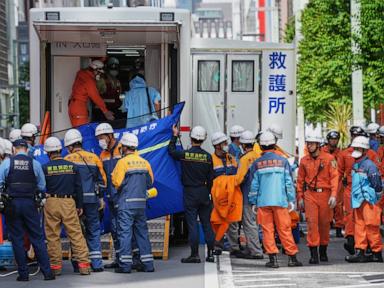
The deployment of an unidentified airborne irritant in a dense urban transit hub reveals critical vulnerabilities in municipal emergency response architectures. When a substance is released in a high-traffic environment—such as the incident in Tokyo where over 20 individuals required immediate hospitalization—the primary challenge is not merely medical treatment, but the systemic management of information, containment, and triage under conditions of absolute uncertainty.
Urban CBRN (Chemical, Biological, Radiological, and Nuclear) mitigation relies on a three-phase operational framework: rapid detection, dynamic triage, and secondary contamination prevention. When an unknown agent is introduced, emergency services operate in an informational vacuum. The immediate cascade of panic often outpaces the physical spread of the toxin, distorting the scale of the crisis and choking local medical infrastructure.
Evaluating these events requires analyzing the friction points between public safety protocols, toxicological assessment, and crowd psychology.
The Tri-Centric Crisis Model of Unknown Material Releases
An urban chemical incident does not expand linearly. It operates across three distinct vectors that move at different velocities, forcing responders to allocate finite resources across competing priorities.
[Agent Dispersion] -------> Exponential physical decay based on ventilation
[Somatic Response] ------> Linear progression of physiological symptoms
[Psychogenic Scale] -----> Geometric expansion driven by information vacuum
1. The Vector of Physical Dispersion
The actual footprint of the chemical agent is dictated by fluid dynamics, HVAC architecture, and ambient atmospheric conditions. In enclosed transit spaces, particulate matter or gas behaves predictably, losing concentration as it moves away from the source. This physical threat diminishes over time through ventilation or settling.
2. The Vector of Somatic Response
This represents the actual physiological impact on exposed individuals. Symptoms such as eye irritation, coughing, and respiratory distress develop based on dose-response curves. The challenge for responders is that different chemical classes (e.g., lacrimators, organophosphates, simple asphyxiants) present overlapping early symptoms, making definitive field diagnosis impossible without specialized spectroscopy.
3. The Vector of Psychogenic Expansion
The largest variable is the geometric expansion of perceived exposure. In mass casualty events involving unknown substances, hyperventilation and acute stress responses mimic the clinical signs of chemical poisoning. This creates a surge of "worried well" individuals who overwhelm triage lines, competing for medical resources with genuinely compromised patients.
Operational Bottlenecks in Mass Triage
The core failure point in the Tokyo transit incident, and similar urban releases, lies in the transition from localized incident to mass casualty protocol. When more than 20 individuals exhibit acute symptoms simultaneously, standard one-to-one emergency medical responses break down. A systemic bottleneck occurs at the intersection of decontamination and transport.
Standard operating procedure dictates that patients exposed to an unknown chemical must undergo decontamination before entering a clean environment, such as an ambulance or a hospital emergency department. This requirement introduces a severe operational delay.
- The Decontamination Logistical Choke Point: Setting up field showers and isolation tents requires a minimum of 15 to 30 minutes from the arrival of specialized hazardous materials units. During this window, symptomatic individuals either remain untreated in the warm zone or bypass containment entirely, risking secondary contamination of transport vehicles and medical facilities.
- The Triage Asymmetry: First responders frequently misclassify psychogenic symptoms as toxicological symptoms due to the absence of rapid-screening biometric tools. This misclassification inflates the reported casualty count, misallocates high-priority transport assets, and dilutes the focus of advanced life support personnel.
The structural flaw in this model is the assumption of a static scene. In reality, a transit hub is highly porous. Exposed individuals who are mobile will naturally flee the immediate area, dispersing into the surrounding city before a perimeter can be established. This self-evacuation effectively decentralizes the crisis, transforming a single-point containment challenge into a multi-site epidemiological tracking problem.
Toxicological Classification Under Information Deficit
When an agent is unknown, field medical personnel must utilize syndromic surveillance to categorize the threat based on observable clinical presentations. This methodology allows for presumptive treatment protocols to begin before laboratory confirmation.
| Observed Toxidrome | Primary Clinical Signs | Suspected Material Classes | Immediate Countermeasure |
|---|---|---|---|
| Irritant / Lacrimator | Profuse tearing, rhinorrhea, superficial skin burning, acute coughing. | Pepper spray (OC), CS gas, CN gas, volatile organic solvents. | Copious water irrigation, fresh air exposure, topical soothing agents. |
| Cholinomimetic | Miosis (pinpoint pupils), salivation, lacrimation, urination, defecation, bronchoconstriction. | Organophosphate pesticides, G-series nerve agents. | Atropine administration, Pralidoxime (2-PAM) injection, immediate clothing removal. |
| Asphyxiant | Cyanosis, altered mental status, tachypnea, headache without upper airway irritation. | Carbon monoxide, hydrogen cyanide, simple choking agents. | High-flow oxygen, specific metabolic antidotes (e.g., cyanokit). |
The Tokyo scenario—characterized by sudden onset irritation leading to hospitalizations without immediate fatalities—strongly correlates with the Irritant/Lacrimator profile. While these substances are rarely lethal in open environments, their deployment in confined spaces increases the risk of mechanical asphyxiation due to crowd surges and severe bronchospasms in individuals with pre-existing respiratory vulnerabilities such as asthma.
The analytical limitation of relying solely on syndromic surveillance is its vulnerability to false positives caused by environmental cross-contamination. For example, a localized refrigerant leak can produce upper respiratory symptoms that mimic a deliberate chemical assault, leading to an inappropriate escalation of defensive measures and unnecessary public alarm.
Structural Redesign of Urban Chemical Defense Systems
Mitigating the impact of future transit-based chemical incidents requires moving away from reactive, post-exposure frameworks toward an integrated, automated defense architecture. Relying on human observation to initiate a CBRN response introduces unacceptable latency.
The first critical upgrade involves the deployment of continuous-monitoring photoionization detectors (PIDs) and surface acoustic wave (SAW) sensors within municipal transit ventilation networks. These sensor arrays must be programmatically linked to the facility's HVAC infrastructure. Upon detection of anomalous volatile organic compound (VOC) spikes or specific chemical signatures, the system must automatically execute an isolation protocol: shutting down intake valves to prevent agent recirculation, reversing exhaust fans to create negative pressure zones within the target area, and directing clean air toward designated evacuation routes.
The second operational shift requires redefining the triage line through the implementation of rapid physiological screening. Instead of relying on subjective symptom reporting, field teams must utilize thermal imaging cameras to instantly assess respiratory rates and facial vascular responses across large crowds. This allows triaging officers to differentiate between the autonomic nervous system responses of panic and the localized inflammatory responses of chemical exposure, effectively separating the psychogenic casualties from those requiring immediate toxicological intervention.
Municipalities must abandon the assumption that casualties will remain at the scene for orderly decontamination. The modern response framework must incorporate decentralized decontamination kits—portable, dry-decontamination wipes distributed to all first-tier responders—allowing for immediate self-remediation and agent neutralization at the point of contact, minimizing the secondary contamination vector during self-evacuation.
The final strategic play requires establishing pre-negotiated data-sharing protocols between transit authorities, emergency services, and regional hospital networks. The moment a sensor detects an anomaly or a mass casualty protocol is initiated, automated manifests of potential patient volumes and suspected agent profiles must be pushed to receiving emergency rooms. This eliminates the communication lag that traditionally leaves hospitals unprepared for the sudden arrival of self-transported, contaminated patients, ensuring that the broader medical infrastructure remains resilient against systemic collapse during an urban crisis.