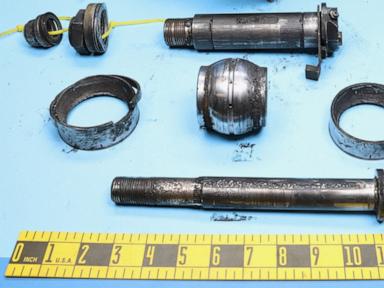
The catastrophic structural failure of United Parcel Service (UPS) Flight 2976 at Louisville Muhammad Ali International Airport—resulting in 15 fatalities—exposes a critical vulnerability in modern aviation asset management: the financial and regulatory optimization of maintenance schedules at the expense of empirical engineering safety margins.
When a multi-ton propulsion unit shears entirely from an airframe during the high-load takeoff phase, the failure is rarely a localized material defect. Instead, it represents the terminal endpoint of a multi-year systemic degradation process. National Transportation Safety Board (NTSB) investigative proceedings reveal that the structural failure of the McDonnell Douglas MD-11F left-engine pylon assembly was completely detectable, entirely predictable, and directly caused by an economically motivated extension of regulatory inspection intervals based on incomplete, legacy data sets.
The Mechanics of Structural Isolation: The Three-Pillar Failure Framework
To understand how a primary structural component fails under nominal operating conditions, the system must be decomposed into three intersecting vectors: Geometric Obscuration, Load-Sharing Transfer Asymmetry, and Data-Asymmetric Regulation.
1. Geometric Obscuration and Visual Impairment
The load-bearing interface securing the engine to the wing pylon relies on a high-strength steel spherical bearing encased within a metal sheath. This assembly is positioned deep within the pylon architecture. It cannot be inspected via standard flight-line walkarounds or light-touch maintenance routines.
- The Inspection Penalty: Achieving physical or visual access to detect micro-fissures or micro-fretting requires the total removal of the propulsion unit. This process demands dozens of maintenance hours, dedicated ground support infrastructure, and the complete removal of the revenue-generating asset from service.
- The Visual Proxy Illusion: Because non-destructive testing (NDT) such as eddy-current or dye-penetrant inspections required intrusive teardowns, operators and regulators relied on visual proxies. They assumed that external structural integrity implied internal component health.
2. Load-Sharing Transfer Asymmetry
The engineering architecture of the MD-11 engine mount relies on a series of structural lugs designed to distribute dynamic flight loads. The design operates under a strict assumption of balanced load sharing:
$$\text{Total Load} = \sum_{i=1}^{n} \text{Lug Load}_i$$
When the internal spherical bearing or its metal sheath experiences wear or crack propagation, the mechanical tolerances within the joint shift. This change introduces localized play.
This structural degradation initiates a dangerous chain reaction:
[Spherical Bearing/Sheath Wear]
               │
               ▼
[Mechanical Play & Tolerance Shift]
               │
               ▼
[Loss of Symmetric Load Sharing]
               │
               ▼
[Dynamic Structural Overload on Securing Lugs]
               │
               ▼
[Accelerated Fatigue Crack Propagation]
               │
               ▼
[Catastrophic Structural Shear during Takeoff Thrust]
This structural asymmetry directly caused the failure of N259UP. The aircraft was operating at 21,043 flight cycles. Under the original design parameters, the structural bearing would have been inspected at the 19,900-cycle threshold, exposing the failure before the lugs reached their ultimate tensile limits.
3. Data-Asymmetric Regulation and the 2015 Interval Extension
The core failure mechanism was not the absence of a maintenance standard, but the degradation of that standard via asymmetric regulatory data processing. In 2015, the Federal Aviation Administration (FAA) approved a manufacturer request to modify the Maintenance Review Board Report (MRBR) intervals for the MD-11 airframe.
The adjustment shifted the mandated inspection interval from 19,900 cycles to 29,260 cycles—a 47% extension in operational exposure between deep-tier structural overhauls.
The Cost Function of Maintenance Harmonization
The drive to extend the maintenance interval was rooted in operational cost accounting rather than structural safety margins. Airlines balance airframe downtime against fixed maintenance intervals. By extending the primary structural inspection window to 29,260 cycles, operators could align deep pylon inspections with major heavy-maintenance checks (C-Checks or D-Checks). This change eliminated intermediate unscheduled ground blocks.
The core vulnerability in this optimization framework lies in how the risk equation was formulated. The manufacturer and the regulator treated the probability of component failure as a static variable derived from legacy design assumptions, rather than an active variable informed by real-world service letters.
| Metric Parameter | Original Specification | Revised 2015 Specification | Post-Accident Emergency Mandate |
|---|---|---|---|
| Inspection Interval (Cycles) | 19,900 | 29,260 | 4,000 (Full Replacement) |
| Inspection Type | Deep-Tier NDT / Disassembly | Synchronized C-Check Visual | Mandatory Component Scrap |
| Pre-Incident Failure Indicators | 7 Documented Instances | 10 Documented Instances (Ignored) | N/A - Total System Overhaul |
The mathematical reality of this extension is stark. The structural flaws documented by the NTSB between 2002 and 2009 all occurred within a tight distribution band between 6,058 and 13,650 cycles. By extending the threshold to 29,260 cycles, the regulator approved an interval that was more than double the cycle age at which empirical field failures were already occurring.
The Information Silo: Regulatory Captance vs. Empirical Data Disconnection
The NTSB investigative hearings revealed a significant disconnect in how risk data is communicated among manufacturers, regulators, and fleet operators.
The manufacturer's Airframe Service Engineering division lacked complete, unified documentation during the hearing regarding the historical design assumptions inherited from the 1997 McDonnell Douglas merger. This loss of corporate memory created a dangerous blind spot: the current engineering teams were managing an inspection schedule without a clear understanding of the original fatigue limits.
This structural data gap caused three distinct system failures:
- The Service Letter Loophole: The manufacturer identified at least seven instances of bearing and sheath degradation prior to the 2015 extension, and three more afterward. This information was distributed via informational service letters rather than mandatory Alert Service Bulletins (ASBs).
- The Operator Reliance Principle: Fleet operators like UPS maintain airframes strictly according to the approved design maintenance programs provided by the OEM and authorized by the FAA. An operator cannot independently re-engineer an airframe's underlying structural fatigue model. If the master program classifies a zone as low-risk, the operator's allocation of NDT resources will reflect that classification.
- The FAA Review Deficit: The regulatory authority accepted historical statistical models presented during the 2015 amendment process without reconciling them against active field service data. The presence of multiple field failures before the planes reached even 14,000 cycles should have mathematically invalidated any proposal to extend the inspection limit toward 30,000 cycles.
The Strategic Path to Fleet Stabilization
Remediating this systemic vulnerability requires a complete restructuring of how high-consequence, low-visibility structural components are monitored across aging commercial cargo fleets. The previous strategy of relying on predictive fatigue modeling without empirical verification has failed.
The industry must shift to an aggressive, data-driven strategy to stabilize remaining MD-11 operations, particularly across major cargo carriers like FedEx and UPS.
Immediate Capital and Operational Reallocation
Operators must abandon the 29,260-cycle interval entirely and implement a rigid, lifecycle-limited replacement strategy. The FAA's recent emergency approval of a 4,000-cycle mandatory replacement mandate for the spherical bearing assembly represents the correct baseline.
This mandate changes the maintenance objective from inspection (attempting to locate a hidden crack within an enclosed housing) to hard-time replacement (scrapping the component before it can reach its statistical fatigue limit).
Implementation of Continuous Structural Health Monitoring
Because physical access to the pylon interior requires significant downtime, operators must deploy advanced NDT technologies during minor field checks. Implementing high-frequency eddy current (HFEC) testing around the peripheral attachment lugs can identify secondary stress fractures caused by internal bearing failure. This helps mechanics spot internal issues before total structural separation occurs.
The economic impact of this operational shift is significant. Shortening an inspection or replacement interval from nearly 30,000 cycles down to 4,000 cycles increases the localized maintenance cost function for this specific sub-assembly by over 600%.
However, when weighed against the total loss of an airframe, severe liability claims, and extensive regulatory groundings, the calculation changes. This change demonstrates that treating maintenance intervals purely as an asset-utilization puzzle creates a fragile system vulnerable to catastrophic physical failure.
For an expert visual breakdown of the structural forces and specific component failures involved in this incident, see this Analysis of the MD-11 Engine Attachment Architecture. This video provides crucial context on the mechanical layout of the pylon lugs and the physical sequence of the detachment.


