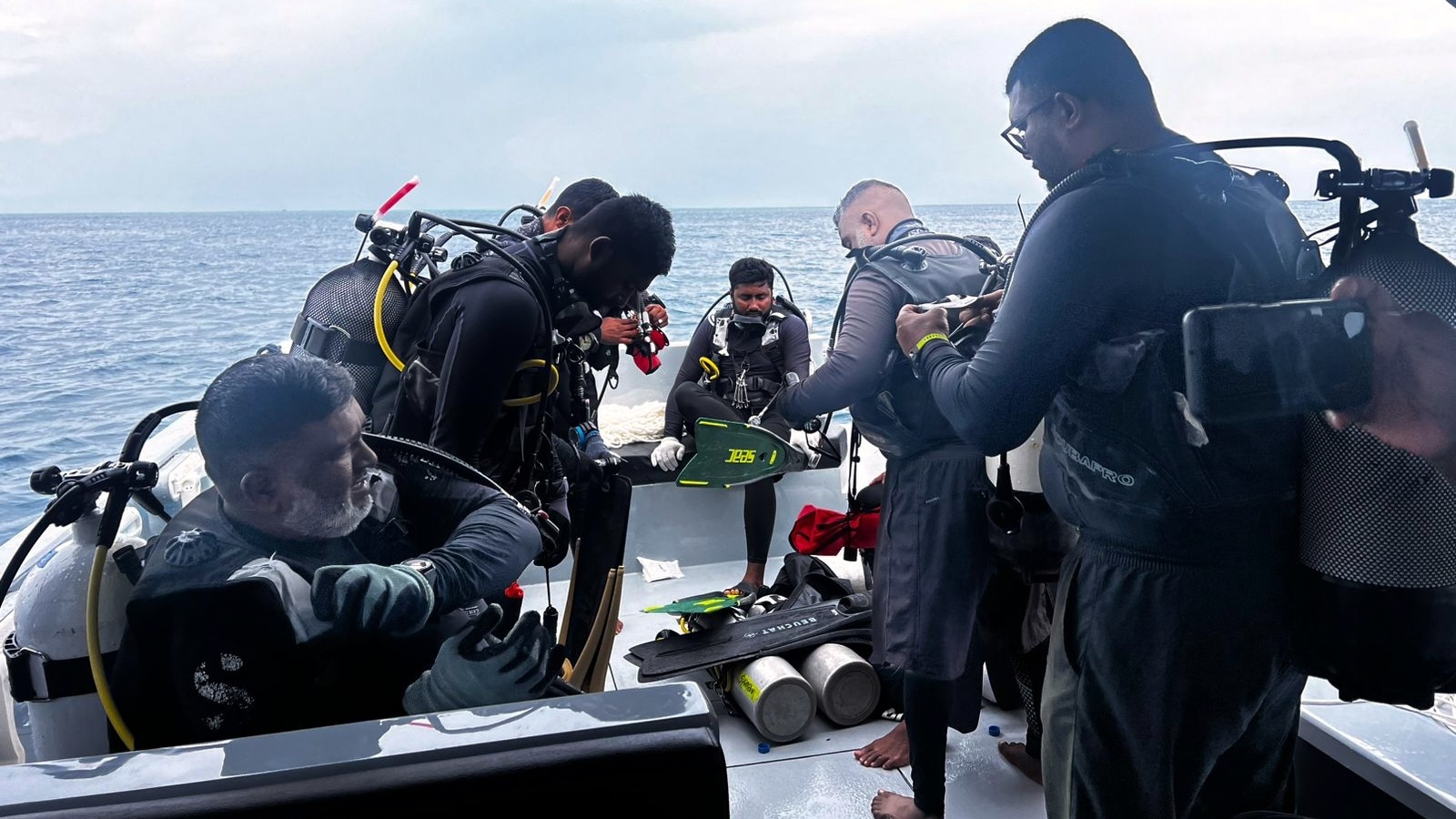
The catastrophic loss of five Italian divers and a military rescue asset within the Thinwana Kandu cave system near Alimathaa Island, Vaavu Atoll, exposes the structural failure modes that occur when recreational protocols cross into technical, deep overhead environments. The fatalities—comprising four academic researchers from the University of Genoa and an experienced liveaboard instructor—cannot be dismissed as an unpredictable environmental anomaly. A systematic reconstruction reveals a distinct cascade of human factors, physiological limits, and environmental variables that compounded to guarantee total system failure.
The event took place at a depth threshold where human physiology shifts from linear degradation to exponential risk. Evaluating this tragedy requires stripping away sensationalized narratives of "murky shark caves" to examine the rigorous physics of deep gas management, neurological impairment, and structural architecture.
The Three Pillars of Deep Overhead Risk
The Thinwana Kandu system is not a terrestrial karst cave formed by freshwater dissolution, but an intricate subaquatic reef matrix characterized by tidal channels, narrow tunnels, and blind horizontal chambers. When the dive team descended to the cave entrance at approximately 50 meters (164 feet), they intersected three separate, compounding risk vectors.
1. The Recreational Depth Boundary Breach
The legal and operational limit for recreational scuba diving within the Maldives is strictly mandated at 30 meters. Operating at 50 meters to 65 meters on standard open-circuit equipment fundamentally alters the safety margin. At these depths, ambient pressure increases to 6 to 7.5 atmospheres absolute (ATA). This pressure produces two immediate consequences:
- Gas Consumption Rate Acceleration: According to Boyle’s Law, gas volume decreases inversely with pressure. A diver's respiratory volume consumption rate at 6 ATA is six times higher than at the surface, drastically compressing the available duration of a standard scuba cylinder.
- Gas Density Impairment: Increased ambient pressure increases the density of the breathing gas, exponentially scaling the work of breathing. This induces carbon dioxide ($CO_2$) retention, a powerful catalyst for panic and narcosis.
2. The Overhead Environment Bottleneck
Unlike open water, where a diver experiencing an emergency can execute a controlled ascendant trajectory to the surface, an overhead environment introduces a physical ceiling. Escape requires linear horizontal navigation before vertical ascent is possible. The Thinwana Kandu system features at least three progressive, distinct internal chambers. The elite Finnish recovery team deployed by DAN Europe confirmed that four of the casualties were located deep within the third, largest, and innermost chamber.
Penetrating three distinct horizontal segments without continuous physical guidelines ensures orientation failure when environmental conditions degrade.
3. Silt-Out Dynamics and Hydrographic Volatility
Alimathaa Island is globally recognized for channel diving, where tidal shifts force massive volumes of nutrient-rich water through narrow reef passes. While this creates optimal pelagic feeding grounds, it also introduces intense current vectors—frequently referred to as "washing machines" by local operators.
When open-circuit divers enter a confined space, their exhaust bubbles dislodge particulate matter, organic growth, and fine coral silt from the ceiling and walls. This creates an immediate "silt-out" condition, reducing visibility from several meters to zero instantly. Combined with external tidal currents blocking or pulling through the cave entrance, the interior environment transitions from clear to an opaque, hydrolically volatile trap.
The Spatial Variance Hypothesis: Decoupling the Instructor and Team
A critical piece of physical evidence emerged during the recovery operation that refutes the hypothesis of a simultaneous, collective medical event. The body of the liveaboard operations manager and instructor, Gianluca Benedetti, was recovered near the cave entrance at a depth of roughly 60 meters (197 feet) on the first day of the incident. Conversely, the remaining four divers—Professor Monica Montefalcone, Giorgia Sommacal, Muriel Oddenino, and Federico Gualtieri—were discovered deep within the third chamber, clustered close together.
This stark spatial variance implies a distinct breakdown in team structural integrity, pointing to one of two plausible causal pathways.
[Cave Entrance: ~60m Depth]
       │
       ▼
┌─────────────────────────────────┐
│ Chamber 1: Instructor Recovered │ ◄── Separation/Exclusion Event
└────────────────┬────────────────┘
                 │
                 ▼
┌─────────────────────────────────┐
│ Chamber 2                       │
└────────────────┬────────────────┘
                 │
                 ▼
┌─────────────────────────────────┐
│ Chamber 3: Four Divers Found    │ ◄── Entrapment & Silt-Out Cluster
└─────────────────────────────────┘
The first pathway is the Separation/Exclusion Event. Under this framework, the instructor may have remained near the primary entrance to monitor current conditions, act as a navigation beacon, or manage the exit corridor. If the inner team penetrated deeper into the third chamber and triggered a catastrophic silt-out, the resulting zero-visibility environment would decouple the group from their guide. The inner group would become disoriented, moving deeper into the blind terminus of the third chamber rather than outward, while the instructor eventually succumbed to gas depletion or environmental stress while attempting to maintain or relocate the exit vector.
The second pathway is the Failed Rescue Extrication Profile. In this scenario, the inner group suffered an acute disorientation or entrapment event within the third chamber. The instructor may have attempted an extraction, but ran out of gas or succumbed to physiological limits before reaching them or during an attempt to exit for help. Because open-circuit scuba configurations do not possess the gas volume redundancy required for multi-person cave rescue at 60 meters, any extended search-and-rescue attempt by a single individual under these profiles guarantees gas starvation.
The Physiological Cost Function of Deep Air Diving
A central focus of the official investigation centers on gas management and gas toxicity. While initial media reports speculated wildly about systemic oxygen toxicity or contaminated cylinders, the fundamental laws of hyperbaric medicine provide a more definitive explanation of the physiological mechanisms at play.
Nitrogen Narcosis as a Cognitive Inhibitor
If the group was utilizing standard atmospheric air ($21%\ O_2, 79%\ N_2$) at a depth of 60 meters, the partial pressure of nitrogen ($PN_2$) reached approximately 4.74 ATA. At this threshold, nitrogen narcosis is not a mild euphoric sensation; it is a severe cognitive and motor skill depressant equivalent to acute alcohol intoxication. Judgment is heavily compromised, short-term memory fails, and the capacity to solve basic mechanical problems—such as a tangled line or a malfunctioning regulator—is virtually neutralized.
The Nitrox Miscalculation Paradox
Alternative theories suggest the team may have inadvertently used Enriched Air Nitrox (EANx), such as EAN32, under the mistaken impression that they were diving on standard air or remaining within shallow parameters. If EAN32 ($32%\ O_2$) is taken to a depth of 65 meters, the partial pressure of oxygen ($PO_2$) skyrockets to:
$$PO_2 = 7.5 \text{ ATA} \times 0.32 = 2.40 \text{ ATA}$$
The universally accepted maximum threshold for safe recreational diving is 1.4 ATA, with 1.6 ATA reserved strictly as a temporary limit for technical decompression phases. A sustained $PO_2$ of 2.40 ATA induces immediate Central Nervous System (CNS) oxygen toxicity. This manifests as violent, uncontrollable grand mal seizures, leading to immediate drowning as the regulator is displaced from the mouth.
However, hyperbaric medical data indicates that susceptibility to CNS toxicity varies widely across individuals. While it is plausible that one or two divers could experience simultaneous seizures, it is a statistical anomaly for all four divers in the third chamber to seize and expire at the exact same moment while remaining clustered together. The cluster formation of the bodies strongly supports a narrative of shared spatial disorientation and gas exhaustion rather than immediate, individual toxicological collapses.
The Cascading Risk of Institutional Search and Recovery
The systemic danger of the Thinwana Kandu cave system was further validated by the death of Staff Sergeant Mohamed Mahdee, an elite diver with the Maldives National Defence Force (MNDF). Mahdee expired from acute decompression illness (DCI) during the initial search phase, forcing authorities to temporarily halt operations until specialized international assets could be deployed.
This secondary fatality highlights the steep risk curve of open-circuit search operations in deep water. When a rescue diver operates under the stress of recovering casualties, respiratory rates increase, accelerating both gas consumption and inert gas tissue loading. If a diver is forced to ascend rapidly due to structural complications, current shear, or gas emergencies, the dissolved nitrogen in their tissues transitions out of solution, forming macroscopic bubbles. In Mahdee's case, this induced a fatal manifestation of decompression sickness, illustrating that the location's physical hazards remained extreme even for trained, sober military personnel.
The operational paradigm shifted only when DAN Europe coordinated the arrival of three Finnish cave-diving specialists: Sami Paakkarinen, Jenni Westerlund, and Patrik Grönqvist. Notably, these individuals were key operators in the infamous 2014 Plura Cave recovery in Norway—a ultra-deep, cold-water extraction that defined modern technical recovery protocols.
The technical choices made by the Finnish team outline the exact tools required to mitigate the Thinwana Kandu environment—and conversely, the exact tools the original Italian group lacked:
- Closed-Circuit Rebreathers (CCR): Unlike open-circuit scuba, which exhausts gas into the water and drains a tank in minutes at 60 meters, a CCR recycles the breathing gas, scrubs carbon dioxide, and dynamically injects oxygen to maintain an optimal, non-toxic partial pressure. This grants hours of life support regardless of depth.
- Diver Propulsion Vehicles (DPVs): The deployment of underwater scooters allowed the recovery team to bypass the exhausting, high-exertion swimming required to fight the intense tidal currents of Vaavu Atoll, preventing carbon dioxide buildup and subsequent panic.
- Trimix Gas Mixtures: By substituting a portion of the nitrogen and oxygen with helium, technical divers eliminate nitrogen narcosis and lower the density of the gas, preserving full cognitive clarity at depths exceeding 60 meters.
Strategic Operational Recommendations for Liveaboard Governance
The suspension of the operating license for the luxury liveaboard vessel MV Duke of York by the Maldives Ministry of Tourism and Civil Aviation signals an impending regulatory overhaul. The investigation must establish how a group of recreational eco-tourists and an onboard operations manager bypassed established marine protocols to execute an unauthorized, ultra-deep cave penetration.
To prevent structural failures of this magnitude from reoccurring, liveaboard fleet operators and maritime authorities must implement three distinct operational protocols.
First, Mandatory Gas Analyzer Logging must be enforced. If specialized or deep diving is occurring off a commercial vessel, all gas cylinders must be analyzed and logged with the signature of both the diver and the vessel’s safety officer. This eliminates the possibility of gas mix confusion before entry.
Second, Acoustic and Electronic Depth-Gate Monitoring should be integrated into liveaboard safety management systems. Modern commercial dive computers track real-time depth profiles. Fleet operators must institute daily digital audits of all guest dive profiles. Any unapproved excursion past the statutory 30-meter boundary must result in the immediate revocation of diving privileges for the remainder of the charter.
Third, Overhead Environment Geofencing must be established for standard marine tourism spots. High-risk coral cave structures like Thinwana Kandu should be legally restricted from recreational access via mooring buoy placement and mandatory local guide certifications. If an operator guides tourists into known overhead channels without specialized technical cave certifications, criminal liability frameworks must apply.
The recovery data gathered by the Finnish specialist team will ultimately confirm the precise timelines of the gas depletion profiles. However, the foundational lesson is already clear: in deep underwater cave systems, there is zero tolerance for protocol deviation. When recreational equipment and training encounter technical depth and overhead restrictions, total system collapse is not a possibility—it is a mathematical certainty.