Most people think ocean crossings are a solved puzzle. You book a commercial flight, complain about the legroom, and watch a movie while flying at 35,000 feet. Or maybe you think of modern adventurers tracking their routes on satellite screens inside high-tech, pressurized cabins.
Then there is Alicia Hempleman-Adams.
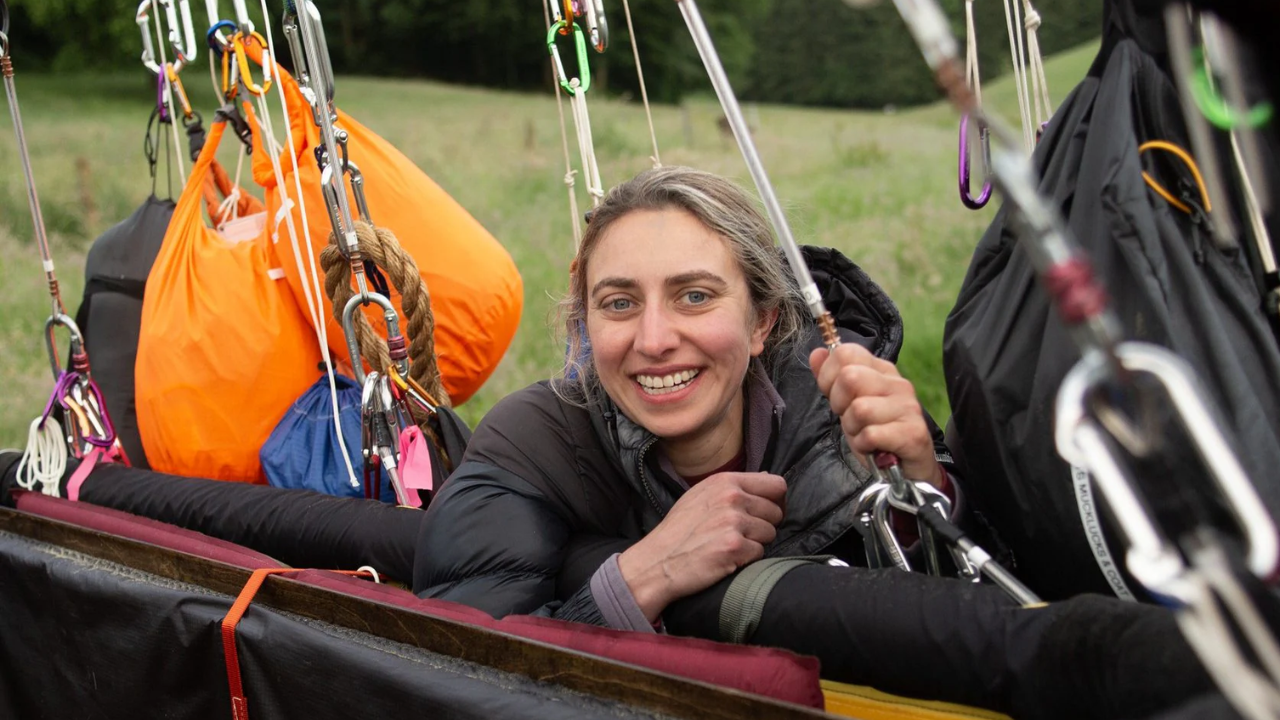
The 36-year-old British explorer just shattered that comfortable illusion. Over a grueling 70-hour journey, she became the first British woman to cross the Atlantic Ocean in a hydrogen gas balloon. She didn't do it in a cozy cockpit. She did it standing in an open wicker basket, exposed to howling winds, freezing rain, and temperatures that plummeted to a bone-chilling minus 30 degrees Celsius.
This wasn't just a weekend stunt. It was a brutal test of human endurance and old-school aviation physics that almost ended in disaster multiple times.
The Absolute Madness of Open Basket Gas Ballooning
If you want to understand why this flight is a massive deal, you have to look at the gear. This wasn't a standard hot-air balloon like the ones you see drifting over valleys on a calm Sunday morning. Hot-air balloons rely on propane burners to heat the air inside the envelope. They consume fuel fast, meaning they can only stay up for a few hours.
Hempleman-Adams and her crew—seasoned American balloonists Bert Padelt and Peter Cuneo—used a specialized craft called the Atlantic Explorer. This vessel uses hydrogen gas as its sole source of lift. Hydrogen is lighter than air, meaning it doesn't need constant heating to stay aloft. It can stay airborne for days.
The catch? You are completely at the mercy of the atmosphere.
To control your altitude, you have to play a high-stakes game of physics. If you want to go up, you throw sand ballast overboard. If you want to go down, you vent a tiny bit of precious gas. Once you run out of sand, you can't go up anymore. Once you vent too much gas, you drop like a stone.
The team took off from Presque Isle, Maine, on a Thursday morning. Their destination? Somewhere in Europe. The exact landing spot was entirely up to the jet stream.
When Ice Meets Hydrogen at 25,000 Feet
The crew spent roughly 36 hours dangling over the empty expanse of the North Atlantic. Once they cleared Newfoundland, there was no safety net. If something went wrong, they were going into the freezing ocean.
Things went wrong quickly.
The flight plan required ascending to altitudes between 14,000 and 25,000 feet to catch the right wind currents. At those heights, the human body struggles. The crew had to rely on supplemental oxygen just to stay conscious. But the real enemy wasn't the lack of air. It was the moisture.
As the Atlantic Explorer drifted through bands of heavy rain, the moisture froze instantly against the balloon envelope. Hundreds of pounds of ice began to coat the craft.
In ballooning, weight is death. The heavy ice started dragging the balloon down toward the water. The crew had to burn through their sand ballast much faster than planned just to stay in the sky. Hempleman-Adams later admitted that the situation grew so grim they had to notify emergency services to keep rescue teams on standby. They didn't know if they would survive the next few hours.
They had to constantly negotiate with the weather, changing altitudes to find pockets of warmer air to melt the ice, all while watching their ballast supply dwindle.
A Legacy Written in the Clouds
If the surname sounds familiar, it's because aviation and extreme exploration run deep in this family. Alicia is the daughter of Sir David Hempleman-Adams, the legendary explorer who was the first person to complete the Explorers Grand Slam (reaching both poles and climbing the highest peaks on all seven continents).
In a poetic twist, Sir David had actually planned to be on this very flight. He ended up stepping aside so his daughter could take his place in the basket. He already knew the terror of this specific route, having completed a solo Atlantic crossing in an open basket back in 2003.
Alicia is no stranger to the cold either. When she was just eight years old, she became the youngest person to reach the North Pole when she traveled there to meet her father. By 15, she walked and skied 200 miles across Baffin Island in brutal wind chills. She already held the world female altitude record for certain balloon classes before this flight.
Yet, this transatlantic crossing was a different beast. It required a level of mental stamina that few people possess. Imagine standing for three days straight in a space no bigger than a office cubicle, shaking from the bitter cold, watching the ocean churn thousands of feet below you, knowing that a single miscalculation with your sand ballast means a fatal crash.
The Historic Landing in Bastendorf
By Saturday evening, the team finally spotted the coast of France. It happened to be June 6, the 82nd anniversary of D-Day, adding a surreal historical layer to their arrival over Europe.
But they weren't out of the woods. As they approached their final destination, a new panic set in. They were running dangerously low on sand ballast. Without enough ballast to control their descent, landing an open-basket balloon safely is incredibly dangerous. You risk slamming into trees, power lines, or the ground at high speeds.
Through sheer piloting skill, the trio managed to guide the Atlantic Explorer to a safe landing in Bastendorf, Luxembourg, at 5:58 AM UTC on Sunday. They had covered 2,852 nautical miles in exactly 70 hours and 11 minutes.
Sir David was waiting on the tarmac to hug his daughter.
With this flight, Hempleman-Adams became only the second woman in history, and the first British woman, to conquer the Atlantic in a gas balloon. If officially verified by the International Aeronautical Association, this journey is expected to go down as the longest transoceanic gas-powered balloon flight ever recorded.
What This Means for the Future of Exploration
It's easy to look at a hydrogen balloon flight and dismiss it as a relic of the 19th century. But this achievement highlights a growing trend in modern exploration, a shift away from relying purely on automated technology and a return to raw human capability.
If you want to test the absolute limits of human endurance, you don't do it inside a pressurized cabin with autopilot turned on. You do it by stripping away the insulation between yourself and nature.
To experience what a flight like this teaches us about resilience, you don't need to jump into a wicker basket. Start by pushing past your own comfort zone. Strip away one modern convenience this week. Turn off the GPS on your next drive. Sleep under the stars without a luxury tent. Face the elements directly and see how your mind handles the friction. That's where real capability is built.



:max_bytes(150000):strip_icc():focal(665x0:667x2)/gettyimages-50733149-2000-8b129a2475974982a915418ce92a73d8.jpg)