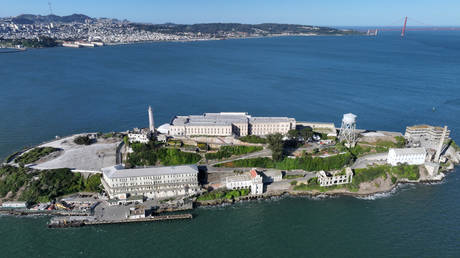
The headlines are screaming about a $152 million price tag to "reopen" Alcatraz, and as usual, the public discourse is stuck in the mud. Critics are busy tallying the cost of concrete and bars, while supporters are masturbating to the idea of a "tough on crime" return to a mid-century fortress. Both sides are missing the point. This isn't about prison capacity. It's about a high-stakes real estate play and a massive injection of capital into a crumbling National Park infrastructure disguised as a law-and-order initiative.
If you think $152 million is actually meant to turn a damp, salt-corroded rock into a modern, constitutional detention facility, you have never stepped foot on a construction site. That money is a drop in the bucket for a facility that has been rotting in the Pacific spray since 1963. I’ve seen developers burn through nine figures just trying to remediate lead paint in a single Manhattan warehouse. On an island where every bag of cement and every gallon of fresh water has to be barged in? That $152 million is a down payment on a ghost.
The Myth of the "Fortress"
The common narrative suggests that Alcatraz is the ultimate high-security solution. That is a fantasy. Modern correctional standards—specifically the requirements for ADA compliance, mental health facilities, and environmental safety—make the existing cellblocks on The Rock functionally useless.
To make Alcatraz "functional" by 2026 standards, you wouldn't be "reopening" a prison; you would be gutting a historical landmark and rebuilding a titanium-and-glass box inside a crumbling shell. The $152 million wouldn't even cover the environmental impact reports required to touch the bird nesting grounds, let alone the seismic retrofitting needed to keep the Main Cellhouse from sliding into the Bay during the next tremor.
- The Logistics Trap: Every logistical move to the island costs 3x to 5x more than on the mainland.
- The Utility Gap: There is no power line. There is no water pipe. There is no sewage system connected to the city.
- The Labor Burn: Union contractors in San Francisco aren't taking a boat ride for cheap.
When politicians talk about "reopening" Alcatraz, they are selling you a vibe, not a spreadsheet. It’s a branding exercise designed to signal a return to "Old School" justice, knowing full well the bureaucracy will swallow the project before a single cell door slams shut.
Why the Fiscal Critics are Wrong
The "lazy consensus" among the fiscal hawks is that this is a waste of taxpayer money because "we have plenty of empty beds in the Central Valley." That is a failure to understand the geography of political optics.
$152 million spent on a prison in Kern County is invisible. $152 million spent on Alcatraz is a global billboard.
From a business perspective, the proposal is actually a genius-level move to force the federal government to subsidize the preservation of a National Park Service asset that is currently falling into the ocean. The NPS has been begging for maintenance funds for decades. By framing the renovation as a "prison reopening," the administration bypasses the usual environmental and park-service gridlock. They aren't building a jail; they are fixing a tourist trap and making the "tough on crime" crowd foot the bill.
The Operational Impossible
Let’s look at the math of modern incarceration. In a standard federal facility, the ratio of staff to inmates is carefully calibrated. On Alcatraz, you have to account for the "Commute Tax." You aren't just paying guards; you are paying for the transport, the housing of staff on a premium-cost mainland, and the massive insurance premiums associated with a site that has no immediate emergency access.
If you have a medical emergency on Alcatraz at 2:00 AM in a fog bank, you aren't just calling an ambulance. You are calling a Coast Guard helicopter. The lifecycle cost of an inmate on that island would be $300,000 to $500,000 per year, easily. For context, the average cost per federal inmate is roughly $40,000.
Imagine a scenario where the government spends $152 million to house 200 inmates. That is $760,000 per bed in capital expenditures alone. You could put those same inmates in the Ritz-Carlton for ten years and still come out ahead. This isn't fiscal policy. It's a vanity project.
The Real Estate Play No One Mentions
San Francisco is currently a city in a "doom loop" narrative. Its commercial real estate is cratering, and its streets are a battleground for public perception. Reclaiming Alcatraz—the most visible piece of land in the Bay—is an attempt to "reclaim" the city's image.
The move is designed to signal that the federal government is taking control of the San Francisco narrative away from local leaders. It’s a hostile takeover of the skyline. If you control The Rock, you control the most potent symbol of authority in the West.
But here is the catch: the salt air wins every time.
Steel rebar expands when it oxidizes, cracking the concrete from the inside out. This is known as "concrete cancer." Most of the structures on Alcatraz are terminal. You don't "fix" them with $152 million. You either replace them entirely or watch them turn to dust. The "reopening" is a PR stunt that will eventually be quietly pivoted into a "renovation of a national monument" once the headlines die down and the first $100 million is spent on "consultation fees."
Dismantling the "People Also Ask"
Is Alcatraz actually being reopened for prisoners?
No. It is being "reopened" for political leverage. The legal hurdles involving the 1972 Golden Gate National Recreation Area Act make a return to high-security incarceration a legislative nightmare. The proposal is a wedge issue, not a blueprint.
Why would it cost $152 million?
Because that is the minimum price to stop the Main Cellhouse from collapsing. The label "prison" is just the wrapper used to ship the money past a divided Congress.
Is Alcatraz still a safe place for a prison?
Technically, it's the least safe place. It is a logistical dead-end. In a post-9/11 world, a prison that can be isolated by a simple boat engine failure is a liability, not an asset.
The Hard Truth
If the goal was actually to house inmates efficiently, the money would go to expanding existing facilities in Victorville or Lompoc. But efficiency is boring. Efficiency doesn't win elections.
We are witnessing the weaponization of nostalgia. People want to believe in a world where the "bad guys" are sent to a rock in the middle of the sea. It feels clean. It feels decisive. It ignores the reality that the "bad guys" in 2026 are largely digital, and no amount of salt-crusted concrete can hold a server or a synthetic drug kingpin.
The $152 million isn't for bars and locks. It's for the lights, the cameras, and the stagehands required to put on this show. The moment the ribbon is cut, the "prison" will likely be a "specialized processing center" or a "high-security holding annex" that sees more camera crews than convicts.
Stop looking at the $152 million as a waste of money and start looking at it as the world's most expensive campaign commercial. The "reopening" of Alcatraz is a ghost story told to a public that misses the simplicity of 1934. It’s a play for the soul of San Francisco, and the taxpayers are buying the front-row tickets.
When the money runs out and the salt continues to eat the walls, don't act surprised. The goal wasn't to keep people in. It was to keep you looking at the island while the real moves were being made on the mainland.
Build the wall? No. Paint the Rock. It’s cheaper, louder, and just as hollow.